
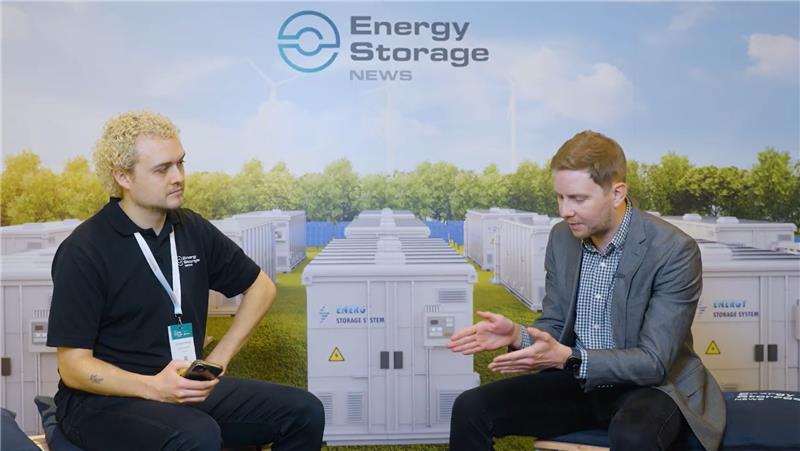
Ex-Fluence alumnus Marek Kubik sat down with Energy-Storage.news at last month’s Energy Storage Summit 2026 in London to talk big picture BESS technology trends, including energy density, LDES and sodium-ion.
Kubik is an independent board advisor and was one of the founding team at system integrator Fluence, which he left in late 2023. He has since taken a role as director of energy storage at Saudi mega-infrastructure project NEOM, although he appears at industry events and in press interviews in an independent capacity.
In this interview, he discussed the Middle East market and the headline topics in battery energy storage system (BESS) technology today. The portion of the chat specifically around long-duration energy storage (LDES) lithium-ion battery cells is below, read on for the full video and write-up.
BESS industry as a whole: successes and challenges
“At a macro level, every year is a successful year without too many exceptions,” Kubik said. “We’re seeing larger and larger projects, longer and longer durations, the weighted average is now around 220MWh, which is way larger than 10 years ago.”
Try Premium for just $1
- Full premium access for the first month at only $1
- Converts to an annual rate after 30 days unless cancelled
- Cancel anytime during the trial period
Premium Benefits
- Expert industry analysis and interviews
- Digital access to PV Tech Power journal
- Exclusive event discounts
Or get the full Premium subscription right away
Or continue reading this article for free
“We’ve seen battery storage overtake pumped hydro on a power basis. On an energy basis, that hasn’t happened yet, but it’s coming, sometime around 2030.”
“But, there are also challenges along the way, right? We’re seeing bumps in the road with lithium pricing again. Those are going to be interesting to monitor and see how companies react to them and what you might see happen as a result. But the general direction of travel is positive, the cells are getting cheaper, system performance is improving at both the cell level and the system level.”
Those system cost declines and performance improvements are helping drive the business case for day-to-night solar load shifting, which typically needs 4-8 hours. It is a use case which has long been elusive for BESS and was previously provided by pumped hydro.
Saudi and UAE markets
As we recently reported, Saudi Arabia and the UAE have emerged virtually out of nowhere to become some of the biggest BESS markets in the world. The initial wave of projects have been funded and will be operated directly by state-owned utilities and energy firms, while the next wave needs private sector investment.
“The rest are planned to be through these IPP models. In Saudi Arabia, it’s the Saudi Power Procurement Company and in the UAE you have EWEC and DEWA in Abu Dhabi and Dubai, respectively,” Kubik explained.
“They’re starting to do these PPAs where essentially there’s a long term contract and offer to offtake flexibility that storage that gives investors guaranteed revenue, via availability based payments. And then the developers bid for those projects at ideally the lowest prices, and we have seen very low prices, take the risk to build it, own it, operate it, but have the guaranteed offtake and usually from very bankable sources.”
“That’s the dominant model with some nuances, but that’s kind of how it’s happening.”
Lithium-ion LDES battery cells
One big shift that has happened in the industry in the past few years is lithium-ion being deployed at durations of 8-hours, or even more, and it increasingly appears to be the technology of choice for that day-to-night use case.
Kubik explained that one enabler of this, and something he expects to see more of in future, is a specialisation in lithium-ion battery cells specifically for LDES applications. Right now, 8-hour BESS are typically just using 4-hour batteries and de-rating them to use half of their power, making them 8-hours.
“But now we’re starting to see specialisation in the cell. Hithium came out with a 0.125C cell, so you can’t use it at a higher power rate,” Kubik said.
“The claim is that it lets you optimise for these very long durations because the bigger the cell, the lower the C rate, the less it has thermal issues with how it heats up when you charge and discharge it, which in theory lets you optimise for the longer duration. So you can see higher density, lower cost, better performance.”
“So I would predict we see more of that. That’s the beginning of this sort of new optimisation because the LDES market is starting to become large enough that you want to optimise for 8/10/12 hours.”
The same benefits will be seen at the system-level because you’ll have less need for chillers and cooling units as the batteries won’t be heating up as much.
However, LFP’s absolute lowest cost possible of around US$25 per kWh based on the cost of its raw materials means it will be difficult to compete significantly beyond 12 hours, he said. At that duration, which gets away from day-night and into inter-day territory, other technologies with a less linear cost-size line will be cheaper on a levellised cost of storage (LCOS) basis.
This should, in theory, only change if we find a much cheaper way of extracting lithium, Kubik added.
However, energy systems in general do not yet face the inter-day imbalance challenge, so the focus is on intra-day/day-to-night, where lithium-ion can play a big role.
Maybe worth noting is that Kubik’s job title at NEOM changed in January 2025 from head of BESS to ‘director of energy storage’. His LinkedIn states that this new role has an “additional responsibility for emerging and novel storage technologies that could hedge BESS LFP supply chain or be directly competitive on use-cases in the 2030-2040 time horizon.”
BESS price trends
As others have recently commented, the impact of the Chinese government’s removal of the VAT export rebate for solar and batteries on prices remains to be seen.
“It depends a little bit on if the Chinese OEMs pass it through fully or if they absorb some of it. The profit margins are much higher than the domestic market and that’s what’s driving them there. If the profit margins are higher internationally, that means there’s more room to absorb the cost.”
“So we have to see how much China’s ‘anti-involution’ measures, trying to curb what they call irrational competition between the different Chinese companies, plays through into the international market. Because you might see a sort of insistence from the Chinese state, which backs a lot of these companies, ultimately one way or another to pass it through.”
‘Anti-involution’ is a series of measures by the Chinese government to curb cutthroat, race-to-the-bottom competition among manufacturers in certain industries, including clean energy, which has led to numerous bankruptcies in solar, though not yet batteries at the same scale.
Sodium-ion BESS
Adoption of sodium-ion technology for BESS has appeared to pick-up recently. BESS solutions using sodium-ion battery cells have been launched by Hithium, BYD and US startup Peak Energy, the latter of which now has a firm 720MWh order from developer Jupiter Power. Large-scale projects have already been deployed in China. But there have been casualties too, with big-name Natron Energy folding last year.
“The really interesting thing about sodium-ion in grid-scale storage is it can operate at very high and low temperatures without needing heating or cooling,” Kubik said.
“So if you can, at a system level, remove the need for a cooling system, first of all, that’s a whole bunch of costs from your container saved. It’s a safer chemistry. I don’t say ‘safe’ because it’s all relative, but it’s harder to initiate thermal runaway with sodium-ion. So you can potentially save money in your own safety systems.”
“It’s a little tricky because it really depends on price. If the cell cost comes down to a point where unit economics look good upfront, all these other benefits will make it quite a clear choice. But for now, it’s a question of how quickly can sodium ion prices come down and that’s happening quicker than the academics think.”
“But at the same time, it’s hard to know exactly what the source of truth is because, naturally, companies that sell sodium ion products have a vested interest in saying it’s coming down.”