Long-duration energy storage (LDES) may be in something of a ‘dot-com’ moment, but grid operators cannot afford the ‘hiccup’ of any bubble bursting, a senior ISO manager said at the Energy Storage Summit USA.
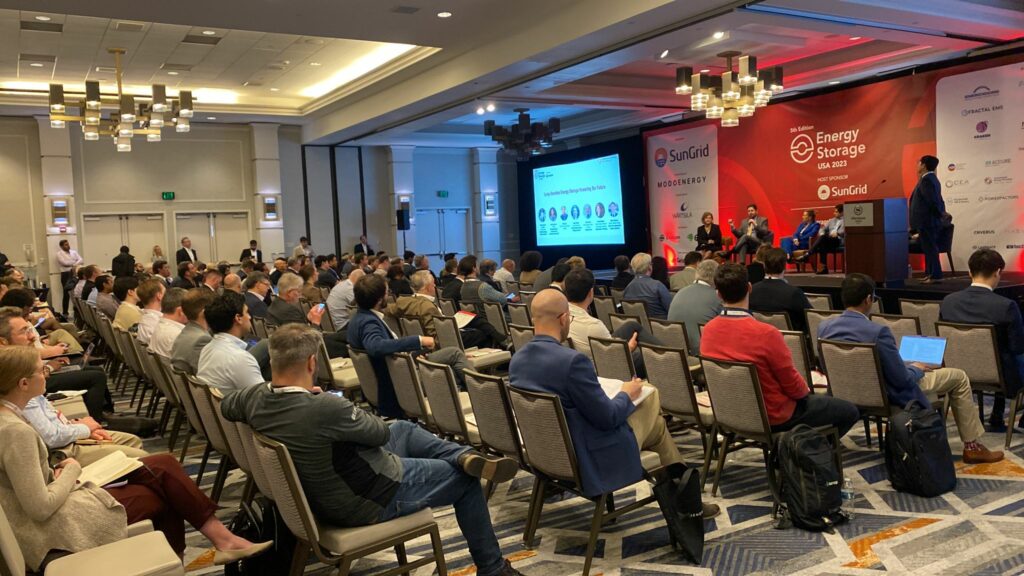
That was the message from Mike DeSocio, director for market design at the New York Independent System Operator (NY-ISO), a speaker on the ‘Long-Duration Energy Storage Powering the Future’ panel discussion at the Energy Storage Summit USA last week, hosted in Austin, Texas by our publisher Solar Media.
Balki Iyer, CCO and US country manager for LDES startup e-Zinc, introduced the analogy in his opening remarks.
“All the predictions to-date about energy storage rollouts have been wrong by a factor; wrong by a factor in the right direction,” he said.
Try Premium for just $1
- Full premium access for the first month at only $1
- Converts to an annual rate after 30 days unless cancelled
- Cancel anytime during the trial period
Premium Benefits
- Expert industry analysis and interviews
- Digital access to PV Tech Power journal
- Exclusive event discounts
Or get the full Premium subscription right away
Or continue reading this article for free
“If we think about the late 90s, ‘internet dot-com’ era – I feel we are in a ‘dot-com’ moment in LDES. I say that because in 1999-2000, no one would have predicted all the eventual use cases of the internet. They knew there was a technology but the use cases came on faster than they could even adopt it. I almost feel it’s the same thing happening in LDES.”
Joe Ferrari, VP sales Americas for Italy-based CO2 battery company Energy Dome agreed: “It’s not that long ago that the utilities rolled their eyes at the thought of lithium-ion. They weren’t familiar with it, and we’re in that phase with LDES.”
DeSocio was then asked for his perspective on the main benefits of LDES to a grid operator like NY-ISO.
“The main benefit is optionality. We need to balance supply and demand on a second-by-second basis. We’re not at the point where renewables can be baseload, and we’re starting to face not a megawatt-capacity issue but a megawatt-hours issue,” he said, before addressing the ‘dot com’ analogy.
“With the dot com thing, remember that in 2000-2001 there was a bit of a bubble burst. We need to be careful about just adding storage for storage’s sake, and it needs to be done in a way that is balanced and keeps up with new supply resources.”
“We need to build renewables and then add the storage. If we build the storage and then add renewables we’re gonna have a problem.”
In response, LDES Council executive director Julia Souder said that the world’s climate goals needed a substantial push to adapt LDES technologies at scale.
“LDES is an affordable, flexible and reliable resource. Our challenge is raising awareness that our products have been commercialised for 10, 20, or even 100 years if we count pumped hydro. The technology is there, we just need to adopt it quickly because we’re dealing with the challenges of decarbonisation today.”
“With the ‘dot-com’ analogy, yes there was that little hiccup which we all learned from, but we accelerated past it and we need to accelerate on this together.”
To which DeSocio said: “We just can’t afford that hiccup on the grid.”