A company that makes 3D-printed concrete anchors and foundations for marine energy projects has been awarded US government funding for its subsea pumped hydro energy storage (PHES) technology.
Sperra, a startup headquartered in San Pedro, California, announced yesterday (31 October) that it has been awarded a US$4 million grant by the Department of Energy (DOE) Water Power Technology Office (WPTO), part of the Office of Energy Efficiency and Renewable Energy.
The company makes products for offshore wind and solar applications, fixed-bottom foundations, and solar solutions for canals as well as developing the pumped storage solution.
The funding will go towards the design, fabrication and testing of a 500kW/600kWh demonstration project off the Southern California coast.
Try Premium for just $1
- Full premium access for the first month at only $1
- Converts to an annual rate after 30 days unless cancelled
- Cancel anytime during the trial period
Premium Benefits
- Expert industry analysis and interviews
- Digital access to PV Tech Power journal
- Exclusive event discounts
Or get the full Premium subscription right away
Or continue reading this article for free
The solution is based on a technology called Stored Energy in the Sea (StEnSea) that was developed in the laboratories of German research institute Fraunhofer IEE.
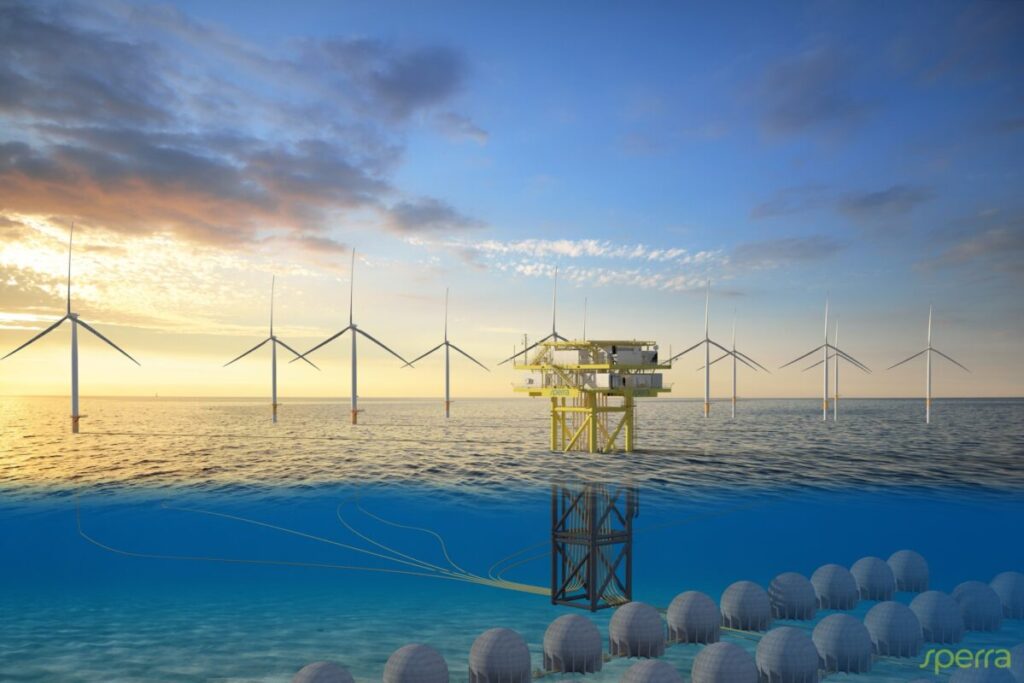
It could enable deep sea, offshore pumped hydro storage systems to be built at scale, storing energy by leveraging the pressure of water at depths of between 600 metres and 800 metres. The water is stored in concrete spheres at the bottom of the ocean.

Sperra claimed this means it has all the advantages of conventional PHES plants, such as the ability to store large capacity of energy for long-duration applications and low cost of operation once built.
However, unlike pumped hydro on land, which requires there being two large bodies of water at different heights—or building them—there are no land constraints or siting concerns with subsea PHES, the company said.
In addition to its design and siting advantages, Sperra also claimed that the use of its 3D-printed concrete technology means the projects could be delivered relatively cheaply, quickly and be replicable at scale.
The DOE’s WPTO has supported projects to advance various pumped hydro innovations with funding or technical assistance. It notes on its site that Sperra (previously known as RCAM Technologies) will work with three US National Laboratories to explore the feasibility of its marine PHES tech.
Meanwhile, Fraunhofer IEE, and submersible pump manufacturer Pleuger received a €3.4 million (US$3.7 million) award from the German Ministry for Economic Affairs and Climate Action (BMWK) for development of pump and turbine technologies. Sperra noted that the three parties are working collaboratively to advance the subsea PHES technology.
Sperra says its subsea solution could be an answer to pairing offshore wind power plants with effective energy storage capabilities, of which there will be growing demand in the US as its nascent offshore wind sector picks up speed.
Germany ministry BMWK launched the country’s National Energy Storage Strategy late last year. It directed the government towards identifying obstacles to the development of pumped hydro projects, such as land limitations and sites in proximity to transmission, generation and demand.
“The Ministry is engaging in intensive dialogue with the industry to remove obstacles standing in the way of the construction and operation of pumped storage plants. It is working to ensure that pumped storage can contribute optimally to the electricity system both today and in the future,” the strategy reads.
There are currently around 30 PHES plants in Germany with a combined 6GW output to the grid and 24GWh of storage capacity, with 4-hour average maximum discharge duration at full power. The US has around 43 PHES plants, totalling 22GW and 553GWh, meaning its fleet equates to an average 25-hour duration.