Pine Gate Renewables has signed a second long-term supply memorandum of understanding (MOU) targeting an alternative to lithium-ion this week, with nickel-hydrogen battery group EnerVenue.
Just two days after signing an MOU with Urban Electric Power to deploy up to 4.5GWh of its zinc-based batteries over a similar timeframe, Pine Gate has today (May 19) announced the deal with California-based EnerVenue.
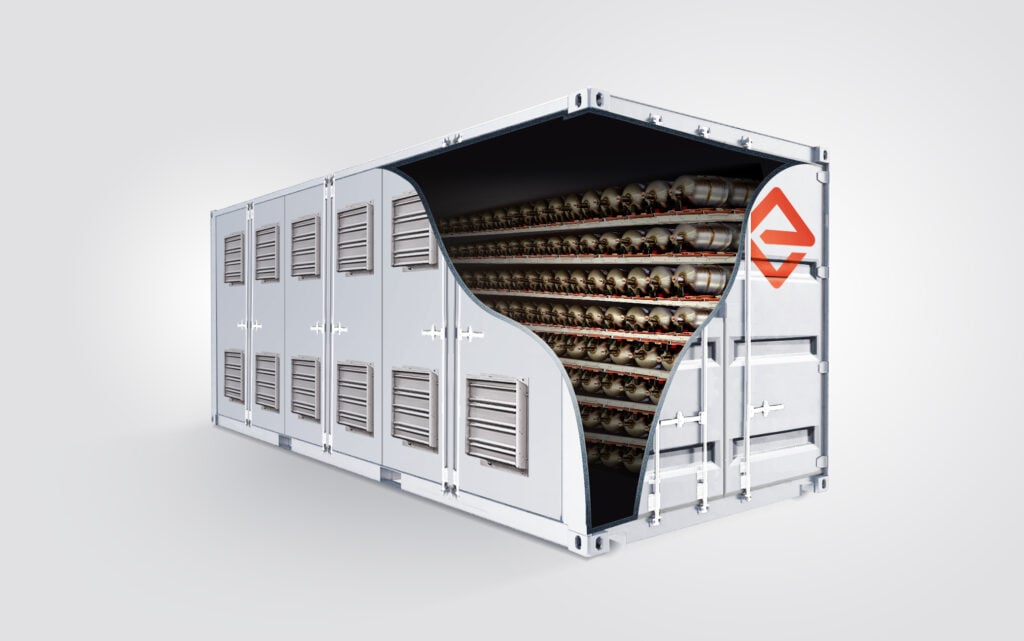
Pine Gate said it will deploy up to 2.4GWh of EnerVenue’s nickel-hydrogen-based battery energy storage systems(BESS) at utility-scale sites across the US.
EnerVenue only launched in 2020 and has said it wants to ‘disrupt’ energy storage with a 2-12 hour duration system with “virtually unlimited number of cycles”, its CEO told Energy-Storage.news when it launched.
Try Premium for just $1
- Full premium access for the first month at only $1
- Converts to an annual rate after 30 days unless cancelled
- Cancel anytime during the trial period
Premium Benefits
- Expert industry analysis and interviews
- Digital access to PV Tech Power journal
- Exclusive event discounts
Or get the full Premium subscription right away
Or continue reading this article for free
“EnerVenue batteries offer a differentiated value proposition – lower degradation across a wide
temperature band, and lower cost for maintenance and augmentation, whilst posing no fire or thermal
runaway risk. These batteries also have a stackable form factor and can last for more than 30-years
while being able to cycle multiple times a day,” said Raafe Khan, Director of Energy Storage at Pine
Gate Renewables.
Pine Gate has 1GW in operational assets and a 16GW pipeline across the US. Energy-Storage.news has asked the company whether it anticipates it will fully exercise both the MOUs – which total just shy of 7GWh – and for which use cases it plans to adopt each respective technology.
Both technologies have several use unique use cases. Zinc batteries are carving out a sweet spot in data centres, for example, as written in a recent guest blog on this site, while EnerVenue’s battery is ideal for remote microgrids in harsh climates because it can withstand more extreme temperatures than lithium-ion.
“Pine Gate Renewables excels at launching and operating renewable energy and energy storage
projects, and is an ideal partner for deploying EnerVenue’s innovative battery systems,” said Randy
Selesky, Chief Revenue Officer, EnerVenue.
EnerVenue raised US$100 million in a Series A funding round in September last year from investors including Schlumberger New Energy, Saudi Aramco Energy Ventures and Stanford University.