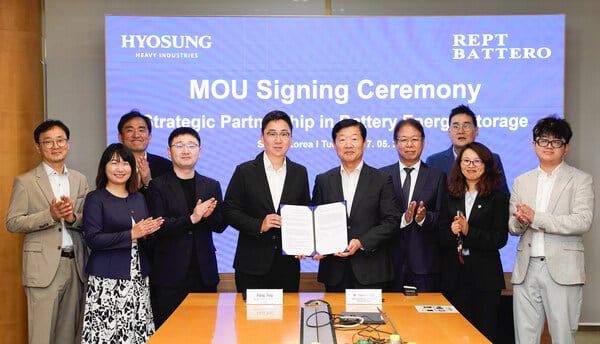
Rept Battero and Hyosung Heavy Industries have agreed to jointly promote energy storage system (ESS) technologies in global markets.
Chinese battery manufacturer Rept Battero announced the signing of a Memorandum of Understanding (MoU) last week (30 May) with the ESS division of South Korea’s Hyosung Heavy Industries.
An MoU typically is not binding and indicates that contracts will be signed pending further discussion.
Rept said that under a global framework deal the two companies have in mind, it would supply 2.5GWh of battery cells, modules and containerised DC blocks for battery energy storage system (BESS) applications.
Try Premium for just $1
- Full premium access for the first month at only $1
- Converts to an annual rate after 30 days unless cancelled
- Cancel anytime during the trial period
Premium Benefits
- Expert industry analysis and interviews
- Digital access to PV Tech Power journal
- Exclusive event discounts
Or get the full Premium subscription right away
Or continue reading this article for free
Hyosung Heavy Industries, meanwhile, would market the BESS solutions globally, establish regional offices and localisation, and obtain the necessary regulatory certifications to do business in different geographies.
Both companies have already established presences in their home countries’ BESS markets and key international markets.
“This signing marks a significant breakthrough in market synergy between Chinese and South Korean energy storage enterprises,” Rept Battero CEO and president Feng Ting said.
Last September, Rept Battero opened a North American subsidiary in Irvine, California, US, a few weeks before the manufacturer showcased BESS products at the RE+ national solar and energy storage trade event.
Its product line at the show included a large-format 564Ah lithium iron phosphate (LFP) cell and a 6MWh+ BESS unit in a standard 20-foot containerised footprint. Customers in the US include Mitsubishi Power Americas spinoff Prevalon Energy, Powin and Energy Vault.
Rept has three production bases and an R&D centre in China, a European subsidiary in Germany, and an office in Indonesia. It has achieved Bloomberg Tier-1 status as a battery supplier and provides nickel manganese cobalt (NMC) and LFP tech to the electric vehicle (EV) sector and stationary energy storage customers.
Hyosung Heavy Industries is one of South Korea’s major industrial corporations, active in areas including power, industrial machinery and new energy solutions, with products ranging from transformers, switchgear, static compensators, to ESS and solar PV, process automation solutions, motors and generators.
Within energy storage, Hyosung Heavy Industries has delivered dozens of projects in South Korea, with overseas projects in markets including the UK and South Africa. It markets its services as a full turnkey solutions provider, delivering BESS projects including power conversion system (PCS), energy management system (EMS) and batteries.