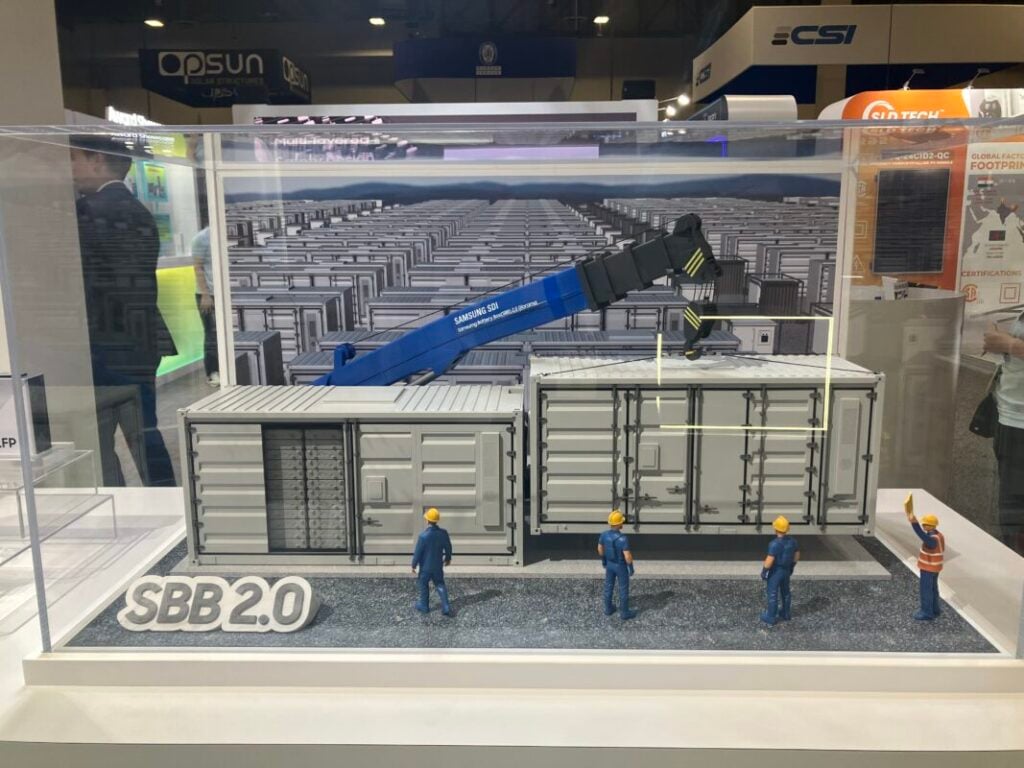
South Korea’s Samsung SDI has signed its first US lithium iron phosphate (LFP) cell deal, while Chinese integrator Trina Storage has expanded an existing supply partnership.
Both Asia-headquartered companies announced their latest customer deals in the US yesterday (10 December).
Samsung SDI said its Michigan-based subsidiary, Samsung SDI America, recently signed a contract to supply US-made LFP cells for battery energy storage system (BESS) applications with an undisclosed customer.
The contract’s three-year term begins in 2027. Its value exceeds KRW2 trillion (US$1.36 billion) and encompasses prismatic cells that Samsung SDI claims have been developed through several years of R&D.
Try Premium for just $1
- Full premium access for the first month at only $1
- Converts to an annual rate after 30 days unless cancelled
- Cancel anytime during the trial period
Premium Benefits
- Expert industry analysis and interviews
- Digital access to PV Tech Power journal
- Exclusive event discounts
Or get the full Premium subscription right away
Or continue reading this article for free
In early November, the Korean company revealed it would begin mass production before the end of 2025 and planned to establish 30GWh of annual production capacity for energy storage batteries in the US by the end of next year.
Around the same time, media outlets The Korea Herald and Reuters both reported that Samsung SDI was in talks over a multi-year, multi-gigawatt-hour BESS battery supply deal with Tesla.
Those reports are still unconfirmed and likely to fuel speculation that Tesla is the undisclosed customer behind the KRW2 trillion deal announced yesterday.
However, in truth, the rising demand for stationary grid storage in the US is such that there are numerous other possible candidates. The manufacturer’s announcement was ambiguously worded, making it unclear whether the deal might also cover complete BESS solutions.
That type of deal would not fit the profile of Tesla, which makes its own Megapack utility-scale BESS products using third-party cells and as of next year, some LFP cells made in-house in the US.
Samsung SDI said then that it would put its energy storage system (ESS) business at the heart of a turnaround strategy to mitigate slower-than-expected growth in its electric vehicle (EV) business (ESN Premium article).
US cell manufacturing head start for Korean providers
The company, like fellow South Korean manufacturers LG Energy Solution and SK On, is retooling some of its EV battery production lines in the US to produce ESS cells, allowing them a significant head start in a market increasingly focused on domestic content supply chains.
A consultant, speaking anonymously with ESN Premium due to the political nature of the subject, stated a couple of weeks ago that South Korean manufacturers’ announcements “could be enough to meet domestic demand for BESS.”
This comes amid the introduction by the US government of foreign entity of concern (FEOC) restrictions that would prevent projects or manufacturing facilities from availing of tax credit incentives if using Chinese-made products or material assistance over a certain threshold.
That threshold all but prevents any project using Chinese cells from qualifying for the investment tax credit (ITC), given that cells comprise the largest single portion of capex cost.
Samsung SDI claims an advantage over its rivals in that it is the only non-Chinese manufacturer capable of supplying US customers with prismatic cells. This makes its batteries a simpler drop-in replacement for system integrators accustomed to China-made prismatic LFP cells, the company has said.
It also touted several key safety features of its designs, including an aluminium casing and a proprietary so-called No Thermal Propagation (No TP) technology, which separates cells with thermal insulation layers.
In addition to cells, Samsung SDI plans to manufacture complete, integrated BESS solutions within the US. It showcased two new products from that range at the RE+ clean energy trade show in September in Las Vegas, the LFP-based SAMSUNG Battery Box (SBB) 2.0, as well as SBB 1.7, which uses nickel cobalt aluminium oxide (NCA) cells.
Trina expands agreement with first US customer
Trina Storage has expanded a strategic partnership with US BESS developer Lightshift Energy, agreeing to supply equipment to a portfolio of projects totalling more than 1GWh.
Trina Storage will supply its Elementa 2.0 and Elementa 2.5 BESS solutions to the developer, owner and operator, which was formerly known as Delorean Power.
The BESS arm of vertically integrated Chinese solar PV manufacturer Trinasolar will be among the companies figuring out how viable their pathways to the US market will continue to be post-FEOC (ESN Premium article).
Chinese companies still have a significant runway of safe harbour projects where sufficient progress has been made to qualify for tax credits ahead of the shutters coming down.
Some sources have also suggested that batteries made in China may even be cheap enough that large customers with healthy balance sheets and fast turnaround project timelines may opt to buy them despite the lack of tax credit support.
Chinese companies may also explore other options that could help them meet FEOC rules by manufacturing in the US under compliant ownership structures, or in non-FEOC countries.
Trina Storage is known primarily as a system integrator, and although it uses in-house LFP cells for projects in China, it has used third-party suppliers for projects elsewhere, including the US.
It completed its first US projects in 2024, delivering four sites in Massachusetts totalling 16MW/64MWh in the summer for Lightshift Energy. The developer built those projects in response to a solicitation held by Massachusetts Municipal Wholesale Electric Company (MMWEC), an organisation representing multiple municipal utilities in the New England state.
The solar and energy storage owner-operator specialises in distribution-connected energy storage. In May, Lightshift said it would build the biggest BESS to date in Vermont, a 16MW/52MWh system scheduled to come online in early 2026, then in October, the company closed US$75 million financing with KeyBanc Capital Markets, following capital raises of US$40 million in July and US$100 million in April 2024.
The 8th annual Energy Storage Summit USA, hosted by our publisher, Solar Media, takes place 24-25 March 2026 in Dallas, Texas, to connect the entire value chain, from storage developers and utilities to investors, grid operators, and innovators. Visit the event website for information, including the agenda and how to get tickets.
On April 22-23 in Charlotte, North Carolina, our sister event, The Battery Show South, brings together the new regional value chain in the Battery Belt to discover the latest technologies across commercial and industrial transportation, advanced battery, H/EV, stationary energy storage and more.