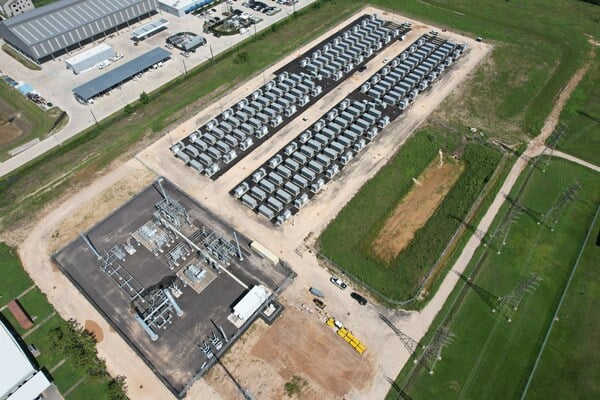
US battery energy storage system (BESS) project developer-operator Jupiter Power has secured a US$225 million corporate credit facility.
The Texas-headquartered company announced yesterday (31 October) that it has closed financing comprising up to US$175 million in letters of credit and a further US$50 million revolving loans.
Lead arrangers for the lending were major retail banks Barclays, HSBC Bank USA and Sumitomo Mitsui Banking Corporation (SMBC).
Jupiter Power said the money will be used to expand its portfolio, adding to a claimed 2,575MWh of battery storage already in operation or construction in the US. The company said it has a 12GW development pipeline.
Try Premium for just $1
- Full premium access for the first month at only $1
- Converts to an annual rate after 30 days unless cancelled
- Cancel anytime during the trial period
Premium Benefits
- Expert industry analysis and interviews
- Digital access to PV Tech Power journal
- Exclusive event discounts
Or get the full Premium subscription right away
Or continue reading this article for free
Renewable energy and sustainability executives from HSBC and Barclays commented that the transaction underscores both banks’ commitments to financing low-carbon energy transition projects.
“Energy storage facilities are critical to meet the need for demand flexibility, which is why Barclays is excited to work with Jupiter Power,” Barclays global head of sustainable project finance James Edmonds said.
“HSBC’s inaugural facility with Jupiter Power not only reinforces our commitment to financing premier clean energy projects, but complements our ambition to deliver a net zero global economy,” Paul Snow, HSBC head of renewables in the Americas, said.
Jupiter Power was founded in 2017. During the construction of the company’s first six BESS projects in 2021, it said that its business model was not based on developing projects with long-term offtake contracts in place but instead on finding strategic locations on the grid where storage can be of most benefit and earn the highest market revenues.
Like many other developers, this meant an initial focus on the Texas ERCOT market, where it brought online its first 110MW/200MWh BESS in early 2022. Later that year it raised US$175 million debt financing for its first 650MWh portfolio in ERCOT, and hired Energy Vault as system integrator as it embarked on more Texas projects and expanded into California.
The developer continued to raise financing during 2023, with US$70 million arranged by First Citizens Bank in July for 320MWh of ERCOT projects, and another US$65 million deal with the same bank in December for the Houston metropolitan area’s first large-scale battery project, which went online recently.
It also has projects in developments in other states, including Maine and Massachusetts, where it has recently been seeking approval for a 700MW BESS at a former Exxon oil depot (Premium access).
This year saw a flurry of big financing deals announced by US BESS developers over the Spring and Summer. These included Canadian Solar subsidiary Recurrent Energy securing US$513 million for a 1,200MWh project in Arizona in June and Intersect Power closing two financing deals worth a total US$837 million for three projects in Texas a month later.
However, the months since August appear to have been relatively quiet for standalone BESS developers. Some sources have commented that capital markets have tightened their grip on spending in the runup to the presidential election.