Bigger, longer-duration projects and more sophisticated deal structuring are driving the energy storage industry forward, but a lack of common approaches from transmission system operators (TSOs) remains a challenge.
That’s according to Danske Commodities’ Rimshah Javed, principle originator for the European Origination desk of the company, one of Europe’s largest power and gas trading companies.
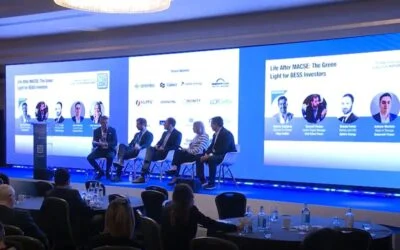
She will be speaking on the ‘How Are Energy Traders Reshaping the Revenue Stack in Europe?’ panel discussion on Day Two of the upcoming Energy Storage Summit 2026, which runs on 24-25 February in London.
Danske Commodities provides balancing and energy trading services for the energy sector. Last year it scored a notable balancing deal for a UK solar plant from Low Carbon, covered by our sister site Solar Power Portal. It has also won optimisation contracts for BESS projects from parent company Equinor, in the UK and in the US.
Try Premium for just $1
- Full premium access for the first month at only $1
- Converts to an annual rate after 30 days unless cancelled
- Cancel anytime during the trial period
Premium Benefits
- Expert industry analysis and interviews
- Digital access to PV Tech Power journal
- Exclusive event discounts
Or get the full Premium subscription right away
Or continue reading this article for free
Discussing broad industry successes and challenges, Javed tells Energy-Storage.news of the deployment of more capacity at higher durations and new and innovative deal structures including structured products.
“I would add Poland will see a number of BESS projects being deployed due to the capacity market and it’s the biggest market in CEE region currently,” she adds.
However, she sees a challenge around differing transmission system operator (TSO) understandings of storage, which in turn affects how assets are treated and means a broader lack of common frameworks.
See the rest of our discussion as a Q&A below.
Energy-Storage.news: How is the financing of BESS projects evolving?
Rimshah Javed: Newer products are being introduced with structured origination on the rise. Merchant and floor deals are fairly understood at this point, and increasingly we see tolling, swaps and virtual products with newer entrants such as corporates. In general, the sector is good at collaborating on customised and unique offtake structures.
Closely related to that is how projects are monetised: how is the balance between merchant and tolling/fixed revenue schemes changing?
Players that need access to debt require revenue certainty that can come from various products, however, there are some merchant projects in the market through equity financing. The share of players requiring revenue guarantees is certainly larger.
What are the key evolutions in how BESS projects are being optimised and dispatched?
In continental Europe, we see the same trend that GB has followed. Saturation of ancillary services requires use of multi-market optimisation across all revenue streams.
BESS is also displacing more expensive technologies. In Sweden, [TSO] Svenska kraftnät publishes data that shows BESS is often becoming the price setting technology and displacing other forms of flex, [such as hydro].
What are the key policy questions and grey areas which industry and government still need to find solutions for, to unlock storage’s full potential for the grid?
Regulatory certainty is important without introducing arbitrary rules that penalises the flexibility inherent in BESS. For example, ramp rate restrictions in Germany for BESS limits how quickly the assets can change power and affects the business case. On the other hand, if the TSO has the right tools to manage such assets, they could benefit by utilising them efficiently.
Do you expect LDES to be deployed at scale, and will it be new, novel technologies used or lithium-ion?
GB has the cap and floor scheme which will enable LDES (defined as 8 hours). For novel technologies, the challenge is the economic viability in comparison to li-ion which has falling costs that has led to mass deployment. Due to this, LDES shortlist was dominated by li-ion projects. So the answer will be determined by economic viability and system needs.
Energy-Storage.news has been hearing from numerous event speakers ahead of the Energy Storage Summit 2026. Use the ESN20 code for a 20% discount, while ESN Premium users can get 30% off.
See other Q&A pieces with event speakers published in this series below: