
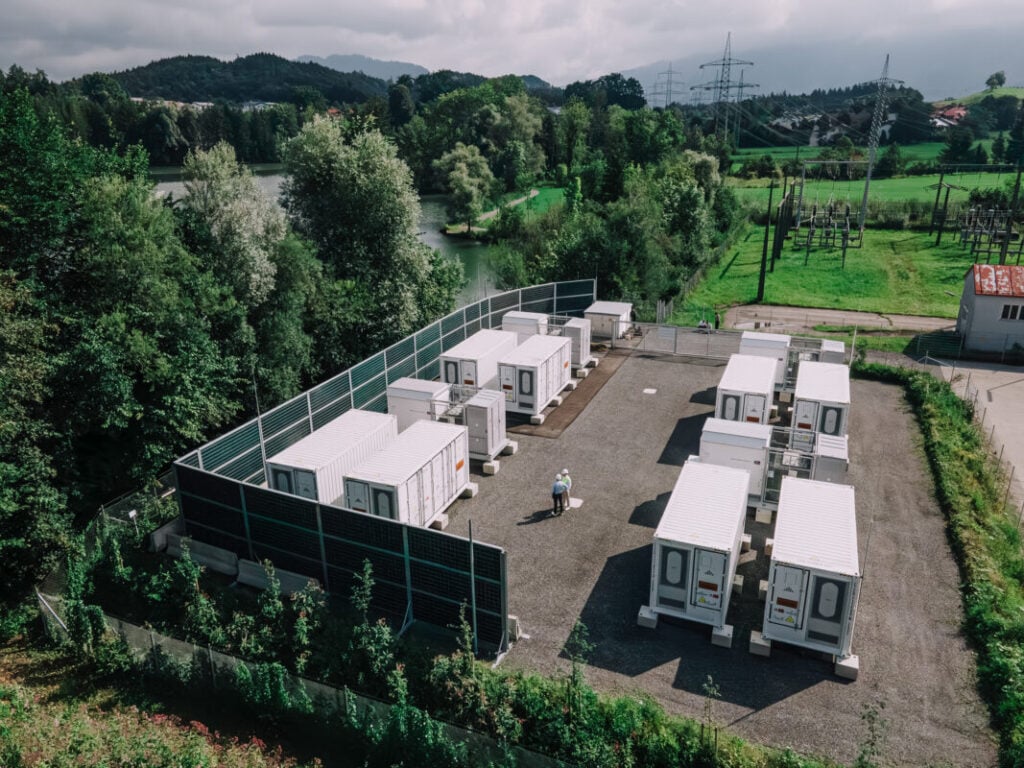
2025 saw genuinely large-scale BESS projects start construction in Germany, strengthening confidence among stakeholders. But significant challenges remain around grid connection, connection agreements and access to revenue streams, an operator said.
Leandra Boes, director of asset management for Green Flexibility, spoke to Energy-Storage.news ahead of the Energy Storage Summit 2026 in London next month, where she will be speaking alongside hundreds of other industry experts.
Green Flexibility was founded in 2023 with a management team largely made up of alumni from Sonnen, the German battery and virtual power plant (VPP) pioneer now owned by Shell. The firm raised €400 million (US$465 million) for its German BESS pipeline a year ago, after which its CEO and strategy director gave an interview with us (ESN Premium access).
Boes will be speaking on ‘The Money Maker: Assessing Germany’s Unique Merchant Opportunities’ panel discussion on Day Two of the event, which runs on 24-25 February.
Try Premium for just $1
- Full premium access for the first month at only $1
- Converts to an annual rate after 30 days unless cancelled
- Cancel anytime during the trial period
Premium Benefits
- Expert industry analysis and interviews
- Digital access to PV Tech Power journal
- Exclusive event discounts
Or get the full Premium subscription right away
Or continue reading this article for free
In this Q&A, she discusses the major trends and challenges in Germany, as well as the wider European energy storage market. The German market moved into a new era of scale last year, with construction on 700MWh projects launched by Eco Stor and RWE and legacy power firm LEAG enlisting suppliers for separate 4GWh and 1.6GWh projects.
Boes touches on the significance of these, as well as trends around financing, technology, optimisation, grid and more.
Energy-Storage.news: How would you characterise the current state of the wider European energy storage market, in terms of the key trends, major successes and achievements, and challenges still to be overcome?
Leandra Boes: Key trends: Tolling has emerged as a significant trend across the European energy storage market, particularly as stakeholders seek ways to maximise asset value, secure predictable cash flows and manage risk. In addition to tolling, there has also been an increased focus on diversifying revenue streams and integrating energy storage into broader energy portfolios, reflecting a maturing market and growing investor confidence.
Major successes and achievements: One of the most notable achievements in recent years has been the substantial build-out of energy storage facilities across Europe, underpinned by significant capital commitments from both public and private sources. The scale and pace of deployment demonstrate growing recognition of energy storage as a vital component of future energy infrastructure. Furthermore, the successful delivery of projects at scale has helped to establish best practices, reduce costs through economies of scale and build investor and stakeholder trust in the sector.
Challenges: A key issue is accessing new revenue streams with existing assets, which often requires retrofitting or upgrading technologies to enable participation in emerging markets and services. This can involve considerable technical and regulatory complexities, as older assets may need to be adapted to meet evolving market requirements or grid codes.
Furthermore, securing grid connections continues to pose a significant obstacle, especially in light of the market’s strong appeal and the increasing number of participants seeking entry. The competition for available grid capacity is intense, resulting in lengthy lead times and considerable uncertainty for project developers.
Same question, but for Germany, your main market?
Key trends: One of the most prominent trends currently shaping the German energy storage market is the increasing prevalence of tolling arrangements, which are being adopted in a variety of forms to suit different project types and investor appetites. Additionally, while less widespread, day-ahead swaps have emerged as an alternative commercial structure, though they are not as commonly utilised as tolling. The rise of these innovative commercial models reflects a broader shift towards more sophisticated approaches to revenue management and risk mitigation.
Major successes and achievements: The German market has witnessed a significant milestone with the commissioning and operation of its first genuinely large-scale battery energy storage projects, particularly those with power ratings exceeding 100MW, over the past year. The successful delivery of such large installations has provided valuable learning opportunities, enabled the development of best practices, and built confidence among investors, developers, and regulators alike. Furthermore, these achievements have paved the way for further innovation and have established Germany as a leading market within Europe for advanced energy storage solutions.
Challenges: Despite these successes, the German energy storage market faces several ongoing challenges. Chief among these is the need to navigate an increasingly complex regulatory environment, particularly with the introduction of Flexible Connection Agreements (FCAs) and a raft of new operational rules imposed by grid operators. These new requirements often entail adjustments to technical parameters such as ramp rates, which can be slower than previously permitted, thereby affecting the way assets are optimised and dispatched.
Adapting to these evolving grid codes requires not only technical modifications to existing assets but also a deeper engagement with regulatory bodies and grid operators. Market participants must therefore remain agile, investing in market, grid and regulatory expertise to ensure continued compliance and market competitiveness.
How is the financing of BESS projects evolving there?
The market is seeing a shift away from single-project financing, with an increasing emphasis on utilising both equity and debt facility structures that aggregate multiple projects into a single portfolio.
Closely related to that is how projects are monetised: how is the balance between merchant and tolling/fixed revenue schemes changing?
Tolling agreements have emerged as a significant trend in the current market, attracting considerable media attention due to the sector’s relatively low maturity.
Nevertheless, the majority of projects are still reaching Final Investment Decision (FID) without securing tolling or other fixed revenue arrangements. While numerous market participants are actively exploring fixed revenue structures, only a limited number proceed to execution, largely because tolling off-takers apply steep risk discounts.
The appropriateness of fixed agreements depends heavily on factors such as financing structures, shareholder composition and the strategic vision of the company.
For forward-thinking BESS owners, there is now an opportunity to establish market standards by being among the first to successfully implement tolling agreements in this emerging sector while still benefitting from a merchant upside.
What are the key evolutions in how BESS projects are being optimised and dispatched?
Grid operator-imposed limitations, such as reduced power outputs and slower ramp rates, have a pronounced impact on how assets are optimised. These constraints necessitate more nuanced dispatch strategies, as operators must carefully balance technical requirements with commercial objectives.
Although warranty conditions remain a critical consideration, the past year has seen a marked increase in operational complexity. This new layer of complexity through FCAs will remain relevant due to the majority of grid-constrained assets transitioning into live operation only recently and over the coming year.
What is the current mix of ‘full wrap’ and ‘multi-contracting’ for BESS project delivery, and is this/how is this expected to change going forward?
We deliberately pursue a multi-contracting approach, as it allows us to tailor technical components, suppliers, and contractual structures optimally to the specific requirements of each project and the respective grid conditions. At the same time, we observe that full-wrap models are gaining importance, particularly in debt-driven financing environments. Looking ahead, we do not expect a single prevailing model, but rather an increasingly project- and investor-specific selection of the appropriate delivery structure.
How is BESS supply and technology evolving to meet key market challenges?
Battery containers are now being designed with greater capacity, aligning with the growing interest in energy-intensive markets across Germany. In particular, 4-hour duration assets are becoming increasingly attractive. Furthermore, the latest inverter technologies are advancing rapidly, with more units now capable of delivering inertia. Although only a select number of inverter manufacturers currently provide such solutions, the market for inertia services is set to open at the end of January 2026, positioning these suppliers at the forefront of this emerging opportunity.
How is the software to manage and evaluate BESS operations’ evolving too?
Operating BESS involves managing, storing and interpreting a vast array of data ranging from technical metrics such as cell temperatures to commercial indicators like aFRR bidding prices for specific EFA blocks. The key challenge is not merely making this information accessible, but transforming it into actionable insights through well-defined KPIs. Although software solutions can streamline and standardise regular reporting, more sophisticated strategic analyses are frequently conducted using Python or even within Excel.
What are the key policy questions and grey areas which industry and government still need to find solutions for, to unlock storage’s full potential for the grid?
One of the most significant challenges lies in the implementation of FCAs. Although a legal framework exists, its interpretation varies considerably between DSOs, resulting in a fragmented landscape where over 800 DSOs in Germany each apply their own FCA standards. Moreover, facilitating grid operator access to storage assets remains problematic, as current procedures require navigating cumbersome bureaucratic tendering processes. Streamlining these processes and harmonising FCA requirements across DSOs would greatly enhance the efficiency and effectiveness of storage integration.
Grid and long interconnection backlogs are commonly cited as a major challenge: what measures do you see being taken to alleviate this, and how would you assess/estimate their impact?
Measures discussed by TSOs/DSOs:
- Transparent and binding application procedures: TSOs/DSOs are considering unified criteria catalogues and clear requirements for project maturity to create consistency and reduce speculative applications
- Maturity-based prioritisation of grid connection requests: Projects will be increasingly ranked by clear readiness criteria (e.g., secured land, submitted building permit application) to ensure that advanced projects move forward first.
- Introduction of steering instruments: Mechanisms such as application phases with fixed deadlines, moderate application fees and early instalments of grid connection costs are being explored to manage demand and filter serious projects
These measures would accelerate the project execution significantly. However, the success of these measures will be measured by how quickly they are introduced and how well the details will fit the current grid connection situation in Germany.
Do you expect LDES to be deployed at scale, and will it be new, novel technologies used or lithium-ion?
Under the current German market design, there is no capacity market or other supportive mechanisms that would enable large-scale deployment of long-duration energy storage (LDES). Without these market structures, such technologies are unlikely to be rolled out at scale. Even if new market mechanisms were introduced, lithium-ion is likely to remain the dominant technology. This is primarily due to the significant cost reductions achieved in recent years, alongside rapid innovation and strong competition in the lithium-ion sector, which together make it the most commercially attractive and proven solution at present.
How is the role of TSOs in the energy storage market evolving?
TSOs are actively working to establish uniform standards for FCAs, whilst also developing new markets specifically tailored for assets such as BESS to deliver services traditionally provided by conventional power stations, including inertia. Notably, some TSOs are now investing directly in battery storage systems themselves to support grid stability (for example, TransnetBW’s project in Kupferzell).
The highly fragmented DSO landscape in Germany presents ongoing challenges, not only for storage asset owners but also for TSOs, as increasing numbers of system services must now be delivered at the DSO level due to the gradual retirement of conventional plants formerly connected to TSO networks.
What new applications (grid-forming etc) for grid-scale BESS do you see emerging at scale?
The inertia market is beginning to open up, but its revenue potential remains closely tied to the boost function of inverters and is generally not particularly attractive. While there is a modest upside if this is integrated effectively, participation is highly complex and technically demanding to implement. Most DSOs are not yet familiar with this emerging market and must come to terms with BESS being permitted to provide inertia at certain grid levels without requiring their explicit consent. Black-start capability and the initial reactive power tenders have commenced; however, these have not been tailored to BESS, as the commercial structures and requirements currently in place are not suitably aligned with battery systems.
Energy-Storage.news publisher Solar Media is hosting the Energy Storage Summit 2026 in London, UK, on 24-25 February 2026 at the InterContinental London – The O2. See the official website for more details, including agenda and speaker lists.
