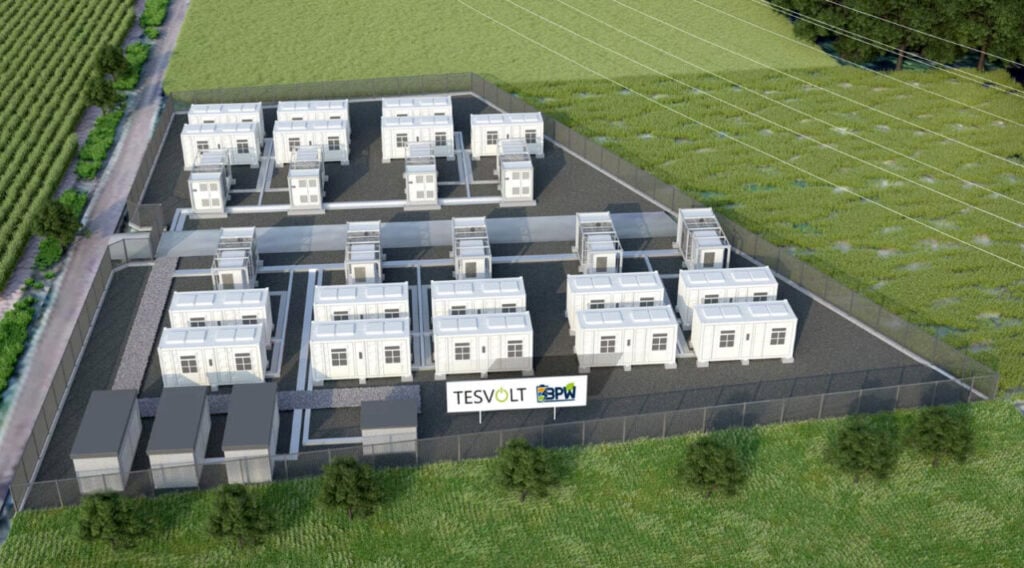
Germany-based commercial & industrial (C&I) BESS provider Tesvolt has won its largest order to-date, for a 65MWh project in Rhineland-Palatinate.
The company will deploy its battery energy storage systems (BESS) for project owner-operators W Power, a developer, and local utility EWR. It will be built by contractor Timbra near the city of Worms.
Tesvolt will support the project development, supply and install the BESS and will take over service and maintenance once online.
The wider array of services is part of an industry-wide shift as large-scale project manager Philipp Schreiber, speaking to Energy-Storage.news at ees Europe last month, said: “Customers increasingly require better services around the BESS deployment, and the requirements for EPC services are growing too. Generally, they want the full package of services from one provider.”
Try Premium for just $1
- Full premium access for the first month at only $1
- Converts to an annual rate after 30 days unless cancelled
- Cancel anytime during the trial period
Premium Benefits
- Expert industry analysis and interviews
- Digital access to PV Tech Power journal
- Exclusive event discounts
Or get the full Premium subscription right away
Or continue reading this article for free
The move into the grid-scale segment does not mean a departure from the company’s main C&I activities, Schreiber added: “Grid scale will be a growing segment for us in the future but C&I will always be the core of the business.”
The shift to larger project sizes does mean the company will increasingly be competing with China-based BESS providers which are increasing their market share of the space globally. The firm is keen however to keep its German identity and manufacturing base.
“Our founders are from the region where our factory is. Tesvolt has always been about keeping the innovation in Germany, we’re expanding here and will not move to another country. The market is accelerating and there is more and more competition from Asia and especially China,” said Christian Löffler, product manager C&I.
“We get our cells from Samsung SDI, package them into our enclosure and implement our own BMS. We source our semiconductors from Taiwan, but the PCB assembly and all other work steps are carried out in Germany.”
The cells are nickel cobalt aluminum oxide (NCA) which Schreiber, quoted in the 65MWh project announcement, said have numerous benefits.
“NCA cells can utilise up to 100 per cent of the installed energy, which is often not the case with other cell technologies. In energy trading, NCA technology allows a higher depth of discharge to be used and the storage system can generate revenue over a longer period of time due to the increased lifespan.”