Dutch TSO TenneT has signed a contract with a developer for a large-scale BESS which will help to relieve grid congestion, possibly enabling the quicker deployment of renewables in the Netherlands.
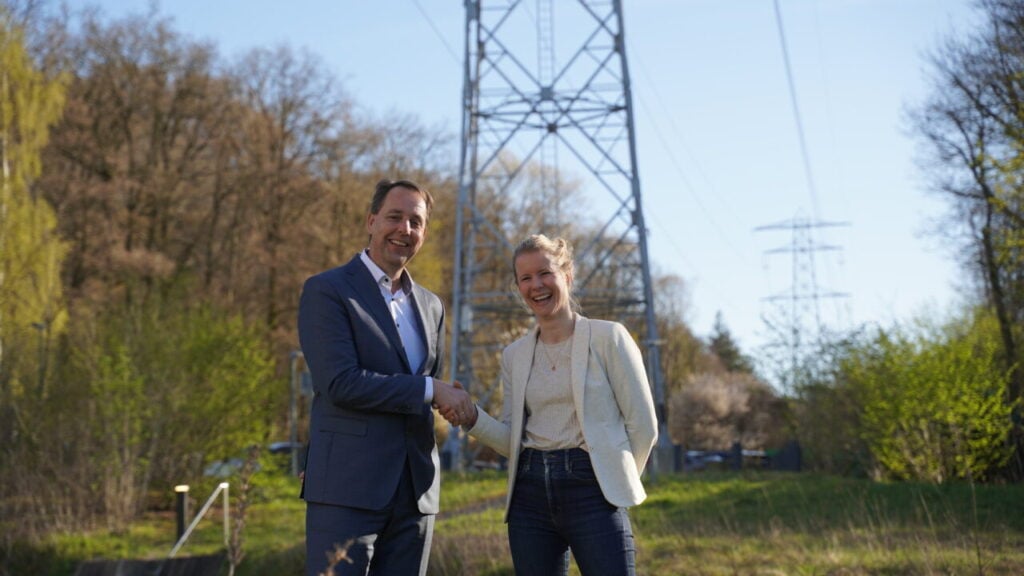
The contract with Green Energy Storage (GES) relates to a 200MW/800MWh battery energy storage system (BESS) in the North Brabant region, called Sequoia, which will help to relieve the high-voltage grid.
It will do so by agreeing not to discharge to the grid at times of high renewable production, and will discharge instead when demand is high. Energy storage would most likely do this anyway in response to price signals, but system operators in countries including Netherlands and Germany are seeking to enshrine this in grid connection contracts.
New kind of grid connection agreement could accelerate renewables buildout
The contract between GES and TenneT is a flexible connection agreement called a time-bound transmission right (TDTR), which offers a transmission system operator’s (TSO’s) customers special contracts for the ‘residual capacity’ available on the grid outside peak hours. GES and TenneT have also entered into a capacity control contract (CSC), which stipulates that a large-scale consumer actively adjusts their electricity consumption or feed-in during busy periods in exchange for a fee, to prevent the grid from becoming overloaded.
Try Premium for just $1
- Full premium access for the first month at only $1
- Converts to an annual rate after 30 days unless cancelled
- Cancel anytime during the trial period
Premium Benefits
- Expert industry analysis and interviews
- Digital access to PV Tech Power journal
- Exclusive event discounts
Or get the full Premium subscription right away
Or continue reading this article for free
TenneT said the combination of both a TDTR and CSC makes GES’ Sequoia BESS project the ‘first congestion mitigator that can be controlled on TenneT’s high-voltage grid at TenneT’s request’.
The agreements are possible after the Netherlands Authority for Consumers and Markets (ACM) last year authorised network operators to offer customers special contracts for the ‘residual capacity’ available on the grid outside peak hours. The BESS will also be given priority on the waiting list in accordance with the ACM’s prioritisation framework, enabling GES to commission it in 2027.
Not only that, but TenneT said that the BESS could help renewable projects in the interconnection queue come online earlier than currently planned, by making part of its capacity available to them. It is doing another review of its grid congestion study for North Brabant this autumn, and will ‘include the impact of congestion relief through GES and indicate what this means in terms of availability for whom on the waiting list and from when’.
Ad Verbaas, COO of GES, said: “This first capacity control contract with a congestion mitigator marks an important step in the development of a flexible energy system. With Sequoia, we are demonstrating how large-scale battery storage can already make a tangible contribution to alleviating grid congestion today.”
Netherlands takes steps to enable storage buildout in highly congested grid
This agreement between Tennet and GES appears to be part of a range of flexible grid connection agreements aimed at helping to accelerate the buildout of BESS in light of the Netherlands’ highly congested grid.
In early 2024, analysis from Aurora Energy Research suggested that new ‘non-firm agreement’ (NFA) connections as well as time-weighted rates in the country could substantially increase BESS project economics.
In an interview later that year, developer LC Energy said that without this, no large-scale project could have reached financial closed in the Netherlands, although an executive at another firm building projects, SemperPower, was more sceptical on the real benefits of it. Developer-operator Giga Storage agreed a time-limited grid usage contract with TenneT which Giga claimed as the first of its kind, that same year.
Although not the only factor, following the reforms, the Dutch grid-scale storage market took off with a flurry of large-scale BESS financing and construction over 2024 and 2025 (see our coverage here).
TSOs and DSOs in Germany are also increasingly offering flexible connection agreements (FCAs), though there are similarly both downsides and upsides to them.