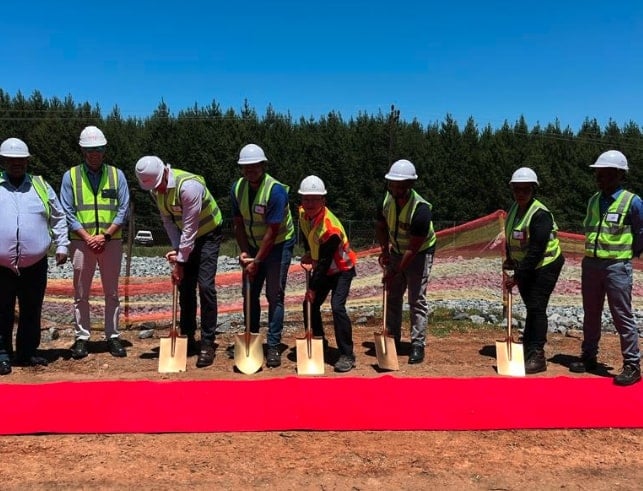
South Africa’s main utility and grid operator Eskom has announced the start of construction of its first battery energy storage system (BESS), with Hyosung Heavy Industries.
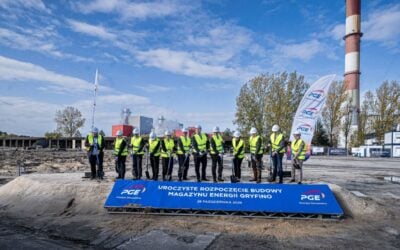
A groundbreaking ceremony was held for the Elandskop BESS project last week (8 December), which is spread across two different municipalities within the eastern province of KwaZulu-Natal.
It will total 8MW of power and 32MWh of energy storage capacity and be built in 7-12 months with connection to Eskom’s Elandskop substation. Its main role will be to boost the network during peak hours to relieve stress to the grid, a press release said, equivalent to peak shaving.
The project is part of phase one of a 343MW/1,440MWh BESS procurement that Eskom concluded in August. The first phase will see 199MW/833MWh built at eight substations throughout the country, alongside 2MW of solar PV, while the second phase comprises 144MW/616MWh of deployments at a further five Eskom sites with 58MW of solar PV.
Try Premium for just $1
- Full premium access for the first month at only $1
- Converts to an annual rate after 30 days unless cancelled
- Cancel anytime during the trial period
Premium Benefits
- Expert industry analysis and interviews
- Digital access to PV Tech Power journal
- Exclusive event discounts
Or get the full Premium subscription right away
Or continue reading this article for free
A total of 11 billion Rand (US$630 million) is being invested in the projects which will be completed by June 2023 and December 2024 in phases one and two respectively. Chinese company Pinggao Group was the other winner of the competitive solicitation process.
The projects are being delivered through one of two procurements by Eskom which are adding large-scale battery storage systems to the South African grid.
The other is the Risk Mitigation Independent Power Producer Procurement Programme (RMIPPPP) which is adding, among other resources, solar and storage capacity to make up projected shortfalls between future supply and demand.
Norwegian firm Scatec is delivering a 540MW solar, 225MW/1,140MWh energy storage portion of this with help from its government-backed export financing agency Eksfin, and started building the units in July this year.
The battery storage portions of those projects are a way for Eskom to bring more renewables online without needing to substantially expand grid infrastructure, a consultant working with independent power producers (IPPs) on projects in South Africa explained to Energy-Storage.news in March.
South Africa is seeking a net zero energy system by 2050 but is also looking to improve grid resiliency in the face of widespread outages.