Vanadium redox flow battery (VRFB) company VFlowTech has raised investment to scale up its manufacturing, extend its reach and enhance the digital capabilities of its tech.
The Singapore-headquartered tech company has raised US$20.5 million in its latest funding round, VFlowTech said in a statement sent to Energy-Storage.news this morning.
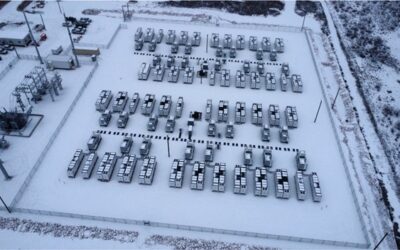
VFlowTech’s modular VRFB product, the Powercube, designed for long-duration energy storage (LDES) applications, comes in two models: 50kW/250kWh and 100kW/500kWh.
Each is claimed to have an expected lifetime of more than 25 years, with round-trip efficiency at 80% up to 100% depth of discharge. It is capable of operating in temperatures of up to 55°C without active cooling and is configurable to both DC and AC installations.
Try Premium for just $1
- Full premium access for the first month at only $1
- Converts to an annual rate after 30 days unless cancelled
- Cancel anytime during the trial period
Premium Benefits
- Expert industry analysis and interviews
- Digital access to PV Tech Power journal
- Exclusive event discounts
Or get the full Premium subscription right away
Or continue reading this article for free
The startup has also built its own energy management system (EMS), which the company claims can optimise charging profiles, including operation in conjunction with solar PV systems.
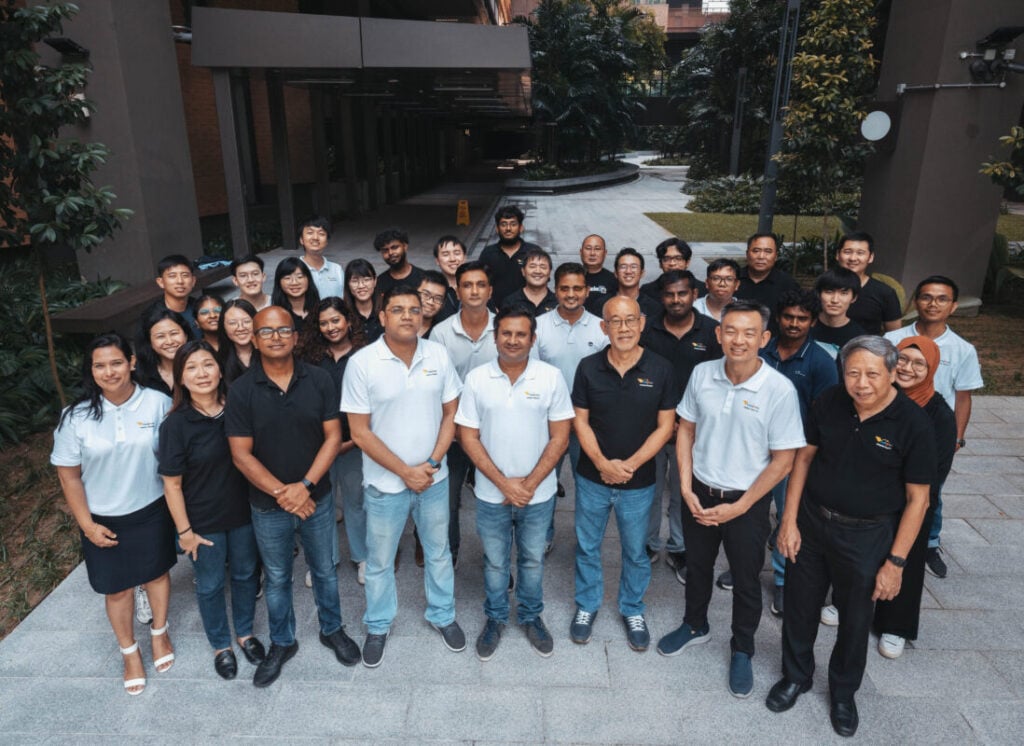
The funding round was led by Singapore venture capital (VC) firm Granite Asia, with participation from four new and six existing investors. VFlowTech said the investment will enable it to scale its manufacturing, expand into new geographies, enhance its AI-driven energy management platform and develop its supply chains.
“With this investment, we are poised for significant growth and technological advancement,” CEO and founder Dr Avishek Kumar said.
“Long-duration energy storage is critical in supporting 100% renewable energy, build out of EV infrastructure, and new energy demand required from accelerated AI adoption,” Granite Asia venture partner Kheng Nam Lee said, adding that the VC firm sees VFlowTech and vanadium flow batteries as being well-positioned “to capture this market in Asia and beyond.”
Angling for pivotal role in Singapore energy system
While that expansion across new markets including Asia and the Middle East is a stated focus, VFlowTech also emphasised the role its technology, particularly in conjunction with its cloud-based energy management platform, could play within Singapore’s energy system.
The platform will introduce smart grid functionalities that will enable customers to optimise energy use, take part in energy trading and enhance the ROI of their storage systems, the company claimed.
“This funding gives us the ability to take on larger projects, expand into new markets, and integrate cutting-edge digital intelligence into our energy storage solutions—making them not just storage systems, but revenue-generating assets,” VFlowTech co-founder Dr Arjun Bhattarai said.
Singapore, a financial and commercial services hub across the Asia-Pacific region, is densely populated and limited in land area for renewable energy development. The city-state is planning to start importing renewable energy generated in other countries like Indonesia and Australia while also doing what it can to get the most out of the electrical and digital infrastructure it has.
Last year, VFlowTech and engineering company Advario were awarded grant funding by Singapore’s Energy Market Authority (EMA) to scale up an existing pilot project from 1.5MWh capacity to 40MWh.
The award was made through a call for innovative energy technologies which could be deployed and trialled on Jurong Island, an industrial and energy generation hub which is also home to a 200MW lithium-ion (Li-ion) battery energy storage system (BESS), considered Southeast Asia’s largest project of its type.
EMA is thought to be considering expansion of that BESS plant and opened a regulatory sandbox testing environment for virtual power plants (VPPs) comprising distributed energy resources (DERs).
VFlowTech’s VRFB technology has previously been trialled in integration with electric vehicle (EV) charging infrastructure and the company raised US$10 million to kick off plans for its first VRFB factory in 2023.
VRFB manufacturers hoping technical advantages can outweigh CapEx disadvantage against Li-ion
For the world’s vanadium redox flow battery manufacturers, the advantages of their technology include the ability to decouple energy from power at the stack level, meaning that unlike Li-ion BESS, storage capacity can be scaled up by increasing the size of liquid electrolyte tanks, without having to replicate a whole battery stack including inverters or power conversion system (PCS) equipment.
Flow batteries are also thought to present a much lesser fire risk than lithium batteries, which could be an advantage in urban settings.
However, challenges facing the commercialisation of flow batteries and other non-lithium electrochemical technologies are also significant. Li-ion is running far ahead regarding market maturity and bankability, sheer manufacturing and supply chain scale and the volumes of investment going into technological improvements around things like energy density, wrote Anh Vu of Clean Energy Associates in a recent Guest Blog for Energy-Storage.news.
As highlighted by a report from BloombergNEF last year, VRFBs are also more expensive than lithium-ion battery solutions, although advocates might argue that the fact that VRFBs do not degrade and therefore require less maintenance and augmentation may offer some balance in terms of cost of ownership over an asset’s lifetime.