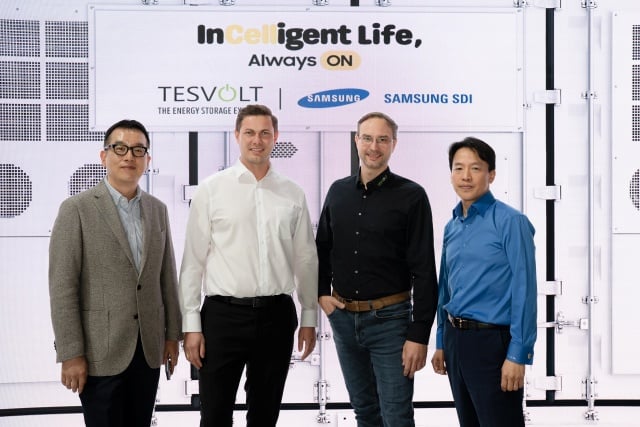
Samsung SDI will supply megawatt-scale battery storage solutions to Germany-headquartered commercial and industrial (C&I) segment specialist Tesvolt.
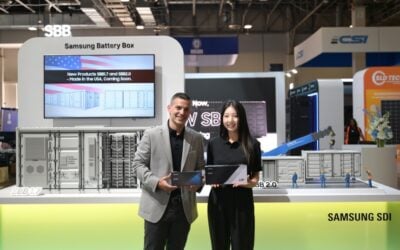
The South Korean battery manufacturer and storage system technology provider announced the supply deal yesterday (11 June) for two products in the company’s Samsung Battery Box (SBB) containerised 20-foot battery energy storage system (BESS) enclosure range.
Samsung SDI will supply system integrator Tesvolt with its SBB 1.0 containerised battery storage units (1.92MW/3.84MWh, 2-hour duration) and SBB 1.5 units (2.63MW/5.26MWh, 2-hour duration).
The German company will then integrate power conversion system (PCS) and cybersecurity components to create complete solutions. Financial terms or volume of orders were not disclosed.
Try Premium for just $1
- Full premium access for the first month at only $1
- Converts to an annual rate after 30 days unless cancelled
- Cancel anytime during the trial period
Premium Benefits
- Expert industry analysis and interviews
- Digital access to PV Tech Power journal
- Exclusive event discounts
Or get the full Premium subscription right away
Or continue reading this article for free
Although Tesvolt’s track record since its founding in 2014 is predominantly in the C&I market, the company is also expanding into utility-scale solutions, for which the Samsung SDI systems could be suitable, as well as the residential market.
The deal builds on a partnership between the two companies that has existed since 2017. Samsung SDI supplies lithium-ion (Li-ion) battery cells for integration into Tesvolt’s own brand BESS solutions. Tesvolt has a production plant in Lutherstadt Wittenberg, Saxony-Anhalt, which it is ramping to 4GWh annual production capacity.
Tesvolt announced its first grid-scale project, a 65MWh BESS in the German Rhineland-Palatinate state for owner-operator W Power and local utility EWR, in summer 2024. However, the company told Energy-Storage.news at the time that it would also remain focused on C&I projects.
In March, it had launched a new subsidiary, Tesvolt Energy, which would trade energy stored in C&I customers’ systems in the German power market in partnership with optimisers enspired, Entrix and The Mobility House. Sebastian Kratz, CEO of Tesvolt Energy, told this site the company saw huge potential for C&I storage systems in German energy and power markets.
Customised for German cybersecurity requirements, novel anti-propagation technology
In a separate announcement earlier this month, Tesvolt gave details of its collaboration with Samsung SDI on integrating the 5.26MWh SBB 1.5 solution with cybersecurity features and onsite project management platforms.
“With larger battery systems in particular, there is a risk that they will simply be switched off from other countries, e.g. due to political conflicts. This makes it all the more important at the moment that our energy provider’s energy storage systems are as secure as possible against cyber-attacks,” Tesvolt CEO and co-founder Daniel Hannemann said.
“Our intelligent battery control system is designed to support cybersecurity.”
The solution is aimed at the rapidly growing German utility-scale BESS market. Tesvolt’s software meets the requirements of Germany’s Critical Infrastructure Protection legislation, KRITIS, regarding information technology infrastructure. Meanwhile, the servers on which system data is stored are in Germany.
Tesvolt’s offering includes turnkey construction and asset monitoring to the cell level, as well as maintenance and onsite technical support for utility customers. The company said the SBB 1.5 is suitable for ancillary services and energy trading applications.
The German company said one of the reasons for selecting Samsung SDI as a vendor is a unique thermal management anti-propagation technology to enhance safety, called Enhanced Direct Injection (EDI). If cell-level overheating is detected, the EDI system injects a cooling agent into an affected battery module.
SBB 1.5 comes with a guarantee valid for up to 20 years and a flexible performance guarantee, a guaranteed round-trip efficiency (RTE) of more than 95% and 97% availability.
“Supplying an outstanding storage system is no longer enough these days. In order to achieve good profitability over the entire lifespan, it is important that large storage systems have the lowest possible downtime,” Samsung SDI energy storage system director Dirk Kaisers said.
Unlike the growing industry standard for Chinese battery suppliers to the BESS industry to use lithium iron phosphate (LFP) cells, Samsung SDI’s product uses nickel cobalt aluminium oxide (NCA) cells.
Samsung SDI is currently delivering SBB 1.0 units to Tesvolt through to the end of this year, with SBB 1.5 deliveries to begin in Q2 2026. In its recent Q1 2025 earnings call, the Korean tech company claimed that it has already secured orders equivalent to 90% of its planned production capacity for energy storage batteries this year.