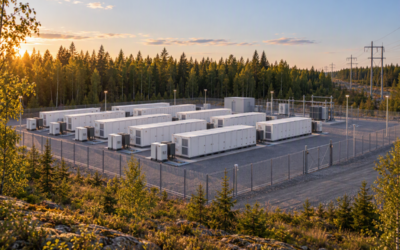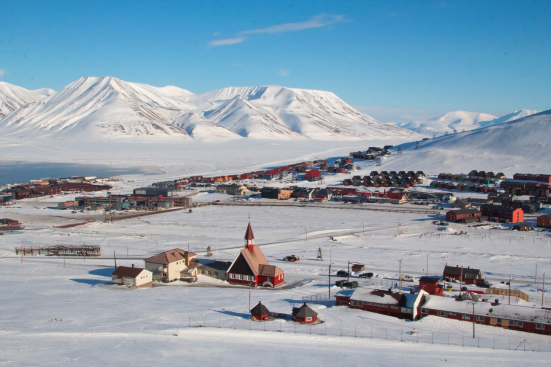
Saft has won a turnkey contract for a 7MWh battery energy storage system (BESS) in a Norwegian archipelago which it claims is the largest in the Arctic, although much larger projects near the polar circle have progressed recently too.
The transport, industry and defense-specialised BESS provider will deliver the 6MW/7MWh system to the Longyearbyen community on the island of Svalbard for completion in late 2022. The bulk of Svalbard’s population of slightly under 3,000 people live there.
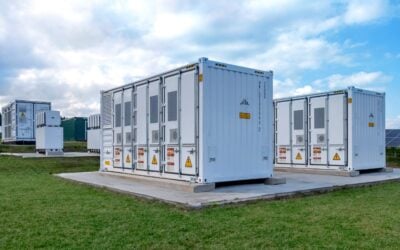
The lithium-ion phosphate (LFP) BESS will be housed in six containers based on Saft’s Intensium Max High Energy technology and will feature a fully integrated solution including power conversion and control systems.
The company says it will allow Longyearbyen to cut its emissions by 100% over time. Joachim Karlsen, Longyearbyen Council’s project manager, told Energy-storage.news it has immediate plans for solar PV capacity.
Try Premium for just $1
- Full premium access for the first month at only $1
- Converts to an annual rate after 30 days unless cancelled
- Cancel anytime during the trial period
Premium Benefits
- Expert industry analysis and interviews
- Digital access to PV Tech Power journal
- Exclusive event discounts
Or get the full Premium subscription right away
Or continue reading this article for free
“Longyearbyen will have about 500 kWp installed capacity by the end of 2022, with an expected increase in the coming years. Regarding other energy sources, this is yet to be confirmed, but will be clearer by the end of 2022, when Longyearbyen lokalstyre (council) will publish their energy plan for Longyearbyen,” he said.
“What is certain is that the city has an ambition toward a zero-emission energy system in 2030, and this will inevitably include other renewable energy sources than solar alone.”
The BESS will for now be next to a coal-fired power station to provide reserve capacity and overcome fluctuations, as well as backup power. The coal station will close in 2023, after which the ESS will “…provide voltage and frequency control to integrate diesel generators and growing amounts of renewable energy,” the press release reads.
“We selected Saft after a competitive bidding process that evaluated price, quality and capability to deliver,” said Karlsen in the press release.
“One aspect we particularly liked about Saft is its experience and proven high reliability with similar systems for remote communities in northern Canada and Alaska. That has given us extra reassurance that their team has what it takes to deliver this complex project in harsh Arctic conditions and that their technology will provide us with reliability and security of supply.”
A Saft spokesperson told Energy-storage.news why it opted for LFP in this case:
“Despite a slightly lower energy density compared to NMC, it offers excellent cycling capability both in shallow and deep cycling, which is very well suited for use cases like Longyearbean, where storage operation patterns change over time as power generation and consumption mix evolve. LFP is operating well at low temperatures, and is easier to manage with regards to safety.”
They added that, despite the remote location, the Saft ESS comes with full remote monitoring capabilities.
“They are based on highly granular data acquisition at battery level, cloud-based data storage and processing capacities, and dedicated online tools available to operators and service personnel. They allow real-time monitoring of all operational data, alarm management, maintenance optimization and other value-adding functionalities,” they said.
Saft’s projects that Karlsen alluded to include a 21MW wind farm in northwestern Finland and a 1MWh system to a remote coastal Arctic community’s microgrid in Cordova, Alaska. Both are relatively close to but not in the Arctic circle, while a smaller 950kWh system delivered to an electric cooperative in Kotzebue, Alaska, does fall within the boundary.
Saft says it will schedule transportation to Svalbard in the warmer months to overcome logistical challenges, as well as carry out final commissioning during winter to demonstrate the system’s tolerance for the intense Arctic winter.
Other projects near the Arctic
Other BESS projects in the far north (but again not technically Arctic) include a large 40MWh system in the Yukon province of Canada. SunGrid Solutions was recently chosen by utility Yukon Energy as the project construction partner after a year-long competitive process. The project will cost CA$35 million (US$27 million) of which CA$16.5 million will be provided by the governments’ Green Infrastructure Stream.
Another, even larger one is a 93MWh Tesla Megapack BESS in Alaska’s Kenai Peninsula provided to utility Homer Electric, which went into full commercial operation on January 19th, 2022. The BESS was installed on the site of a gas power plant to provide voltage support, enhance grid stability and reduce gas burn.