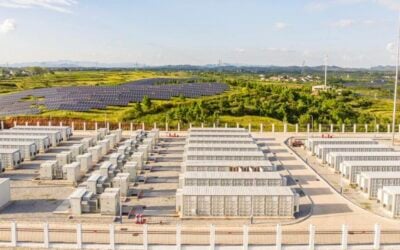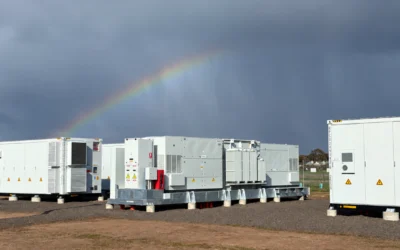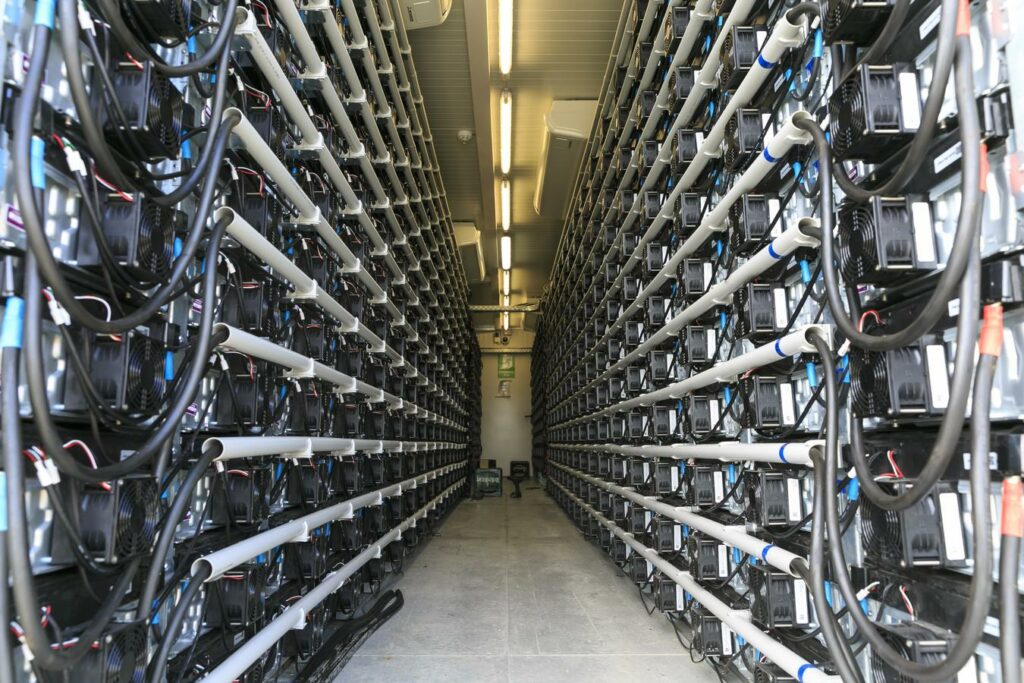
A solar-plus-storage power plant, deployed at the site of an opencast lignite mine in Germany, is almost ready to go into action, RWE has said.
The Germany-headquartered multinational energy company said on 26 April that its project at Inden lignite mine in Duren, in the state of North Rhine-Westphalia, will go online in “just a few weeks” in late summer this year.
It will be RWE’s first project in Europe to include a hybrid of solar PV and battery energy storage system (BESS) technology, with 14.4MW of PV generation capacity and 4.8MW/9.6MWh of batteries.
The BESS will be used to enable the solar-generated power to be fed into the local grid smoothly, RWE said.
Try Premium for just $1
- Full premium access for the first month at only $1
- Converts to an annual rate after 30 days unless cancelled
- Cancel anytime during the trial period
Premium Benefits
- Expert industry analysis and interviews
- Digital access to PV Tech Power journal
- Exclusive event discounts
Or get the full Premium subscription right away
Or continue reading this article for free
Germany needs to close its lignite coal mines in order to meet national climate objectives. In the case of Inden, RWE has committed to a 2029 closure date.
Although the opencast site’s rehabilitation will ultimately see it dominated by a lake, the water will take about two decades to reach and fill the pit and RWE saw the opportunity to site the solar-storage plant there in the intervening years.
The company plans to build at least 500MW of renewable generation assets in the Rhenish lignite mining district that surrounds Inden, including 200MW of wind farms already in construction.
RWE CEO for onshore wind and solar in Europe and Australia Katja Wunschel said that the Inden project represents EU11 million of RWE investment and that the North Rhine Westphalia region is “one of the centres in our growth and innovation strategy”.
“Here, we want to implement every wind and solar project possible and thus help to shape the enormous transformation, especially in the Rhenish mining district.”
RWE was awarded the project through a so-called Innovation Tender hosted by Germany’s federal network regulator, the Bundesnetzagentur.
These were first held in September 2020 alongside specific solar, onshore wind and biomass tenders, with the innovation tranches requiring proposed projects to combine at least two different clean energy technologies each. So far, all of the winning bids have been solar PV-plus-battery storage plant proposals.
German energy storage association BVES’ chief, Urban Windelen, told Energy-Storage.news last year that the tenders and the profiles of winning projects demonstrate the “inextricable” link between energy storage and the achievement of decarbonisation objectives.
Innovation Tenders award contracts for asset owners to receive a fixed Eurocents per kilowatt-hour (kWh) sum, in addition to market-based revenues they are able to earn. Volume-weighted average of the premiums awarded in a September 2021 round was €0.0455 (US$0.048)/kWh, while the figure for a previous round awarded in May last year was €0.053/kWh.
RWE has won Innovation Tender contracts for two more solar-plus-storage projects, which together add up to about 30MW of PV and 10MWh of battery storage. Each will be DC-coupled to the lithium-ion batteries and use bifacial PV modules.
The company is also building large-scale battery storage at two run-of-river hydro plants in Germany, while abroad it is building some much larger solar-plus-storage plants in the US.