Updated 27 July 2021: An RWE spokesperson told Energy-Storage.news that the combined capacity of the BESS installations will be 128MWh across the two sites. It was also confirmed that the project will be commercially-oriented, rather than a demonstration of the technology or potential business models with the two systems mainly providing “balancing energy” for the grid and “therefore geared towards the FCR (Frequency Containment Reserve) market,” the spokesperson said.
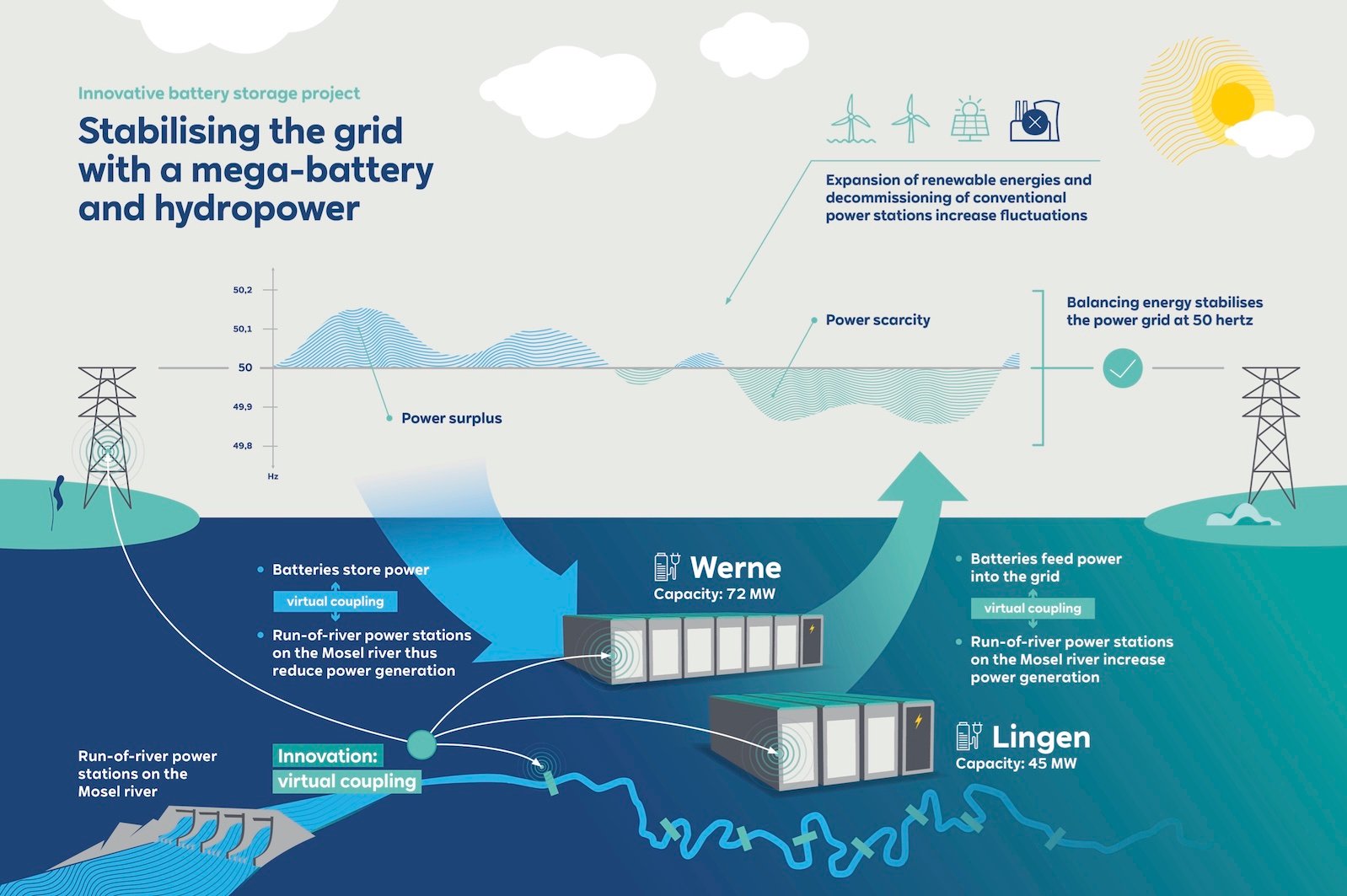
RWE has announced the construction of two battery energy storage systems (BESS) in Germany which will be “virtually coupled” with existing run-of-river hydroelectric power plants.
The Essen-headquartered power generation company said on 22 July that it will install 117MW of batteries at the two sites: 45MW of BESS at its Gersteinwek power plant in Lingen, Lower Saxony and 72MW at Emsland power station in Werne, North Rhine-Westphalia. The battery projects will require an investment of around €50 million (US$59 million) and are scheduled to go into action at the end of 2022.
RWE said the battery systems can be used to raise or decrease the flow-through of power at the hydropower plants, increasing the effective capacity available to be put into electricity system balancing markets. The hydroelectric generation adds about 15% extra capacity to the battery systems, with their primary application being to help maintain the grid’s operating frequency.
Try Premium for just $1
- Full premium access for the first month at only $1
- Converts to an annual rate after 30 days unless cancelled
- Cancel anytime during the trial period
Premium Benefits
- Expert industry analysis and interviews
- Digital access to PV Tech Power journal
- Exclusive event discounts
Or get the full Premium subscription right away
Or continue reading this article for free
Energy-Storage.news has reported on a small handful of other projects around the world that pair batteries with run-of-river hydropower. These include three in Sweden: a 5MW / 6.2MWh BESS at the 44MW Forshuvud hydropower station, installed in 2019 by the power plant’s owner Fortum ,and two battery storage system projects of 6MW and 9MW from technology provider Nidec ASI at hydropower plants in Edsele and Lövön by E.On’s energy supplier subsidiary Uniper which are currently underway. Like RWE’s two new projects, these will also be providing frequency regulation services.
“Large battery storage systems in the megawatt category make a key contribution towards network stability in the new energy world. The implementation of this project at a power station with a tradition as long as Werne’s demonstrates impressively how competence and innovative technologies can be used to design the secure energy supply of the future,” North-Rhine Westphalia state minister for economic affairs and energy Andreas Pinkwart said.
“The Lingen power plant is a role model for the energy transition. It’s impressive how quickly the transformation from conventional electricity generation to a state-of-the-art, environmentally friendly energy world is progressing,” Olaf Lies, Lower Saxony state minister for environment, energy, building and climate protection said.