Three-quarters of the lithium-ion battery supply chain could have exposure to forced labour, contravening US and EU laws and potentially leading to products being blocked from those markets, according to a report from AI supply chain risk platform Infyos.
The report notes that Infyos’ analysis of thousands of data sources reveals that many of the largest automotive, energy storage and other industry firms use lithium-ion batteries that could have exposure to human rights abuses in their supply chain. Lithium-ion is the predominant technology used for battery energy storage systems (BESS) today.
Infyos CEO and co-founder Sarah Montgomery and head of sustainability Jeff Williamson discussed the findings and significance for the industry with Energy-Storage.news. The company provides a platform to show its research and allow suppliers and customers to record mitigating actions.
The company didn’t name which lithium-ion original equipment manufacturers (OEMs) it has specifically identified with the risks, but pointed to the recent calls by Republican lawmakers in the US to immediately block shipments of batteries from China-based firms CATL and Gotion.
Try Premium for just $1
- Full premium access for the first month at only $1
- Converts to an annual rate after 30 days unless cancelled
- Cancel anytime during the trial period
Premium Benefits
- Expert industry analysis and interviews
- Digital access to PV Tech Power journal
- Exclusive event discounts
Or get the full Premium subscription right away
Or continue reading this article for free
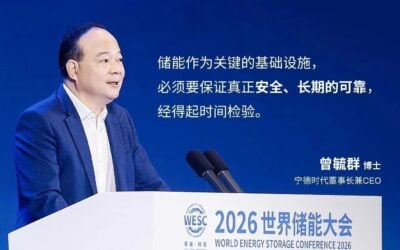
CATL declined to comment further to previous denials of forced labour in its supply chains, while other companies contacted did not respond to a request for comment, though this week has some public holidays in both China and South Korea.
Infyos said that most of the allegations of severe human rights abuses involve companies mining and refining raw materials in China, mainly the Xinjiang Uyghur Autonomous Region, which are then used in batteries. The Republican lawmakers alleged “deep” supply chain links between CATL and Gotion to “the most troubling Chinese organisations involved in the enslavement of Uyghur Muslims in Xinjiang”.
CATL, and another firm BYD, are generally touted as the two largest players with over 50% of the global market, followed by—in an order depending on the period—LG Energy Solution, Panasonic, Rept, Hithium, SK On, Samsung SDI, Gotion and CALB, all of which are based in either China or Korea.
A recent fire at a lithium-ion battery parts facility in South Korea operated by a company called Aricell saw 23 workers killed, mostly contract workers from abroad. Potential exploitative labour contracts in cases like those would be another risk that Infyos’ platform identifies, Montgomery said.
The supply chain abuses and lack of visibility identified by Infyos could be in breach of the EU Batteries Regulation’s supply chain requirements, which are to come in from August next year, and the US’ Uyghur Forced Labor Prevention Act (UFLPA, covered regularly by our colleagues at PV Tech).
In the US that could mean imports being blocked and impounded, which happened to US$1.4 billion worth of products last year. In the EU, products that do not comply could also be blocked from the market.
Energy-Storage.news will be publishing the interview with Montgomery and Williamson next week, in which the pair go into more details on the findings, what they mean for companies wanting to sell into the EU and US markets, and what the industry response looks like.
After this article was published, a CATL spokersperson provided the following statement: “CATL opposes and prohibits any forms of forced labor in the operations of CATL and our suppliers. CATL actively works to create an open and transparent purchasing environment. Any suggestion that CATL has used forced labor, or has any connection to forced labor, is absolutely false. CATL has policies in place to ensure responsible sourcing and compliance with industry and global standards, such as responsible and sustainable supply chain management and due diligence policies.”