Government policy and regulation offer the biggest barriers to the deployment of battery energy storage in the UK according to a cross-party group of MPs focussed on energy storage, which claims 12GW of batteries could be deployed by 2021 under the right circumstances.
A sustainable energy company founded by Swindon Borough Council, a local authority in western England, has submitted plans for a 50MW battery energy storage system (BESS) for its latest project.
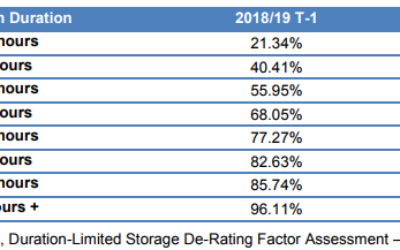
Future battery energy storage projects in the UK have been hit with a major blow after the government published its intention to lower the de-rating factor in capacity market auctions by almost 80% for 30 minute duration batteries.
The developer of one of the world’s biggest battery energy storage systems (BESS) installed globally so far will be taking its vanadium redox flow systems into the international market, beginning with a pilot in Belgium.
On-site energy storage is “the way that you make the subsidy free package work” for large scale solar according to climate change minister Claire Perry who has pointed to Anesco’s Clay Hill solar farm as proof of why the technology so longer needs financial support from tax payers.
Battery storage technology costs will have to fall by a further 30% before projects in the UK are feasible without lucrative frequency response revenues, a leading investor has said.
Norwegian oil and gas company Statoil’s Batwind project in Scotland, combining wind turbines with energy storage, will have a battery system installed by system integrator Younicos.
Northern Powergrid, one of the six distribution network operators (DNOs) responsible for delivering power across regions of the UK, is to plough £1.9 million (US$2.53 million) into the creation of a smart energy grid across its network, allowing its eight million customers to trade power and services using their home solar, battery systems and electric vehicles (EVs).
Over the past couple of weeks, various flow battery makers have touted new sales and supply chain agreements as the fledgling sector fights for a share of the stationary energy storage market.
Verv, an energy monitoring and AI company, has laid claim to launching the UK’s first energy trading community at a housing estate in Hackney, East London.