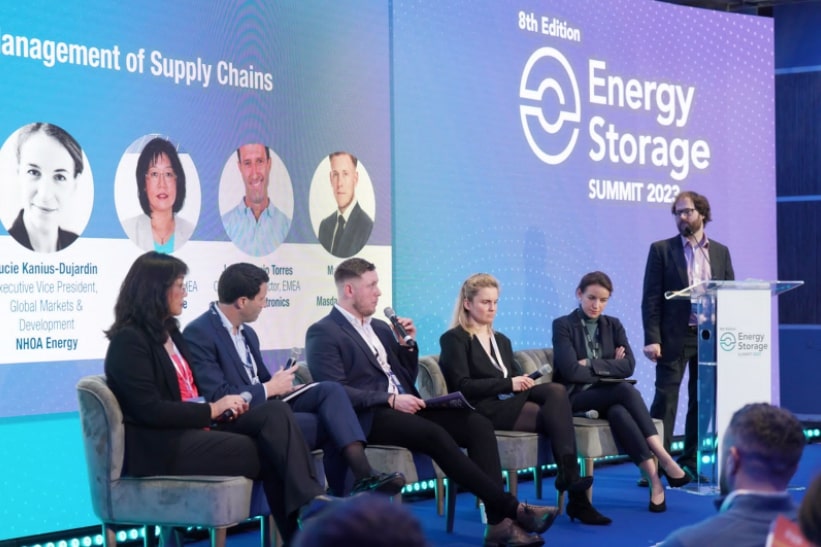
Managing your battery energy storage system (BESS) supply chain is a complex issue with no easy fixes, according to leading developers, system integrators and investors.
That was the message from panellists on the ‘Effective Management of Supply Chains’ on day one of Energy Storage Summit in London last week (22/23 February). Supply chain has been a major topic in the BESS industry in the past few years, covered extensively by Energy-Storage.news.
Whilst clearly affecting every project to some degree, some of the most high-profile stories we’ve reported on include Fluence’s financial results taking a hit, gigafactory project delays and high-profile projects in California being pushed back or having their offtake contracts renegotiated.
Battery storage issues unlike other clean energy
Try Premium for just $1
- Full premium access for the first month at only $1
- Converts to an annual rate after 30 days unless cancelled
- Cancel anytime during the trial period
Premium Benefits
- Expert industry analysis and interviews
- Digital access to PV Tech Power journal
- Exclusive event discounts
Or get the full Premium subscription right away
Or continue reading this article for free
“You have transformer delays, battery delays etc. Trying to tie all that up with an asset class that, if you get it online too early it sits there and degrades, is challenging. We have problems with BESS that did not exist with other supply chains,” said Matt Clare, CEO of UK developer Masdar Arlington Energy.
Alicja Kowalewska, principal at battery storage investor Gore Street Capital sounded a similar note of pessimism, saying it was “hard to see capex numbers coming down”.
That had followed on from Clare saying that broad brush stroke numbers on how much capex had risen in the past year or two were misleading because of the wide variety of factors that can go into the figure: “One of the main points that everyone needs to remember, in relation to the effective management of the supply chain, is that it’s very complicated.”
Ultimately, Kowalewska said, management of supply chain issues depended “…on the geography and the strength of the system integrator’s relationship with the key component suppliers”.
How to manage it
Unsurprisingly then, one of the key takeaways from the session on how to deal with these issues was building stronger, long-term relationships with said suppliers.
“Transparency is key. As a sales team we know what is happening in the wider market and feeding that back to our customers is key. It’s about planning and building a relationship between supplier and offtaker. We all know there are huge supply chain problems and the market is constantly shifting,” said Sonia Benard, head of EMEA sales at Trina Storage, the BESS arm of Trina Solar.
EV and energy storage solutions firm NHOA’s Lucie Kanius-Dujardin, EVP, Global Markets & Development, made a similar point.
“We are reinforcing the framework agreements we have with several players in batteries and inverters but also smaller components. We have to do long-term booking for components which are a very small part of the overall system for which we never expected to need to do that before,” she said.
Gore Street’s approach to hedging against supply chain risk was partially about diversifying into new geographies as it has been doing recently.
“As you might know, the GB market is not seeing the same numbers as it did in 2022 in terms of revenues. But other markets can keep on delivering. Ireland is still good and the US markets like Texas and California are not yet saturated,” Kowalewska said.
Both her and Clare said another hedge being seen across the BESS industry is looking outside of Tier 1 suppliers.
“You had it in the solar panel industry ten years ago where initially it was only Tier 1 suppliers that people were comfortable with but then you had the Tier 2 ones arrive in force. You’re now seeing it in the BESS industry. It’s not quite there yet, but people are becoming more familiar and comfortable with other (non-Tier 1) products,” Clare said.
Kowalewska added: “You don’t have huge negotiating power with the Tier 1 suppliers. If we can get comfortable with Tier 2 then, despite the lack of lithium pricing drops, we can keep delivering small capex price wins.”
Index pricing
Raw material index (RMI) pricing has been a big theme in the sector – which Energy-Storage.news recently wrote was starting to ease – and it was raised by NHOA’s Kanius-Dujardin, Trina Storage’s Benard and Power Electronics’ commercial director for EMEA Juan Antonio Torres. Although Torres said it had proved impossible considering the number of components that go into its solutions, which encompass parts of the broader electricity network than just BESS.
Kanius-Dujardin called RMI pricing the “new normal” which did not solve the problem, but said there has been progress on it recently.
“We explored formulas to limit the changes in capex. From this year, we have a proposal for customers to lock in pricing,” added Benard.
Reasons to be cheerful
There were other reasons for optimism too. Clare said that the investment community is becoming more familiar with the BESS sector and, as mentioned by other panellists, financing plays a huge role in managing supply chain risk.
“The investor community plays a massive part in stepping up to the plate in terms of stepping into an asset class that is commercially less well understood. There is now some really educated capital starting to understand it. That’s demonstrated by increased debt and leverage within senior lenders.”