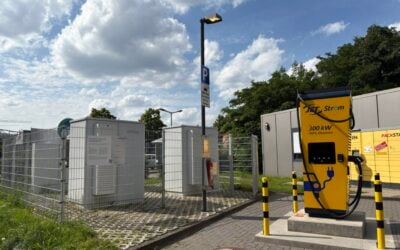
German utility firm RWE has launched a power-to-gas storage system, which it claims has achieved efficiencies as high as 86%.
The plant uses excess electricity from the local grid to create hydrogen via an electrolyser bult by UK firm ITM Power. The hydrogen is pumped into the natural gas network and heat from the process is drawn by a district heating system. The hydrogen can be called on to generate power when it is needed.
The plant in Ibbenbüren North Rhine Westphalia (NRW) could be the first of many with RWE executives lining up to extol its virtues.
The plant in Ibbenbüren North Rhine Westphalia (NRW) could be the first of many. Source: ITM Power
“In order to be able to pick up excess electricity from renewable sources onto our grid, we need alternatives to conventional grid expansion methods. This was the driving force behind our decision to embrace this new technology,” said Dr Joachim Schneider, CTO, RWE Deutschland. “The hydrogen that is created by electrolysis can be stored and later used to generate power. The benefit of this form of electricity storage is the enormous infrastructure already offered by the natural gas network – which has huge storage capacity and a high-performing network.”
Try Premium for just $1
- Full premium access for the first month at only $1
- Converts to an annual rate after 30 days unless cancelled
- Cancel anytime during the trial period
Premium Benefits
- Expert industry analysis and interviews
- Digital access to PV Tech Power journal
- Exclusive event discounts
Or get the full Premium subscription right away
Or continue reading this article for free
Dr Arndt Neuhaus, CEO, RWE Deutschland said the technology had a role to play in matching the government’s ambitions for Germany’s electricity network: “According to German Government plans, in fifteen years’ time, renewable energy sources will cover 50% of the country’s power needs – or almost double the current rate.
“Our electricity grid will have to perform at an even higher level than before to achieve this. Under these changed conditions, the power-to-gas technology will be an exemplary solution, as it makes it possible for us to respond immediately to fluctuating volumes of incoming power,” added Neuhaus.
Professor Christopher Hebling, director of Hydrogen and Fuel Cell Technology Co-ordination, Fraunhofer Institute, told PV Tech Storage that power-to-gas technology played a major role in their modelling of a scenario whereby 80% emission reductions are achieved by 2050.