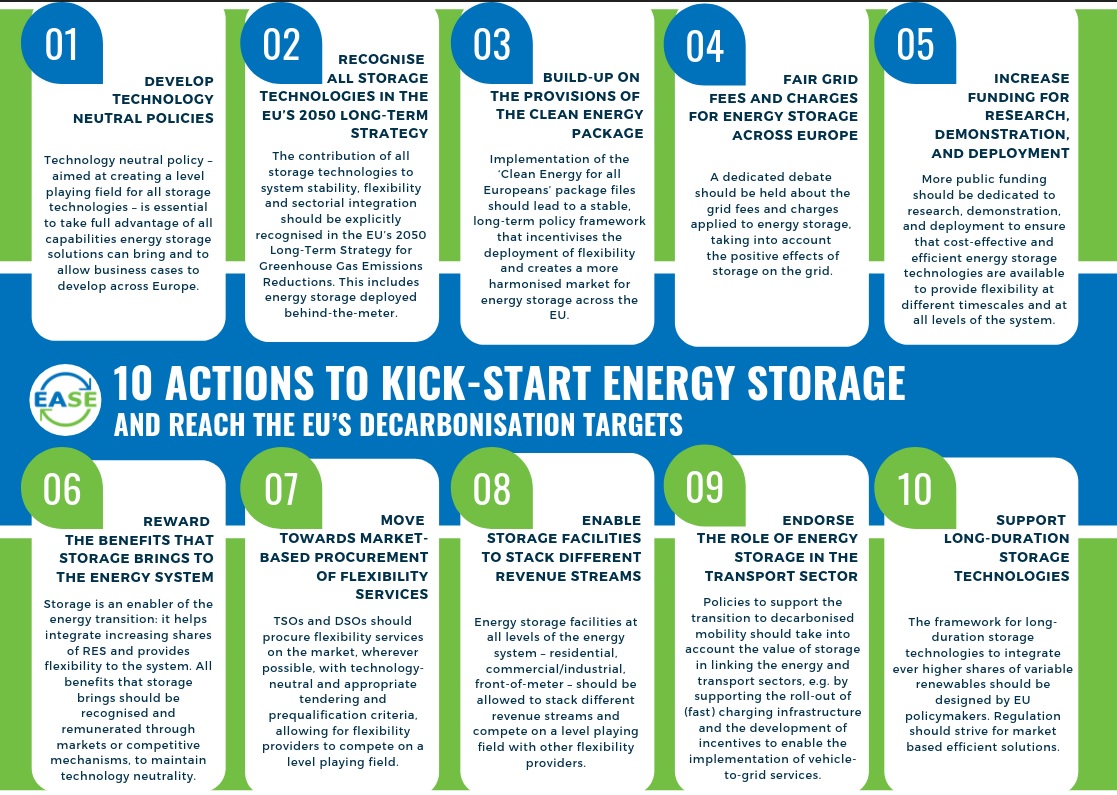
Timed to coincide with this week’s EU elections, a set of 10 recommendations to “kick start” energy storage has been unveiled by European trade association EASE.
EASE, which aims represent companies and stakeholders along the entire value chain for energy storage in Europe, said that policymakers in the European Union have “taken important steps towards creating a regulatory framework that is supportive for energy storage”.
Nonetheless, with the Clean Energy for all Europeans Package from the EU setting out the continent’s ambitions and the EU 2050 Long-Term Strategy geared towards achieving net zero greenhouse gas emissions by that date, EASE, which contributed to EU initiatives and forums to create those plans, said it is now “crucial to build on what has been achieved so far”.
Try Premium for just $1
- Full premium access for the first month at only $1
- Converts to an annual rate after 30 days unless cancelled
- Cancel anytime during the trial period
Premium Benefits
- Expert industry analysis and interviews
- Digital access to PV Tech Power journal
- Exclusive event discounts
Or get the full Premium subscription right away
Or continue reading this article for free
The 10
Under EU ‘decarbonisation by 2050’ scenarios (between 80% reduction by 2050 compared to 1990 levels or net zero emissions by 2050), there could be as much as 450TWh of stationary storage on the power system by then. EASE, which includes utilities, technology providers and distribution and transmission network operators in its member base, has issued its work sheet of “10 points to kick start energy storage”. It’s been made available in Europe’s seven most commonly spoken languages. Which still includes English.
1. Develop technology neutral policies
-Create a level playing field for all storage technologies to “take full advantage of all capabilities energy storage solutions can bring”, as well as associated business models.
2. Recognise all storage technologies in EU long-term strategy
-Capturing the flexibility, stability and sectorial integration capabilities of different storage technologies, including recognising the different technical and market dynamics for behind-the-meter storage
3. Build up on the provisions of the EU Clean Energy Package
-Mechanisms should be introduced to incentivise the deployment of flexibility and to create a “more harmonised market” across Europe for energy storage and made integral to EU long-term planning.
4. Fair grid fees and charges for energy storage across Europe
-Perhaps the biggest current stumbling block, from what Energy-Storage.news has heard in the recent past. The “positive effects” of storage on the grid are currently not recognised at system or network level, EASE argues.
5. Increase funding for research, demonstration and deployment
-EASE calls for more public funding of R&D, demonstrations and also deployment of storage, which would help ensure that energy storage is ultimately deployed cost-effectively and using the most efficient methods and technologies – at all scales and for all seasons and times of the day.
6. Reward the benefits that storage brings to the energy system
-The critical role of energy storage in the energy transition; providing flexibility to enable the ongoing deployment of renewable energy, for example, should be recognised in such a way that they are “rewarded through markets or competitive mechanisms, to maintain technology neutrality, EASE said.
7. Move towards market-based procurement of flexibility services
Transmission and distribution network operators should be allowed to procure flexibility services – including energy storage and demand side response – through market mechanisms, where possible. Again, this is in view of creating a fair and level playing field for storage to compete with flexibility providers.
8. Enable storage facilities to stack different revenue streams
-All scales of energy storage systems should be allowed to perform multiple functions and applications where technically and economically feasible. A combination of revenue streams, ‘stacked’ together, would make storage more competitive with other providers.
9. Endorse the role of energy storage in the transport sector
-Linking together the transport and energy sectors for the decarbonised vehicle industry and energy storage will raise the value of both. EV fast-chargers will likely need associated energy storage capacity, while vehicle-to-grid (V2G) technology is an obvious marrying of the two concepts and technology sets.
10. Support long-duration storage technologies
While for the moment, most battery storage systems hold medium or short durations of storage of one to around 4 hours for energy applications and 15 minutes to half an hour for many power applications. Regulators in Europe should now develop “market based efficient solutions” to create a framework to deploy longer duration storage, which can enable higher shares of renewables penetration on Europe’s grids.
EASE’s recent guide to the European storage market, EMMES 3.0, produced with research firm Delta-ee, found that in 2018 the continent’s market grew by 75% in 2018 to 1470MWh. Activity will be little slower this year, the report predicts, due to “short term saturation” in some front-of-meter markets as well as the maturation of Germany’s booming residential sector.