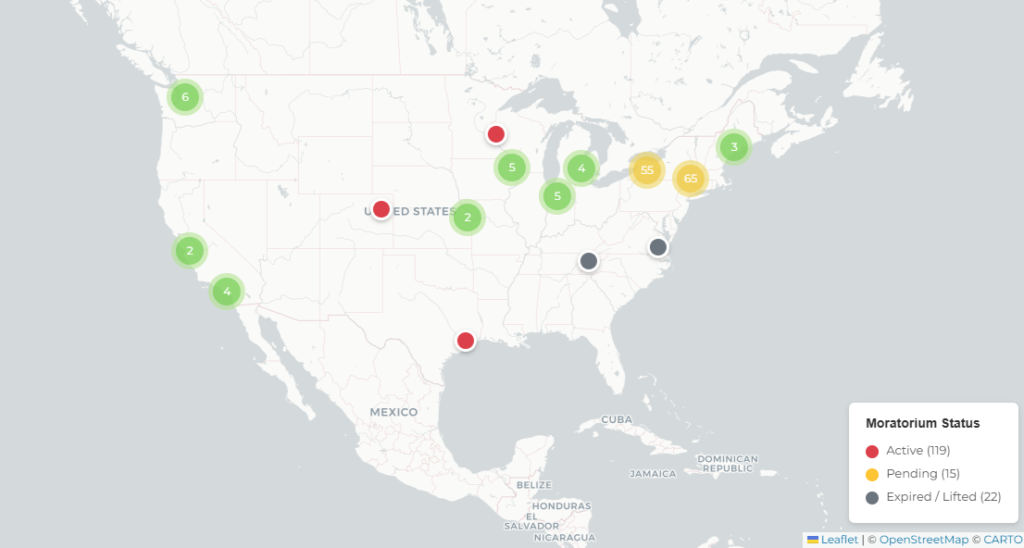
New York is leading the US in battery energy storage system (BESS) moratoriums, with 97 moratoriums in place within the state, according to renewables service provider Carina Energy.
Carina is tracking BESS moratoriums with its BESS Moratorium Monitor. According to its data, there are at least 150 local governments across 17 US states that have enacted moratoriums, bans, or restrictive ordinances targeting BESS.
In New York, Westchester County has the highest number of active moratoriums at nine, with Chautauqua County close behind at eight, and Erie County at six. Overall, 37 out of New York’s 62 counties currently have at least one active moratorium.
Energy-Storage.news Premium reported that in 2025, the US division of Canada’s Northland Power proposed a retrofit for a 250MW/1,000MWh BESS, but it was unanimously rejected by all five members of the Town of Hanover’s Town Board in Chautauqua County.
Try Premium for just $1
- Full premium access for the first month at only $1
- Converts to an annual rate after 30 days unless cancelled
- Cancel anytime during the trial period
Premium Benefits
- Expert industry analysis and interviews
- Digital access to PV Tech Power journal
- Exclusive event discounts
Or get the full Premium subscription right away
Or continue reading this article for free
Along with pausing Northland Power’s Hall Point BESS expansion, the Hanover Town Board approved a six-month moratorium on new energy storage facility approvals. During that period, officials aimed to develop laws regulating storage facilities within the town.
In that same year, local officials from the neighbouring town of Hurley asked the Town of Ulster in New York to temporarily halt the permitting process for a 250MW/1,000MWh BESS project being developed by independent power producer (IPP) Terra-Gen.
Hurley officials sent a letter to the Town of Ulster expressing their “serious concerns” about the project and requesting a six-month moratorium on its development.
Seven states have enacted laws enabling BESS developers to bypass local moratoriums if specific conditions are met. Usually, these pathways require projects to meet a minimum size and undergo state-level review rather than local approval.
These states include New York, with a 25MW and under threshold, California, and Michigan, both with a 50MW/200MWh and under threshold.
Illinois and Massachusetts have no minimum set, while Oregon and Washington have not specified a threshold.
Outside New York, California has the most active restrictions with four, followed by Iowa and Washington, each with three. Additionally, eight states: Indiana, Michigan, Colorado, Illinois, Maryland, Maine, Texas, and Wisconsin, each have one to two active moratoriums.
Fire safety concerns
Fire safety is frequently raised as a concern by residents and officials in areas implementing moratoriums. Both New York and California have experienced BESS fire incidents, which likely affect perceptions of their safety among local residents.
In New York, two fire incidents were reported within weeks of each other at different BESS installations in 2023, and in late 2025, a fire occurred at energy storage developer Convergent Energy & Power’s Church Street Battery Storage Facility in Warwick, New York.
In 2025, California saw a fire at IPP Arevon Energy’s California Flats solar-plus-storage project, and the fire at Vistra Energy’s Moss Landing Energy Storage Facility, which was the impetus for multiple legislation updates in the state.
In 2025, US Environmental Protection Agency (EPA) Administrator Lee Zeldin discussed fire safety concerns related to BESS installations during a press conference in New York, where the EPA announced new safety guidance for BESS. The EPA stated that this guide is the first comprehensive federal resource covering the entire project lifecycle, from siting to emergency response.
According to the EPA’s BESS guidance, “Since 2020, BESS failure incidents have decreased, but some recent fires have gained attention in the media.”
Community members worry that BESS fires might release toxic chemicals into the air, impacting public health.
The EPA responded by citing its efforts at the Moss Landing facility as an example. The agency explained, “A joint effort among company personnel and the North County Fire Department kept the fire contained to one building, though with one notable flare-up. Air quality monitoring and sampling occurred during and after the fire and found no risks to public health. Following the incident, EPA continues to work with other regulators to ensure the safe storage, handling, and transportation of undamaged batteries remaining at the Moss Landing site.”
As explained in a guest blog for ESN from Aaron Marks, energy storage consultant at Clean Energy Associates (CEA), Moss Landing was a unique facility, built within the turbine hall of the old Moss Landing power plant, repurposing that existing building in a way that no other BESS has done.
Most BESS facilities currently utilise container-enclosed battery racks, which are more cost-effective than standalone buildings. These containers are equipped with integrated safety features, such as fire suppression and explosion-prevention systems, designed to contain failures within a single container, rack, or even an individual module or cell.
While some freestanding buildings serve BESS, most are specially built from the ground up to comply with fire codes like NFPA 855.
The Phase 1 system that burned in the fire utilised nickel manganese cobalt (NMC) batteries, which are more reactive compared to the lithium iron phosphate (LFP) batteries commonly used in most BESS today.
Including the history of safety incidents at the Moss Landing site makes the facility seem particularly vulnerable to the very type of incident that occurred, perhaps even uniquely so.
Companies are also continuing to advance BESS safety. In a guest blog for ESN, Drew Bandhauer of Leeward Renewable Energy noted significant advancements in BESS safety practices from 2018 to 2023.
These advancements encompass certifications and standards such as UL 9540, UL 940A, NFPA 855, NFPA 68, NFPA 69, and NFPA 72, all aimed at containing thermal runaway incidents, preventing fire spread, and reducing the risk of uncontrolled fires.
In September 2025, the US National Fire Protection Association released the latest edition of the NFPA 855 safety standard, incorporating several updates from the 2023 version. Industry best practices are often ahead of standards development, but feed into that process.
Joe DeBellis, Global Head of Clean Energy at Firetrace International, spoke with ESN Premium in November 2025 about a report that showed 71% of Americans support energy storage projects.
DeBellis noted at that time about fire safety concerns, “From that survey as well, we saw that 47% of the folks said that they’re going to be more comfortable with a battery energy storage site if they had a clear understanding of safety measures as well. That’s something that can be addressed very early on, not just when the public remarks that, ‘Hey, we’re a little bit concerned.’”
Time will tell how receptive the public is to BESS, but it is clear that moratoriums will remain in place for some time.
This week alone, the San Benito County Board of Supervisors in California enacted a 40-day moratorium on BESS facilities, while Sedgwick County Commissioners in Kansas approved a one-year moratorium on BESS.
The Energy Storage Summit USA 2026 will be held from 24-25 March 2026, in Dallas, TX. It features keynote speeches and panel discussions on topics like FEOC challenges, power demand forecasting, and managing the BESS supply chain. ESN Premium subscribers can get an exclusive discount on ticket prices. For complete information, visit the Energy Storage Summit USA website.