The six US states comprising New England have banded together to request federal government funding for large-scale electricity transmission and storage projects.
Connecticut, Massachusetts, Rhode Island, Vermont, New Hampshire, and Maine state agencies responsible for energy are applying for the funds through the US Department of Energy (DOE) Grid Innovation Program (GIP).
The programme makes US$5 billion available to states between the 2022 and 2026 fiscal years and is aimed at supporting projects which enhance the reliability and resilience of the grid through technologies, including transmission upgrades, energy storage, and distribution grid upgrades, with an emphasis on innovation.
The coalition of New England states is applying with two projects: Power Up New England, which will upgrade and add new grid interconnection points between the southeastern parts of Massachusetts and Connecticut, and Clean Resilience Link, which would increase electricity transfer capacity between New England and New York.
Try Premium for just $1
- Full premium access for the first month at only $1
- Converts to an annual rate after 30 days unless cancelled
- Cancel anytime during the trial period
Premium Benefits
- Expert industry analysis and interviews
- Digital access to PV Tech Power journal
- Exclusive event discounts
Or get the full Premium subscription right away
Or continue reading this article for free
It is understood that the states would seek the upper end of the US$250 to US$1 billion available to each project through the GIP, given they fall into the more expensive transmission category. The current second round of the programme, for which applications closed yesterday, will disburse up to US$1.82 billion.
While both projects will unlock increased ability to integrate renewable energy on the New England grid and opportunities for energy storage, Power Up New England is perhaps of more immediate interest to Energy-Storage.news readers in terms of directly including energy storage resources.
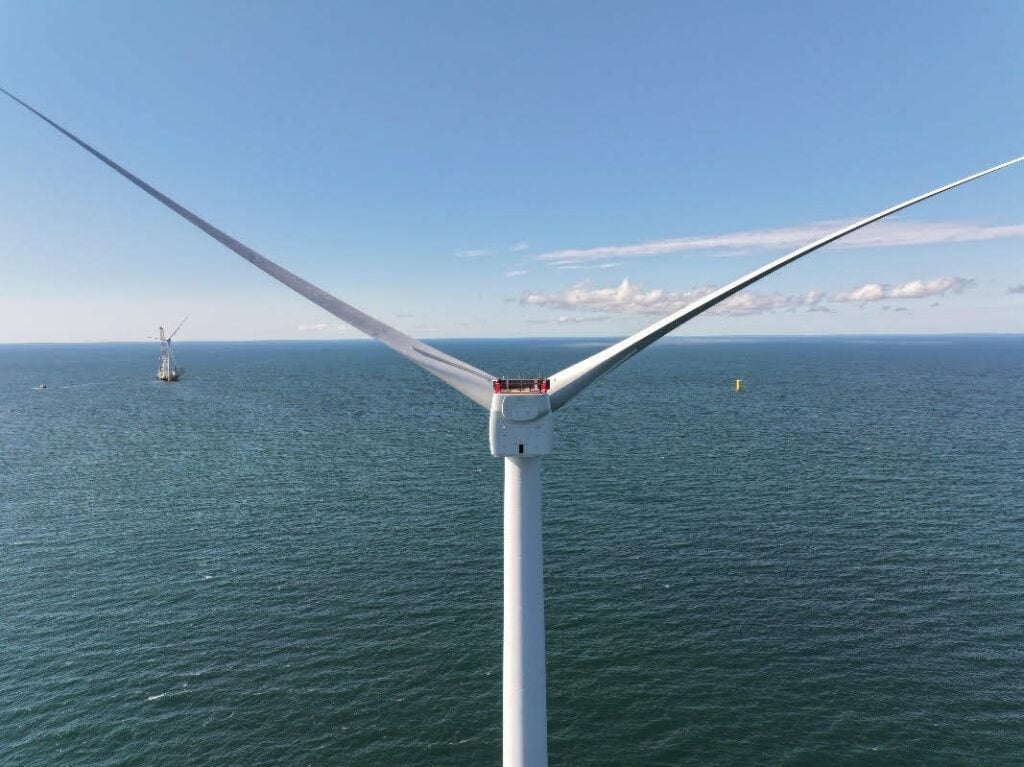
With the Atlantic coast of the US set to host multiple gigawatts of offshore wind generation in the coming years, the states claimed Power Up New England’s interstate link would enable the development of up to 4,800MW of new offshore wind and energy storage resources in Connecticut and Maine.
An announcement by the Connecticut Department of Energy and Environmental Protection noted that the Power Up England application is supported by energy storage developer Elevate Renewables, utilities and developers Eversource and National Grid, and an undisclosed “multi-day energy storage technology provider.”
Energy-Storage.news would take an educated guess that the technology provider is startup Form Energy, which is developing an iron oxide-based battery technology and building its first factory in West Virginia.
The site has contacted Form for confirmation and is waiting for a reply but given that the company authored a paper in Q3 last year on the value of multi-day energy storage in New England, it would not be surprising if it were so.
Meanwhile, developer Elevate Renewables’ business model is deploying large-scale standalone battery energy storage system (BESS) assets at the sites of existing or former thermal generation power plants.
At the beginning of this month the company, which is owned by independent power producer (IPP) Arclight, said it was “exploring or advancing” plans to deploy BESS assets on the sites of at least five power stations in Connecticut. Arclight committed US$150 million investment to its energy storage subsidiary in 2023 after forming Elevate Renewables a year prior, with a remit to develop and install utility-scale battery energy storage systems co-located with existing power infrastructure.
In related news, a new study was published last week (11 April) which identified that Maine’s fleet of fossil fuel peaker plants could be effectively replaced with batteries.
Authored by consultancy Strategen for the non-profit group Clean Energy States Alliance, the study found that the business case for batteries would largely be based on energy capacity market revenue opportunities, and that this model would be widely replicable throughout the New England region.