Australia’s MGA Thermal has secured AU$17 million (US$12 million) in new investment for its long-duration thermal energy storage (TES) technology as it enters the commercial scale-up phase.
This brings the total capital raised to more than AU$50 million.
The funding round introduces IP Group Australia, a specialist venture capital firm that partners with Australian and New Zealand universities to commercialise scientific research, as a new investor, alongside existing investor Main Sequence.
MGA Thermal’s investors also include Shell, and the company closed a funding round in 2023, raising AU$8.5 million (US$5.47 million).
Try Premium for just $1
- Full premium access for the first month at only $1
- Converts to an annual rate after 30 days unless cancelled
- Cancel anytime during the trial period
Premium Benefits
- Expert industry analysis and interviews
- Digital access to PV Tech Power journal
- Exclusive event discounts
Or get the full Premium subscription right away
Or continue reading this article for free
As part of the investment, Shane Meaney of IP Group Australia will join MGA Thermal’s Board.
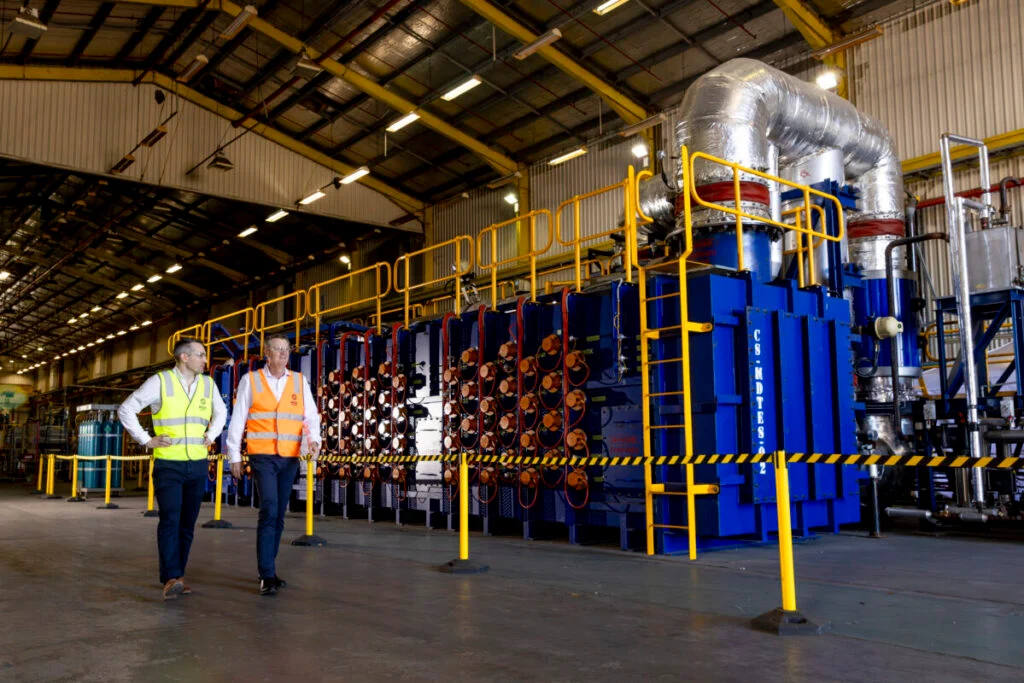
MGA Thermal has developed an Electro-Thermal Energy Storage (ETES) system of thermal blocks that stores renewable energy as heat and releases it as continuous industrial-grade steam available 24/7.
Its patented MGA Block technology stores energy as latent heat, enabling long-duration thermal storage that delivers 200% more energy than conventional heat storage systems, with a footprint up to 24 times smaller than batteries.
“Industrial heat is the next frontier of decarbonisation – MGA’s technology delivers it 24/7 for less,” Meaney said.
“We’re excited to support the team moving into full commercial deployment and look forward to partnering closely with MGA Thermal through this next phase of growth.”
The technology targets one of the most challenging areas of the energy transition: industrial process heat.
Decarbonising industrial heat applications becomes increasingly difficult as temperature requirements rise. Industries requiring extremely high temperatures, such as steel manufacturing, which often demand temperatures of 1,500°C to 1,700°C, present particularly complex decarbonisation challenges.
By contrast, sectors like food and beverage processing typically require lower temperature ranges, especially for syrup preparation and pasteurisation, which are often around the 70°C to 90°C threshold.
MGA Thermal’s system is designed to address higher-temperature industrial applications, positioning it differently in the market compared to technologies like sand batteries, which primarily serve lower-temperature district heating networks.
Accelerating commercial deployment
The new funding accelerates MGA Thermal’s transition from pilot deployments to full commercial rollout, enabling the company to expand its workforce, fast-track customer projects, and scale manufacturing capacity over the next two years.
CEO of MGA Thermal, Mark Croudace, described the new funding as a powerful endorsement of the team and technology.
“We are entering a period of rapid scale up – expanding our commercial capability, growing manufacturing, and delivering projects that help industry decarbonise at speed,” Croudace said.
“Partnering with IP Group, alongside continued support from Main Sequence, gives us the global reach and deep tech expertise we need.”
As previously reported by Energy-Storage.news, the company launched the world’s first industrial steam heat energy storage demonstrator in April last year. That project validated the technical feasibility of the MGA Block system for industrial applications.
In July 2025, the company completed prefeasibility studies for Australia’s largest 180MWh industrial-scale thermal storage project.
Building project pipeline with ARENA support
The company’s commercial momentum was strengthened last month by AU$3.25 million in funding secured from the Australian Renewable Energy Agency (ARENA) to conduct up to five front-end engineering design (FEED) studies for its thermal energy storage technology.
The funding, provided under ARENA’s Powering the Regions: Industrial Transformation Stream, subsidises FEED study costs to reduce early-stage financial barriers for industrial and manufacturing customers exploring opportunities to transition away from fossil fuels.
At the time, ARENA CEO Darren Miller said the project aims to address one of the most challenging areas of decarbonisation.
“Decarbonising industrial process heat is critical to Australia’s net zero transition, but it remains one of the hardest problems to solve,” Miller said.
“By supporting detailed FEED studies, this project could give industrial customers greater confidence in the technical and commercial viability of thermal energy storage, helping move promising projects closer to investment and deployment.”
The FEED studies, which commenced in early 2026, will advance five commercial opportunities with strategic customers, producing detailed technical designs, cost estimates, delivery schedules, risk assessments and commercial strategies to accelerate project investment readiness.
The studies focus on industrial facilities with significant process heat requirements, where thermal storage can displace fossil fuel consumption, helping Australian industries reduce both energy costs and carbon emissions.
Energy storage in the industrial sector
MGA Thermal’s technology operates in a growing market for industrial heat decarbonisation solutions.
Alongside MGA’s thermal blocks, various molten-salt-based thermal energy storage technologies, and specially designed heat-retaining bricks are among the technologies being commercialised to decarbonise industrial heat.
Perhaps the most common application of these technologies is industrial steam generation, where the difficulty of emissions abatement increases as required temperature ranges rise.
Speaking at the Energy Storage Summit Australia 2025 in March, Croudace noted that the scale of the opportunity to decarbonise the industrial sector presents a significant test for energy storage technologies.
“It’s going through enormous change, and it’s at the very start of it. In contrast to the residential sector, the industrial sector is at least 400% bigger in terms of energy and opportunity,” he said, adding that the successful demonstration plant shows the technology “isn’t just a concept – it’s a commercially viable solution ready for deployment.”
However, the company’s development pathway has not been without challenges.
In 2023, an overheating incident at the Tomago site prompted emergency services to be called to the 5MWh demonstration unit after a dangerous heat build-up was declared.
“It is a reminder that we are working on cutting-edge technology, innovating new large-scale energy storage, and the importance of in-house trials,” an MGA Thermal spokesperson said at the time.
The Energy Storage Summit Australia 2026 will be returning to Sydney on 18-19 March. It features keynote speeches and panel discussions on topics such as the Capacity Investment Scheme, long-duration energy storage, and BESS revenue streams. ESN Premium subscribers receive an exclusive discount on ticket prices.
To secure your tickets and learn more about the event, please visit the official website.