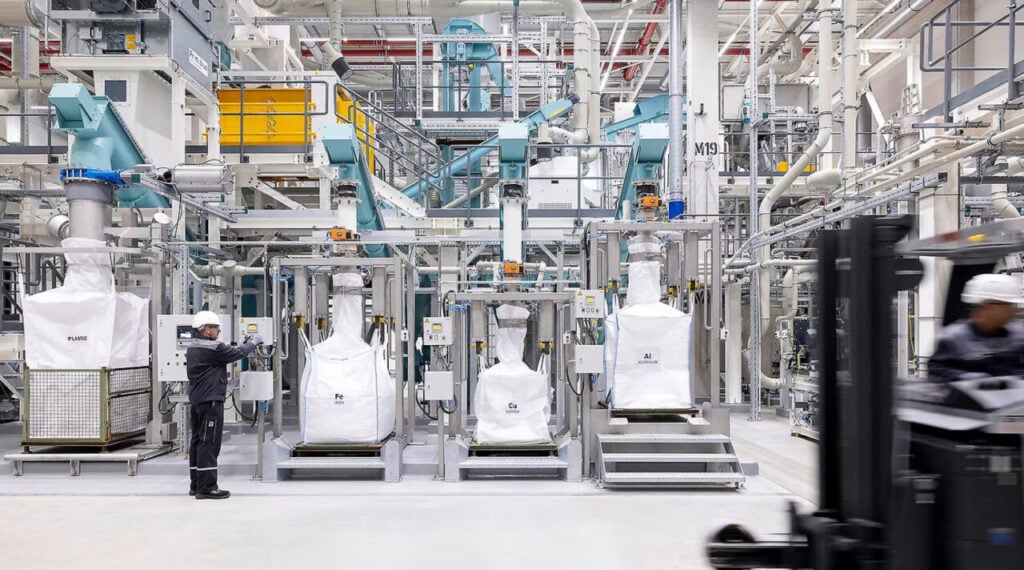
Automotive group Mercedes-Benz has inaugurated what it claimed is the first integrated hydrometallurgical facility in Europe for battery recycling in Baden-Württemberg, Germany.
The firm claimed the facility in the town of Kuppenheim is the first on the continent with an integrated mechanical hydrometallurgical process, and makes it the first car manufacturer worldwide to close the battery recycling loop with its own in-house facility.
Hydrometallurgy is the process by which black mass – shredded battery scrap – is separated into individual metals (primarily lithium, cobalt and nickel) via chemical processes for re-insertion back into the battery manufacturing supply chain.
Many battery recycling facilities already exist in Europe, but these are primarily black mass production facilities, which requires a much lower capital expenditure than hydrometallurgy.
Try Premium for just $1
- Full premium access for the first month at only $1
- Converts to an annual rate after 30 days unless cancelled
- Cancel anytime during the trial period
Premium Benefits
- Expert industry analysis and interviews
- Digital access to PV Tech Power journal
- Exclusive event discounts
Or get the full Premium subscription right away
Or continue reading this article for free
The facility is the first plant to cover all steps from shredding battery modules to drying and processing the active materials, the company said.
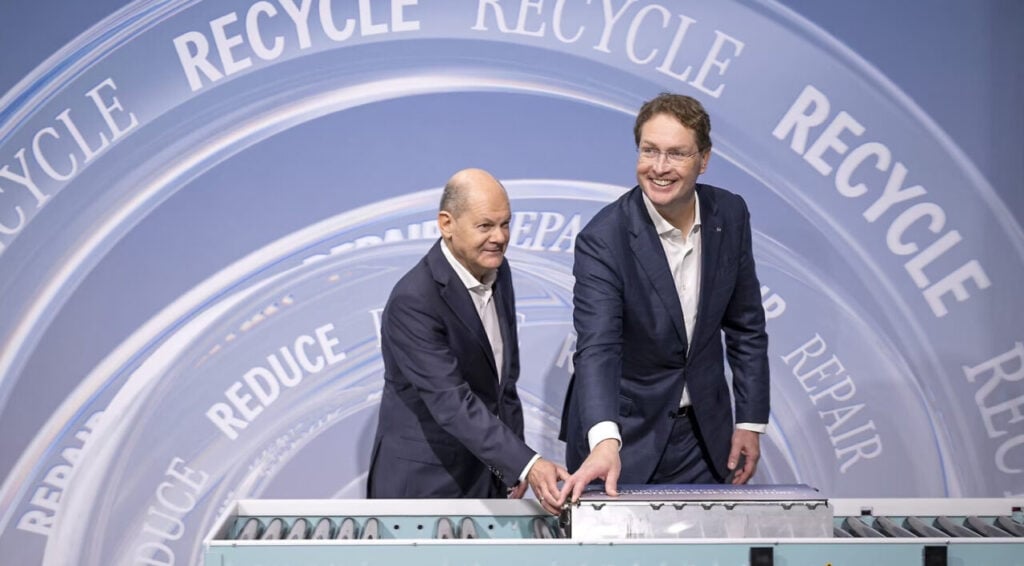
Germany’s Chancellor Olaf Scholz and Baden-Württemberg’s Environment Minister Thekla Walker visited the plant for the opening ceremony.
Scholz commented: “The future of the automobile is electric, and batteries are an essential component of this. To produce batteries in a resource-conserving and sustainable way, recycling is also key. The circular economy is a growth engine and, at the same time, an essential building block for achieving our climate targets! I congratulate Mercedes-Benz for its courage and foresight shown by this investment in Kuppenheim. Germany remains a cutting-edge market for new and innovative technologies.”
Mercedes-Benz collaborated on the project with Primobius, a joint venture between German plant and mechanical engineering company SMS group and Australian process technology developer Neometals. The facility has also received funding from the Federal Ministry for Economic Affairs and Climate Action as part of a scientific research project with three universities in Germany.
Most battery recycling volumes will come from the electric vehicle (EV) market, both end-of-life batteries and scrap from production, with smaller volumes from the battery energy storage systems (BESS) segment.
Europe is building up its lithium-ion battery industry, although there are significant bumps on the road ahead with Northvolt, the most-funded homegrown lithium-ion company, facing significant challenges in ramping up as planned.
Mercedes-Benz is also active in designing and deploying second life BESS with EV batteries via subsidiary Mercedes-Benz Energy – the CEO of that division Gordon Gassmann discussed the second life space in an interview with us last year (Premium access).
Fraunhofer ISE inaugurates battery energy storage research centre
In related news, research organisation Fraunhofer Institute for Solar Energy Systems ISE has inaugurated a Center for Electrical Energy Storage, in the Haid industrial area in Freiburg.
It will conduct research on batteyr materials and cells, develop optimised solutions for BESS and promote their integration into different applications. It will also carry out quality assurance tests on batteries.
Its customers will be material and battery manufacturers, equipment manufacturers, system integrators and operators for electric mobility or stationary BESS. It will also cooperate with industrial partners for recycling and second life BESS concepts, the institute said.
Alongside providing research as a service, Fraunhofer also has a patent for a sodium alumina solid state battery. Last year saw it progress plans for a 100MWh factory to manufacture the technology in partnership with Altech Chemicals.