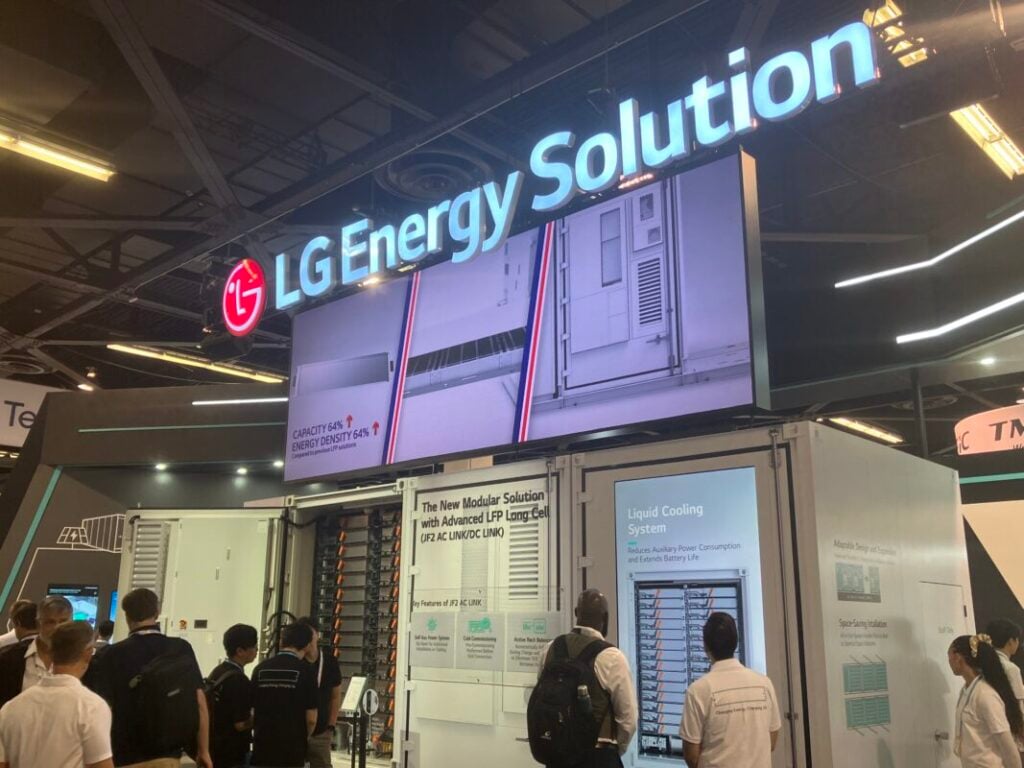
LG Energy Solution has entered into a US$4.3 billion supply agreement with Tesla, announced by the US government, while simultaneously upgrading its EV battery plant with GM for ESS cells.
US government announces US$4.3 billion LG ES and Tesla agreement
The Trump administration announced via the US Department of the Interior (DOI) that South Korean battery manufacturer LG Energy Solution (LG ES) has closed a US$4.3 billion supply agreement with Tesla.
The co-operation between the two was first rumoured last year.
According to the DOI, LG ES will build a lithium iron phosphate (LFP) prismatic battery cell manufacturing facility in Lansing, Michigan, launching production in 2027.
Try Premium for just $1
- Full premium access for the first month at only $1
- Converts to an annual rate after 30 days unless cancelled
- Cancel anytime during the trial period
Premium Benefits
- Expert industry analysis and interviews
- Digital access to PV Tech Power journal
- Exclusive event discounts
Or get the full Premium subscription right away
Or continue reading this article for free
The LFP cells will be used in Tesla’s Megapack 3 energy storage system (ESS) solution, produced in Houston, Texas.
One of LG ES’s factories in Holland, Michigan, previously set up for EV battery cell production, has been reconfigured to enable large-scale manufacturing of energy storage system (ESS) cells.
LG ES Vertech CEO Jaehong Park discussed in March 2025 with ESN Premium about retooling three EV battery production lines, each with a 5.5GWh annual capacity. Park mentioned that only minor renovations were needed, but the different cell designs—such as larger capacity and longer cycle life for stationary storage—likely required the most effort.
The company started manufacturing ESS batteries at the Michigan plant in early May 2025, asserting it is the first US facility to produce LFP batteries on a large scale. An official celebration was held at the site on 24 June to mark the start of production.
South Korean battery manufacturers are more frequently repurposing EV factories or setting up ESS-specific facilities in the US. The latter is partly fueled by the enactment of the ‘One Big Beautiful Act’ and its restrictions on foreign entities of concern (FEOC), while repurposing from EVs is because of a slowdown in EV demand.
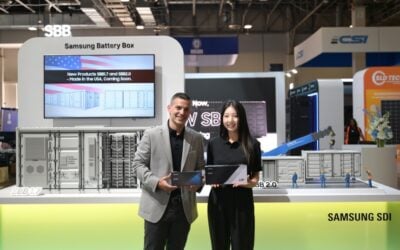
Earlier this week, Samsung SDI announced it secured a US$1 billion deal to provide ESS batteries for an unspecified US energy company. While the recipient was not disclosed, reports from 2025 suggested that Samsung SDI was in negotiations with Tesla for a multi-year, multi-GWh stationary energy storage battery supply contract.
As reported by news agency Reuters, the agreement is part of a broader set of deals highlighted by president Donald Trump’s administration during the Indo-Pacific Energy Security Summit, touted as “American Energy Dominance Powers Security and Growth”.
The agreement was placed under the subheading “Critical Minerals and Supply Chain Security”, which is overshadowed typographically by the subheading of “American ‘Big Beautiful Coal’ Power Resurgence”, which included news of Terra Energy Centre coal plant coming to a US$1 billion agreement in principle with Hyundai Heavy Industries Power Systems to provide large-scale coal power plant boilers for a 1.25GW project in Alaska.
KOREIT, a prominent private equity firm specialising in infrastructure in Korea, invested US$500 million in equity for the Terra Energy Centre coal power plant project.
Furthermore, the US and South Korea are examining a Critical Minerals Memorandum of Understanding (MoU) through the Department of Energy (DOE) to formalise cooperation on the resilience of the critical minerals supply chain.
The US Trade and Development Agency (USTDA) also awarded a grant to Indonesian-owned geothermal developer PT Geo Dipa Energi, supporting a pilot project to extract lithium from geothermal brine at the Dieng geothermal field in Central Java, producing lithium carbonate for battery manufacturing.
LG ES and GM joint venture retooling EV battery plant for ESS
Ultium Cells, the joint venture (JV) between vehicle manufacturer General Motors (GM) and LG ES, is retooling its electric vehicle (EV) battery plant in Spring Hill, Tennessee to manufacture LFP cells for ESS.
Regular readers of Energy-Storage.news may recall our July 2025 reporting that Ultium was planning to upgrade the cell manufacturing facility to scale production of LFP cells.
According to Reuters and news agency Bloomberg, Ultium laid off approximately 700 workers in January, at its Tennessee and Ohio plants, due to a slowdown in EV sales. The company will recall the laid-off workers as it pivots to energy storage battery cells.
Spring Hill was developed to double Ultium’s production of nickel manganese cobalt (NMC) battery cells for GM vehicles such as the Cadillac LYRIQ.
The company said the facility has been designed to enable quick integration and production of multiple cell chemistries.
Last year, Ultium stated the LFP upgrade was built on a US$2.3 billion investment first announced in 2021. Ultium also stated that the conversion of battery cell lines at Spring Hill to produce LFP cells would start later the same year, with commercial production anticipated by late 2027.
ESN asked LG ES for comment on both of these recent announcements, but did not receive a response by the time of publication.
The Energy Storage Summit USA 2026 will be held from 24-25 March 2026, in Dallas, Texas. It features keynote speeches and panel discussions on topics like FEOC challenges, power demand forecasting, and managing the BESS supply chain. ESN Premium subscribers can get an exclusive discount on ticket prices. For complete information, visit the Energy Storage Summit USA website.