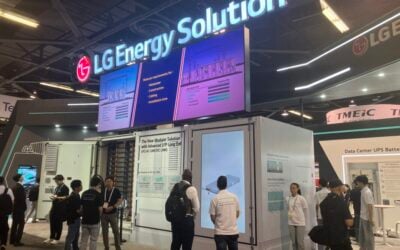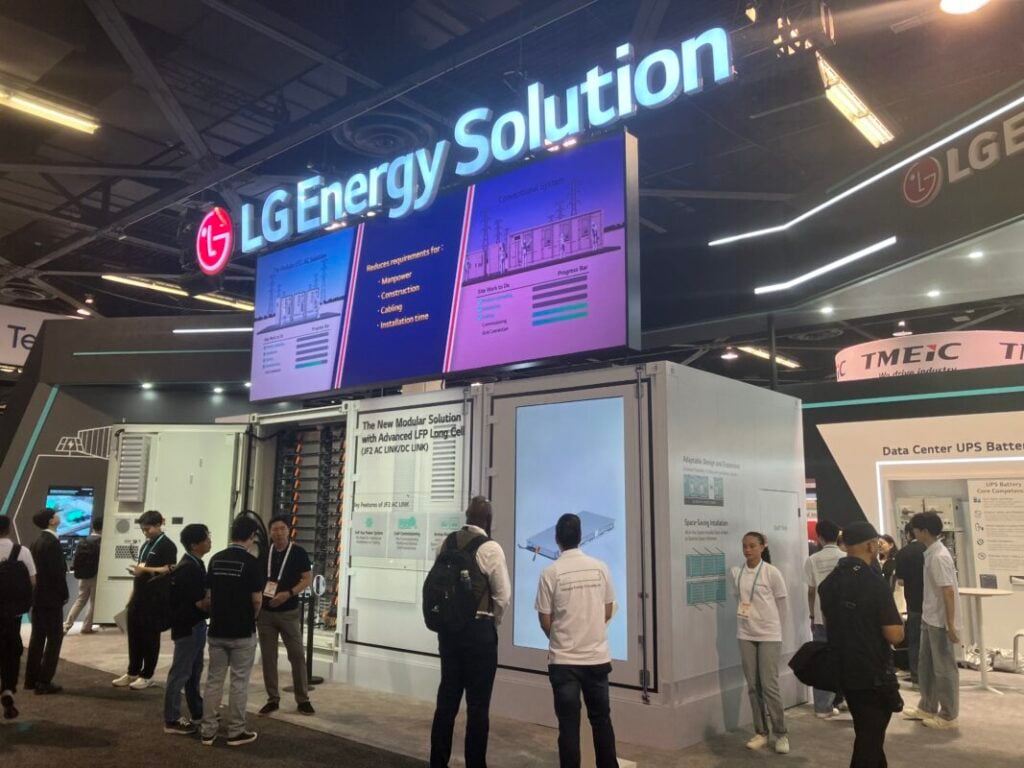
LG Energy Solution will keep global battery cell production at around 300GWh in 2026, while increasing its proportion of supply for energy storage system (ESS) applications.
In the South Korean battery manufacturer’s Q4 2025 results release last week (29 January), LG Energy Solution (LG ES) leadership said the company would ramp up ESS cell production to “more than 60GWh” by the end of 2026, with emphasis on the US.
LG ES also released its full-year 2025 earnings and announced its key initiatives for 2026, including a planned year-over-year Capex reduction of around 40%.
LG ES saw annual revenues decline amid a continued slowdown in US electric vehicle (EV) demand growth. While this was partially offset by stronger performance in the US stationary storage market due to the start of production at dedicated lines in Michigan, investments at the factory complex impacted Q4 profits.
Try Premium for just $1
- Full premium access for the first month at only $1
- Converts to an annual rate after 30 days unless cancelled
- Cancel anytime during the trial period
Premium Benefits
- Expert industry analysis and interviews
- Digital access to PV Tech Power journal
- Exclusive event discounts
Or get the full Premium subscription right away
Or continue reading this article for free
The company reported KRW23.7 trillion (US$16.3 billion) in consolidated revenue for 2025, a 7.6% decline from KRW25.6 trillion in 2024, which in turn was a 24% drop from KRW33.7 trillion in 2023.
Operating profit increased 133.9% from KRW575.4 billion in 2024 to KRW1.3 trillion, propelled in part by its first-mover advantage in being a major domestic supplier of lithium iron phosphate (LFP) cells to the US battery energy storage system (BESS) sector.
However, although it was able to avail of KRW332.8 billion in production incentives in the US in Q4, investment in repurposing nickel manganese cobalt (NMC) EV cell production lines at its Holland, Michigan, factory contributed to a quarterly loss of KRW122 billion and an operating profit margin declining quarter-on-quarter from 10.5% in Q3 2025 to -2%.
Meanwhile, the US government’s withdrawal of tax credits for electric vehicles from September 2025 meant that production incentives accrued declined 9% quarter-on-quarter.
90GWh target for 2026
“In 2025, the EV market was heavily impacted by the policy changes,” CFO Chang Sil Lee said in an earnings call to explain results.
“In 2026 we expect [EV] growth to continue at least around 10%, although becoming more moderate than the past.”
In the ESS sector, the LG ES CFO said the company forecasts annual demand growth of more than 40% this year, driven by “industrial electrification and growing cooling and heating demand due to climate change,” as well as increased power consumption and the growing deployment of renewable energy.
Chang Sil Lee added that rising power demand, the need for grid stability and AI and data centre developments “are all factors triggering structural growth of the ESS market.”
The CFO said LG ES expects the ESS market to comprise around half of all battery demand in North America, with investment tax credit (ITC) policies in the US a major factor in that growth.
The order backlog in the ESS segment stood at 140GWh by the end of 2025, and LG ES targets adding a further 90GWh in new ESS orders this year on top of turnkey project solutions, primarily from utilities and developers in North America.
Yesterday, (3 February) the company’s US energy storage system integrator subsidiary LG ES Vertech and solar and storage technology provider Qcells’s project arm announced a 5GWh US deal, on which more will follow on Energy-Storage.news.
That being said, while LG ES claimed it could capture half of the US BESS market’s demand in 2026, the company has also opened 5GWh of ESS cell production at its site in Oh Chang, Korea, and has also retooled some EV production capacity in Poland.
It could repurpose more still at its Polish site in a proactive response to demand, the company said, while lines in China could be used to support entry or market expansion in grid storage markets in Australia and Japan.
Under Joe Biden’s Democrats, the US market was already shifting to an emphasis on domestic content and stimulating onshoring of supply chains, in tandem with reduced dependence on imported products primarily from China, through higher Section 301 import tariffs, taking an approach that industry veteran Andy Tang described in 2024 as a blend of “carrot and stick” policies.
However, the Republicans under Donald Trump have also introduced new foreign entity of concern (FEOC) rules for production tax credit (PTC) and investment tax credit (ITC) incentives, which rule out the use of Chinese products over a certain threshold of material assistance.
The threshold is considered prohibitive for the use of battery cells, which comprise a high proportion of BESS costs. LG Energy Solution and fellow Korean manufacturers Samsung SDI and SK On all had existing investments in EV cell production in the US to varying degrees, which have given them a competitive advantage in the domestic content market.
Some industry experts have forecast that these producers alone could potentially make enough cells to meet US demand fairly quickly, although there does appear to be some uncertainty over the fate of downstream US battery manufacturing for BESS applications.
LG ES Capex streamlining contrasts with Tesla’s 2026 plans
As noted by Solar Media Market Research analyst Charlotte Gisbourne in our reporting of Tesla’s Q4 2025 and full-year results on Monday, cell manufacturing has become “a key talking point when it comes to the future of the energy storage market” in the US.
“Both companies are pushing to increase cell capacity” in the US, Gisbourne noted, although the companies are showing diverging plans moving forward.
While Tesla remains largely dependent on third-party suppliers for its BESS cells and is at the early stages of ramping its first LFP lines in Nevada with 7GWh annual output, LG ES has already opened its 17GWh lines in Michigan and will also retool some of its EV lines built through joint ventures (JVs) with Stellantis and Honda.
CFO Chang Sil Lee said the retooling strategy would enable LG ES to ramp without “incurring significant costs” in 2026.
ESS battery planning division representative Kim Min-Su highlighted that the company’s upstream activities include securing greater quantities of cathode materials from Indonesian suppliers, with the Southeast Asia country recently emerging as a key player.
On the other hand, Tesla just announced that 2026 would be a Capex-heavy year, with investments in the upstream battery space—LFP lines, cathode materials production and a lithium refinery among them—alongside major investments in AI, humanoid robots and self-driving cars and taxis.
“LG ES appears to be erring on the side of caution, aiming to minimise new investments and wants to reduce capex by more than 40% in 2026 while utilising some existing factories for ESS,” Gisbourne said.
“Tesla, on the other hand, is aiming to ramp up six new production lines and estimates a steep rise in capex to over US$20 billion [for 2026],” Gisbourne said, adding that although the investments include increased production of the Megapack BESS solution, “the majority of the focus appears to be on AI and robotics.”
The Energy Storage Summit USA will be held from 24-25 March 2026, in Dallas, TX. It features keynote speeches and panel discussions on topics like FEOC challenges, power demand forecasting, and managing the BESS supply chain. ESN Premium subscribers can get an exclusive discount. For complete information, visit the Energy Storage Summit USA website.
The headline and body text of this article have been amended from their original form to reflect LG ES company and executive statements more accurately.