
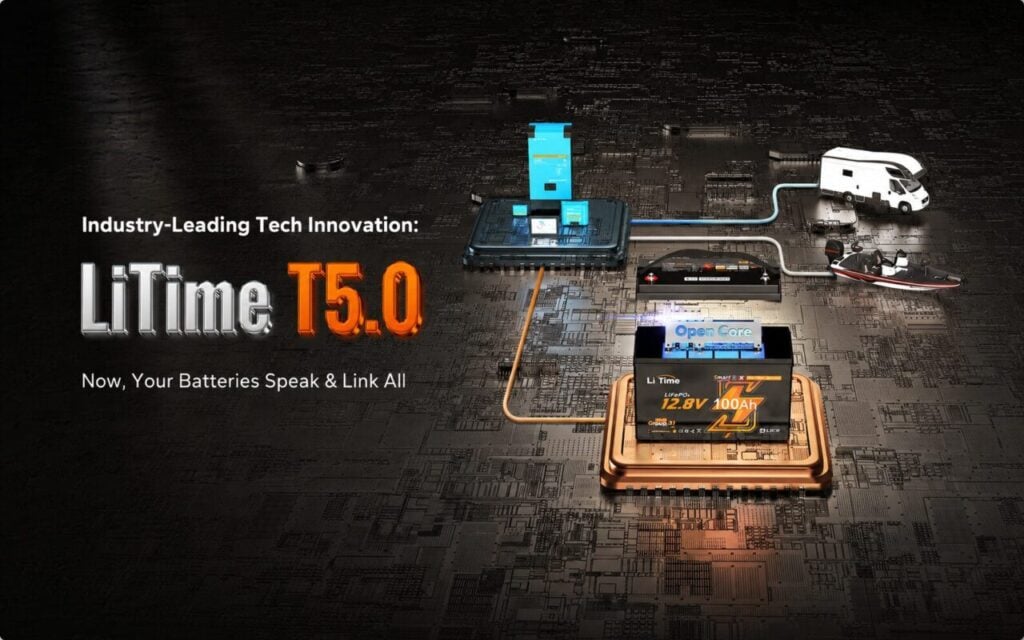
Distributed energy storage systems are becoming increasingly modular. An off-grid home, residential backup installation, recreational vehicle or marine energy system may combine batteries, solar charge controllers, inverter-chargers, displays and monitoring platforms from different manufacturers. Although each device can operate independently, overall system performance depends on whether these components can exchange accurate information and respond to the battery’s condition.
In a conventional architecture, the battery stores and supplies energy while the inverter or charger operates according to preset voltage and current parameters. State of charge may be estimated from battery voltage or an external shunt, and users may need to access several platforms to monitor different components.
This approach can meet basic power requirements, but it does not fully use the real-time data generated by a modern BMS. A BMS continuously monitors pack voltage, current, temperature, state of charge, individual cell voltage and protection status, using this information to determine the battery’s permissible charging and discharging limits. If these parameters cannot be communicated to the wider system, the inverter and charger must continue operating according to fixed settings, which can reduce state-of-charge accuracy, limit charging and discharging optimisation, and increase complexity during commissioning, fault diagnosis and system expansion.
The key issue is therefore not simply whether battery data is available, but whether it can actively inform system control.
Communication-enabled batteries change the relationship between the battery, inverter and charging equipment. The BMS can report state of charge, temperature, charge voltage limits and charge and discharge current limits to the energy management system, allowing an inverter or inverter-charger to adjust its operation according to the battery’s real-time condition.
Rather than relying continuously on fixed parameters, the wider system can use BMS data to adapt its charging and discharging strategy. If the battery approaches an operating limit or detects an abnormal condition, the system can respond before a hard protection shutdown occurs.
CAN and RS485 interfaces allow batteries to exchange information with inverters, energy management platforms and other compatible equipment. However, the presence of a physical communication port does not by itself guarantee interoperability. The battery, inverter and controller must also be aligned on data formats, device addressing, message definitions, alarm codes, firmware versions and system behaviour following communication loss.
Communication therefore provides more than additional monitoring, allowing the operating limits calculated by the BMS to be recognised and acted upon by the wider energy system.
Many energy storage systems are built around relatively closed device ecosystems. Using batteries, inverters and controllers from one manufacturer can simplify configuration, but it may also restrict component choice. Functional equipment may still need to be replaced if it cannot communicate with a newly added device.
An open or configurable communication architecture offers an alternative. By supporting multiple protocols or device profiles, a battery can connect with different inverter brands, energy management platforms and monitoring systems. Compatibility can then be expanded through protocol development, firmware updates and system validation rather than remaining permanently limited by hardware.
For users and system integrators, this can provide:
- Greater flexibility in component selection;
- Lower integration costs and fewer replacements caused by compatibility issues;
- Less dependence on a single equipment ecosystem;
- Simpler system expansion and upgrading; and
- A longer useful service period for installed equipment.
Open communication does not mean that any battery can connect directly to any inverter. Each product combination still requires protocol adaptation, testing and validation. However, a configurable platform creates greater flexibility for cross-brand integration and future upgrades.
LiTime developed T5.0 to support the transition of LiFePO₄ batteries from standalone storage devices into coordinated components within connected energy systems. The platform integrates CAN and RS485 communication into the BMS and supports Bluetooth monitoring and over-the-air (OTA) firmware updates. These capabilities are incorporated into LiTime’s Smart ComFlex battery series, allowing the batteries to exchange data with inverter-chargers, local displays and third-party energy management platforms, depending on the system configuration.
OTA functionality allows LiTime to add communication profiles, refine data-processing logic and expand third-party compatibility after installation, reducing the need to replace battery hardware when protocols or external equipment change.
When connected to a compatible Victron system, Smart ComFlex batteries can transmit more than 25 battery parameters and operating limits, depending on the model and configuration.
These include:
- State of charge;
- Pack voltage and current;
- Battery and cell temperature;
- Individual cell status;
- Charge voltage limits;
- Charge and discharge current limits; and
- Protection status and abnormal-condition alerts.
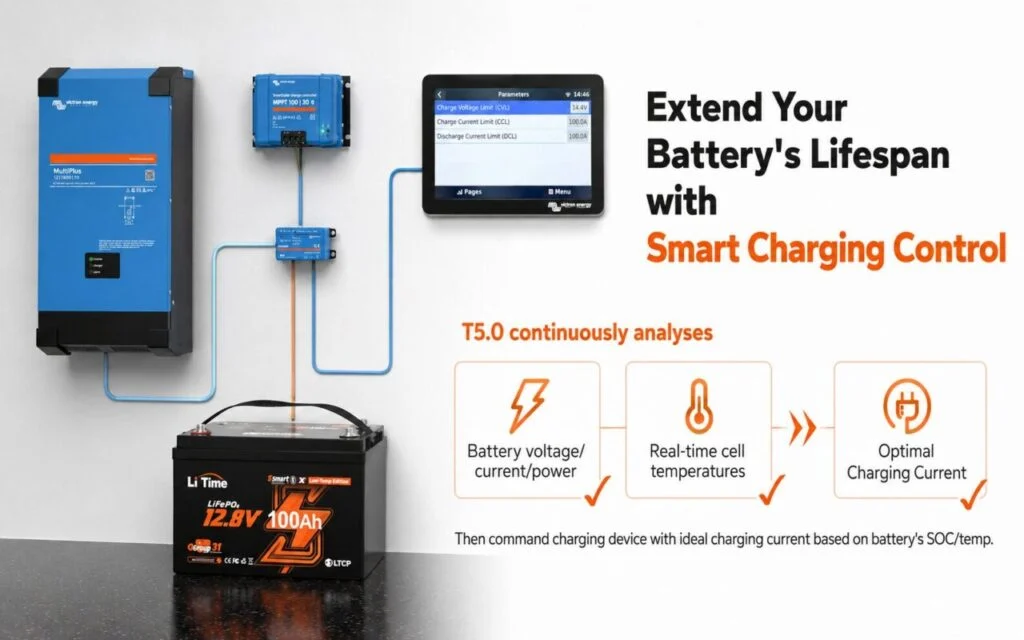
The Victron system can use this information to adjust charging and discharging strategies, while users can monitor the battery, inverter, solar charge controller and other connected equipment through a local GX display or the Victron Remote Management platform.
Through its native CAN interface, the battery can report state of charge and operating information directly to a compatible Victron system without requiring an additional external BMS or Victron SmartShunt. By dynamically calculating an appropriate charging current based on real-time state of charge and temperature, the system can help reduce unnecessary charging stress and support longer battery service life. Battery alerts can also be displayed alongside data from other connected devices, simplifying monitoring, commissioning and fault diagnosis.
The 12.8V 100Ah model provides 1.28kWh of nominal energy per battery and is designed for recreational vehicles, marine systems and smaller off-grid installations. Up to 16 batteries can be connected in parallel in communication mode, providing up to 20.48kWh of nominal storage capacity. CAN and RS485 interfaces support data exchange with compatible energy management and monitoring equipment.
The 25.6V 100Ah model provides 2.56kWh of nominal energy per battery and is intended for higher-power recreational vehicle, marine and compact off-grid systems. Up to 16 batteries can operate in parallel with communication, providing up to 40.96kWh of nominal storage capacity. The battery can also work with compatible Victron equipment and LiTime’s 24V inverter-charger platform.
The 51.2V 100Ah model provides 5.12kWh of nominal energy per battery and is designed for off-grid homes, container homes, residential backup systems and other higher-capacity distributed energy applications. Up to 16 batteries can be connected in parallel with communication, expanding nominal storage capacity to 81.92kWh. The battery can communicate with compatible Victron systems and LiTime’s 48V solar inverter-charging equipment.
Extending T5.0 across three voltage classes allows the same external communication capabilities to support a broader range of power, capacity and application requirements.
Battery chemistry, cell quality and power electronics remain fundamental to energy storage performance. However, as distributed systems become more modular and remotely managed, communication increasingly determines how effectively these components work together.
In smaller systems, communication can reduce the need for external monitoring components, simplify commissioning, improve state-of-charge accuracy and support earlier fault detection. In larger off-grid and residential installations, it can also enable dynamic charging, coordinated protection, remote diagnostics and scalable multi-battery management.
The next stage of distributed energy storage will therefore be defined not only by storage capacity, but also by how accurately batteries communicate their condition, how effectively the wider system responds and how easily equipment from different manufacturers can operate together. Moving from isolated devices towards connected and coordinated energy systems can improve the flexibility, serviceability and operating efficiency of distributed energy storage.
