
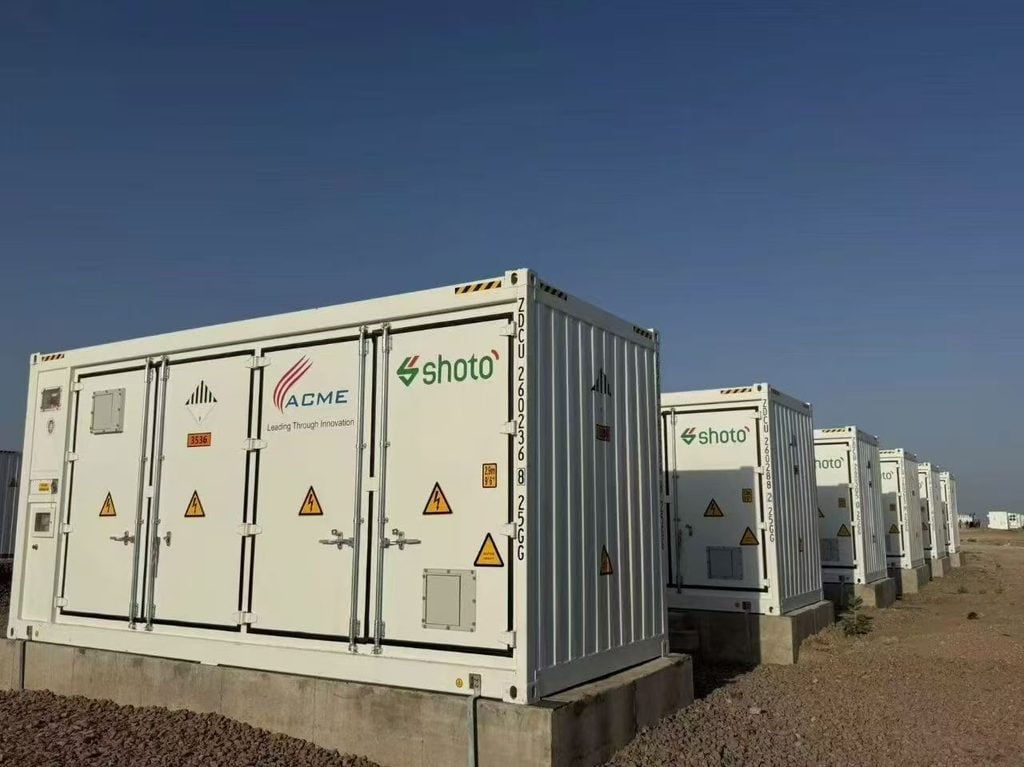
In October, rows of storage containers were running in the countryside of Rawatbhata, Chittorgarh district, Rajasthan, next to the Rawatbhata Atomic Power Project (RAPS). This is ACME’s 100MW/400MWh battery storage project. Its size alone is not striking; what Indian peers keep discussing is how it was financed – a syndicate of domestic institutions including the State Bank of India (SBI), ICICI Bank and Axis Bank extended credit on a non-recourse project-finance basis.
In solar, that structure took more than a decade to become routine; applied to battery assets whose main revenue comes from buying power cheap and selling it dear, Indian banks made it work in 2026.
Indian media reports note that the arrangement ‘highlights the growing role of institutional funding in supporting large-scale energy storage infrastructure in India’, framing it as technology suppliers, renewable developers and financial institutions working together. A 400MWh project’s financing keeps being cited because it is close to a replicable template.
According to the Central Electricity Authority’s National Electricity Plan, India will need 208GWh of storage by 2030 to absorb its renewable build-out. Policy support kept accumulating through 2026, with the Union Cabinet approving the GEC-III transmission programme, with INR 1.36 trillion for intra-state transmission and INR 50,000 crore earmarked for 50GWh of storage. The Ministry of Power allowed storage to absorb curtailed renewable generation while grid connectivity was delayed and to resell it in the market and CTUIL is accelerating storage connectivity through the non-ROFR route. On the tender side, roughly 50GWh of assured peak-power tenders had been floated through September 2027, with another 200-250GWh of short-term peak tenders expected in the near term.
Demand is pulling too. Rooftop and C&I solar push midday net load towards zero, while an evening peak gap of about 300GWh will rise to 400-500GWh within a few years. Solar alone cannot serve that ramp, so round-the-clock storage-backed supply is priced at several times the plain solar tariff. That is why developers raced to install batteries first in 2026 – batteries come online first, solar catches up, and short-term peak contracts hold the revenue.
The difficulty is comparable data. Solar output can be estimated ex ante and banks hold more than a decade of it, with battery degradation, cycle life and balance-of-plant reliability still lacking a long record. To address this challenge, Indian practice stacks three requirements: third-party technical due diligence (DNV, Bureau Veritas or CRISIL, eight to twelve weeks at INR 150,000-300,000) before drawdown; performance warranties issued by an entity with real net worth, with guarantees from small integrators rejected; and a six-month debt service reserve account plus debt service coverage of 1.15-1.35x.
Lenders are tiered as well. IREDA is the most active storage project lender in 2026, at roughly 9.0-10.5% for 15 years and 70-75% of project cost; the SBI group, led by SBI Capital Markets, arranges syndications of INR 300-800 crore; PFC and REC cover projects above INR 500 crore at larger scale. Those terms decide how the same battery system performs on different developers’ balance sheets.
As one of India’s leading independent power producers, ACME Solar (NSE: ACMESOLAR) reported a project portfolio of 8.37 GW across 11 states in the second quarter of this year, including roughly 20 GWh of energy storage capacity. On its October 2026 earnings call, ACME raised its guidance for cumulative commissioned energy storage capacity to more than 12 GWh by the end of March 2027, up from the prior target of 10 GWh.
The jump from 400 MWh to 12 GWh underscores that a corporate energy storage financing template is taking shape in India through ACME’s rapid expansion.
The first batch is the 100MW/400MWh project, held by ACME Solar Holdings Limited at Rawatbhata in Chittorgarh district, next to RAPS, financed by a syndicate led by SBI and ICICI Bank together with local green-finance institutions, on a non-recourse basis.
The second batch totals about 500MWh across two sites: 241MWh at Kelan in Bikaner district’s Chhatargarh and 296MWh at Pokhran in Jaisalmer district, under ACME Greentech Seventh, with ICICI Bank extending non-recourse credit at project level.
The third batch is at 1GWh scale, including 968MWh at Neemach in Chittorgarh district, held by ACME Sigma Urja, with ICICI Bank, Axis Bank and SBI participating on non-recourse terms.
All three packages sit inside FDRE and hybrid projects: batteries are commissioned first, solar follows, short-term peak contracts generate early revenue and long-term PPAs take over. ACME plans to reach more than 12GWh of cumulative commissioned storage by the end of March 2027, the sample the market will use to judge whether this financing structure can scale.
ACME finances at project level, and a single project often runs equipment from several suppliers. Shoto (HKEX: 06960), for one, has about 1.9GWh of systems installed across these sites, where batteries from other suppliers also operate. For lenders the core question is not who supplied the hardware but who signs the performance warranty and whether the delivery record can be verified.
In addition to its arrangements with Shoto, ACME has secured about 19 GWh of battery supply from leading suppliers including CATL, Hithium, Trina and Lishen. ACME sources from multiple suppliers and uses bankability as a selection criterion. Shoto supplied a four-hour system for ACME’s 100MW/400MWh Rajasthan project, customised for Indian grid codes and local heat, drought and dust and reported about RMB 398 million of new-power storage revenue in the first half of 2026, up 354.7% year on year.
ACME raised its cumulative storage commissioning guidance to more than 12GWh by the end of March 2027 from 10GWh, with about 12GWh more in FY2028 and more than INR 1,500 crore of FY2028 storage revenue already contracted, covering 50-60% of that year’s capacity. Signed and awarded projects underpin the target: SECI’s 300MW/1,200MWh (ACME Greentech Twenty, at INR 6.00/kWh), NTPC’s 400MW FDRE (duration raised from four to 4.5 hours), SJVN’s 450MW/1,800MWh and NHPC’s 400MW FDRE (ACME Venus Urja).
According to its financial disclosures, ACME doubled its 2030 storage target from 25 GWh to 50 GWh and raised its generation capacity target from 10 GW to 15 GW. India’s Central Electricity Authority projects in its National Electricity Plan that the country will need 208 GWh of storage by 2030. The constraint is therefore not demand but whether banks can value a battery the way they value a solar plant, which is what FY2027 will test.
From 400MWh to 12GWh, Indian storage companies are completing one transition: turning batteries from equipment purchases into bankable assets. Volume procurement drives cost down, long-term and peak contracts lock revenue in, and project-level non-recourse debt ring-fences risk inside project companies. Once those three steps work, the template no longer depends on a single developer.
For suppliers, being written into it depends on performance warranties, delivery records and real-world validation in hot, arid conditions; the 400 MWh Rajasthan project is the first such case that lenders have assessed in full.
