
Africa stands at a defining moment in its economic development journey.
Across the continent, governments are pursuing ambitious plans to expand manufacturing, strengthen mining operations, develop industrial parks, attract digital infrastructure investments and accelerate economic growth. Yet despite abundant natural resources, growing energy demand and increasing investor interest, one challenge continues to stand in the way of progress: reliable power infrastructure.
For years, Africa’s energy conversation centred on electrification and expanding access to electricity. Today, the discussion has evolved. The priority is no longer simply generating more power – it is creating resilient energy systems capable of supporting industrialization, attracting investment and enabling long-term economic transformation.
These themes were at the centre of many conversations among government leaders, investors, utilities, developers and technology providers during recent discussions at the 2026 Africa Energy Forum in Cape Town.
While the topics ranged from infrastructure financing and industrial development to renewable energy integration and grid modernization, a common message consistently emerged: Africa’s challenge is no longer a lack of ambition. The challenge is creating the infrastructure foundation that can transform ambition into bankable projects and sustainable economic growth.
Participants highlighted that many industrial projects do not fail because of insufficient demand or limited investor interest. Instead, they often struggle with power reliability, grid constraints and uncertainty around long-term infrastructure planning.
Another important takeaway was the growing recognition that energy storage should no longer be viewed solely as a renewable energy technology. Increasingly, it is being recognized as critical infrastructure capable of improving grid stability, reducing investment risk, enhancing project economics and supporting industrial development across the continent.
The discussion also reinforced a key reality facing many African markets today: capital is available for well-structured projects. What investors increasingly seek is policy consistency, regulatory certainty and infrastructure solutions that can deliver predictable long-term performance.
In many ways, Africa’s industrial future will be shaped not only by how much energy is generated, but by how effectively that energy can be delivered, stored and managed to support economic growth.
Battery Energy Storage Systems (BESS) are rapidly becoming one of the most important enablers of Africa’s energy transition.
Historically viewed as a supporting technology for renewable energy, storage is now evolving into a strategic infrastructure asset that strengthens grid stability, improves renewable integration, enhances energy security and increases the reliability of power systems.
More importantly, energy storage is transforming project economics.
As battery costs continue to decline and performance continues to improve, storage is helping developers and investors create more bankable projects. By reducing intermittency, improving power quality, and increasing asset utilization, BESS can enhance both operational performance and long-term financial returns.
For industries such as mining, manufacturing, industrial processing, telecommunications and emerging data centre developments, reliable power is no longer simply an operational requirement—it is a competitive advantage.
The question facing Africa is no longer whether energy storage is needed.
The question is how quickly deployment can be accelerated to support the continent’s industrial ambitions.
Across Africa, energy storage projects are already proving their value in real-world applications.
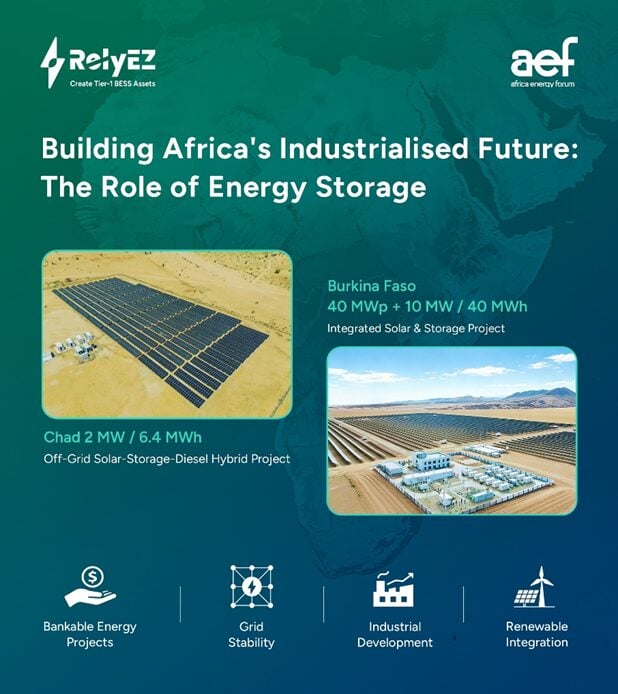
In Chad, a 2MW/6.4MWh solar-storage-diesel microgrid project is helping address power shortages, improve energy reliability and reduce fuel consumption. As one of the country’s first lithium battery-based microgrid projects, it demonstrates how advanced storage solutions can support electrification while laying the foundation for economic development.
In Kenya, energy storage technologies are supporting off-grid microgrid deployments that provide reliable electricity access to remote communities while enabling greater integration of renewable energy resources.
In Burkina Faso, a 40MWp solar project paired with a 40MWh BESS highlights how storage can strengthen grid resilience and improve the performance of renewable energy assets.
Meanwhile, ongoing renewable energy initiatives in Zimbabwe and Zambia continue to demonstrate the growing demand for storage-enabled infrastructure capable of supporting industrial expansion and economic growth.
The lessons from these projects are reinforced by some of the world’s largest energy storage deployments.
One notable example is the 500MW/2000MWh standalone energy storage project in Inner Mongolia, China. As one of the largest projects of its kind globally, it demonstrates how utility-scale storage can provide grid flexibility, support renewable integration, enhance system reliability and create long-term value for power systems operating at scale.
These projects demonstrate a clear reality: energy storage is no longer an emerging technology. It is proven infrastructure capable of supporting the next generation of energy systems.
As the market matures, successful projects will require more than equipment alone.
Developers, investors, utilities and governments are increasingly looking for solutions that combine technology, engineering expertise, project development capabilities, operational excellence and long-term asset management.
This is where full-lifecycle energy storage providers can play a critical role.
RelyEZ is a global full-lifecycle energy storage solutions provider focused on creating Tier-1 BESS assets across utility-scale, commercial & industrial, microgrid and renewable integration applications.
The company delivers end-to-end solutions covering project development, engineering, system integration, deployment, commissioning, operation and asset optimization.
Its portfolio includes the GridUltra liquid-cooled utility-scale BESS platform, advanced Grid-Forming technology, EnergyHub EMS, EnergyCloud digital management platform, microgrid solutions and integrated energy storage systems designed to maximize reliability, safety and long-term project value.
Today, RelyEZ has delivered more than 10GWh of energy storage projects globally, with operations spanning more than 30 countries and regions. The company has established a strong track record across utility-scale, microgrid, renewable integration and grid-support applications while maintaining a zero-major-incident safety record.
As energy systems become increasingly complex, the industry is moving beyond simply deploying batteries. The focus is shifting toward creating reliable, financeable and high-performing energy assets capable of generating value throughout their operational life cycle.
Africa possesses many of the ingredients required for industrial success: abundant renewable resources, critical minerals, a growing workforce, expanding markets and increasing investment interest.
What remains is the infrastructure capable of unlocking that potential.
The conversations taking place across Africa’s energy sector today are no longer focused solely on electrification. They are increasingly focused on industrial competitiveness, investment readiness and economic transformation.
The message emerging from policymakers, investors, developers and industry leaders is clear: reliable energy infrastructure is no longer optional. It is the foundation upon which Africa’s next phase of industrial growth will be built.
The opportunity is immense.
The technology is available.
The capital is interested.
The next chapter of Africa’s industrial future depends on turning those advantages into investable, resilient and reliable energy infrastructure capable of powering sustainable economic growth for decades to come.
