
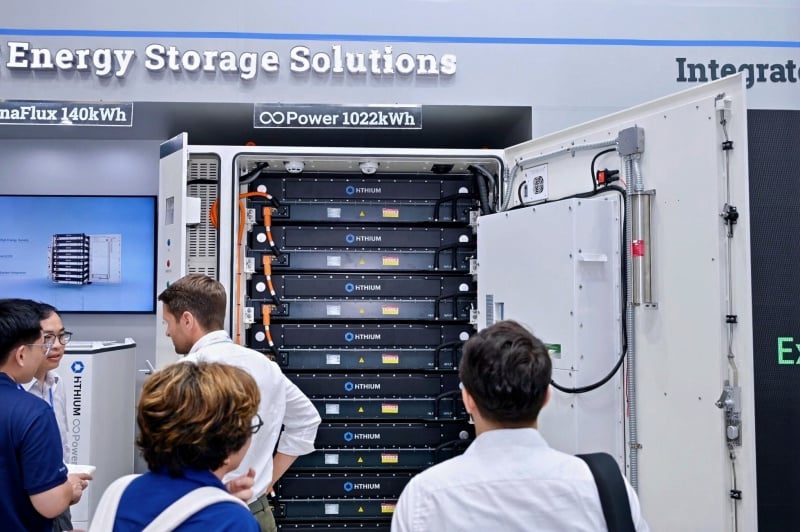
A shift is happening in Europe’s commercial & industrial (C&I) energy storage market, and integrated energy storage solutions provider Hithium is addressing this demand with a purpose-built 4-hour solution.
We caught up with the company at the at the Smarter E Europe trade show in Germany last month to discuss its view of the market and the technology underpinning its new solutions.
We also discussed its residential/commercial & industrial (C&I) product, which we will publish a separate piece on in the next few days.
Energy-Storage.news: To start with, before we get into Hithium’s products, how would you characterise the European C&I storage market?
Try Premium for just $1
- Full premium access for the first month at only $1
- Converts to an annual rate after 30 days unless cancelled
- Cancel anytime during the trial period
Premium Benefits
- Expert industry analysis and interviews
- Digital access to PV Tech Power journal
- Exclusive event discounts
Or get the full Premium subscription right away
Or continue reading this article for free
Hithium: We think it’s a very active market, and we can see it’s becoming more active in recent years. I believe the reason is that many investors in renewable energy have started to suffer from negative prices on the grid, and they want to ensure their previous investments get paid back. Now they want to add energy storage systems to their previous investments, whether in wind, solar, or biomass, as a way to achieve greater ROI on their investment. When everybody started to realise that adding energy storage systems can increase their return on investment, they started to purchase BESS, and that’s why we see this booming demand in the European market. I think it’s going to continue for a couple of years until all the demand and gaps are filled.
It’s really a renewable energy-driven market, so all the demand actually comes from renewable energy penetration—the high penetration of renewable energy drives both utility and C&I markets. For utilities, there are large PV farms and wind farms that need utility-scale products, but there are also many smaller investors or smaller companies running PV farms, and these people also need to increase their return on investment. The C&I cabinet or C&I systems would be their best choice, because they’re small, connected to low-voltage PCS solutions with 400 Vac, and easy to move, store, and commission. We see this market—C&I systems will be a perfect match for previous investments in PV.
What about energy prices as well? As I understand it, many C&I users see batteries as a way to mitigate against energy price volatility.
That’s also a big driver of demand. First of all, European energy prices have been rising because of war and international tensions. Another factor is the price drop for lithium-ion batteries—battery and BESS costs have fallen sharply, especially for stationary storage. That makes many investments possible, because previously, if you calculated ROI, you might need 10-20 years to get your investment back with batteries. But now, with high energy prices on one end and low device prices on the other, many investments become possible, and investors can get their investment back within seven or even five years. I’ve heard customers tell me they can get their investment back in three years in some markets, so it’s a very attractive market for small investors.
Bearing all that in mind, what led you to launch the ∞Power 1,022kWh?
We’re launching this product this year, and I believe it matches the demand in Europe. As I said, this is a renewable energy-driven market, and most renewable energy is solar. Solar energy has a peak period during the day of about four hours. The German market is currently suffering from negative rates because of too much solar power in the market. People need energy storage within those four hours to ensure they don’t lose money on the energy they generate.
Previously we had two-hour systems, which aren’t enough for customers. They need to store energy for the entire four hours, and if they use a two-hour system, they have to pay maybe 20% extra, because two-hour systems are more expensive. I saw this demand and thought I could design a C&I cabinet with four hours—a native four-hour battery cell—with a more competitive price. We’ll be more attractive to customers because, with maybe 20% less investment, they’re more interested in investing. It will increase their intention to buy BESS.
Even though many people realise BESS can help them get their investment back, some are still waiting—waiting for prices to keep dropping. But actually this year the pace of price decline is slowing, while raw material volatility is returning. People are waiting longer, but I believe this 1MWh cabinet can give them a chance to start investing, because we’re cutting the price by 20%, and it will be a good opportunity to invest.
What market segments are you targeting with it?
I would say mostly the PV market—those who need to recoup their PV investment—and those doing energy arbitrage. I know there’s a lot of value in the frequency market, but this product isn’t designed for frequency regulation. It’s more designed for arbitrage and PV buffering, so it might be less profitable, but it actually helps more people, because many people need PV buffering.
I think this product is more for customers without dedicated trading or market-operations teams, because companies doing frequency markets are very professional, they have their software and teams. There are many small corporations who invest in PV who just need a simple solution, and I think this 1,022kWh system can help them with a simple, plug-and-play solution.
Why the 4-hour duration / 1,175Ah cell?
The most important reason is system cost. With the larger cell, we can have 73% fewer components in the system, and we can cut key components to a quarter. We used to need four liquid cooling units, four PCS units, or four fire suppression systems in a 280Ah system if you wanted to make a 1MWh system. But with this cabinet, you only need one set of everything. That means 75% fewer high-value components.
Also, the RTE—round-trip efficiency—is higher because it’s a more integrated cabinet with a higher-efficiency liquid cooling unit, which gives even more return on investment for the customer. Choosing the bigger cells makes all this happen. Using smaller cells never gave us the chance to reduce the price. As you can see, the mainstream product, the 280Ah, has a lot of competition in the market, and people are cutting prices and discounting their products, but the 280Ah is at the bottom line of the price range—it cannot go any lower. But with this new product, with new factory cells, a further price cut becomes possible.
What else sets it apart from other products in the market?
One thing, as I just mentioned, is efficiency. This bigger system makes efficiency high, and efficiency is actually very important during long-term operation. Also, the land-saving feature is another important aspect of this product. We designed the liquid cooling unit on the front door, so all the air intake and exhaust are at the front. You don’t need any ventilation space at the back or sides, so you can put them side by side and back-to-back. That saves a lot of space. Investment in the device itself is one cost, and investment in land is another, so if you can save land, you’re also saving cost for the customer.
Efficiency can go up to 90% under defined operating condition, which is really good—no 280Ah system can reach that. It’s possible with this large system which reduces thermal management auxiliary consumption by up to 40%. There’s one more thing: under a 0.25P long-duration operating profile, the large-capacity cell platform helps reduce system complexity and connection losses, supporting higher DC-side efficiency and better thermal consistency. Adding those together gives us 2-3% more efficiency, which helps a lot.
Anything else you want to add on the new product?
Yes, one thing about the EMS. We used to believe that EMS is something we need to find locally—we’d have to purchase a local EMS from Europe. But now we realise that for smaller projects like C&I projects, Hithium can provide an integrated EMS that supports PV self-consumption, peak shaving, basic arbitrage and remote O&M. For more advanced market participation, the system can be integrated with local EMS platforms, aggregators or trading partners according to project requirements, that helps customers do simple arbitrage and energy trading. That’s also something we want to offer customers—they can save money on the EMS and get better service from Hithium. I think that’s also one thing that comes with the new product that’s noticeable.
