
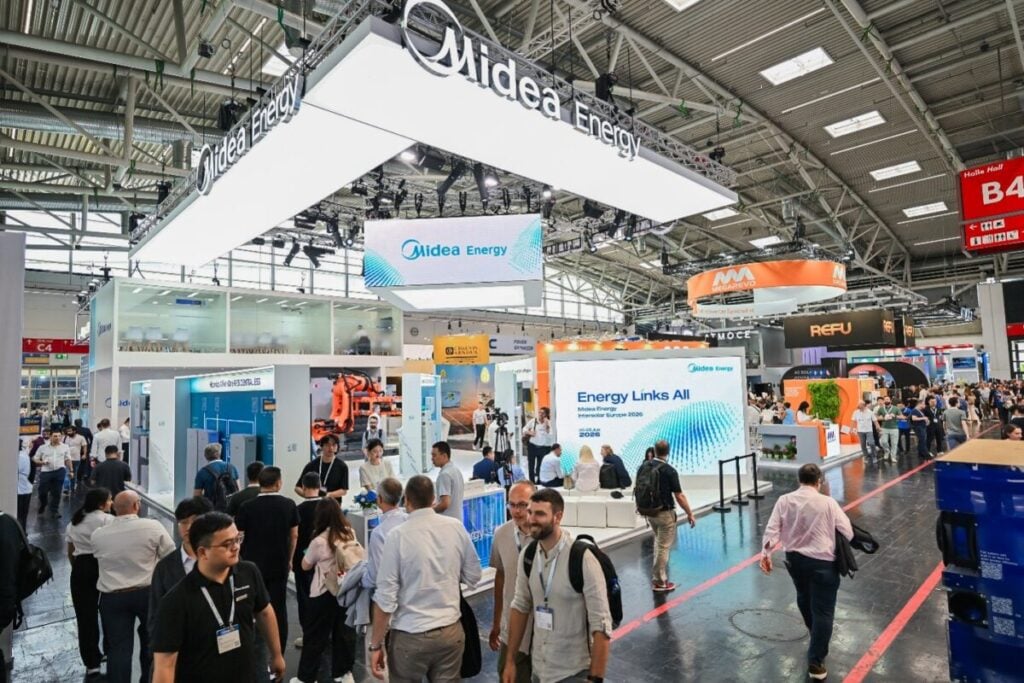
At Intersolar Europe, there was a buzz about residential and commercial & industrial (C&I) energy storage systems. Amid a continent-wide heatwave and another geopolitical energy price shock, the benefits to consumers of clean, distributed energy were laid bare.
Energy-storage.news spoke with Gerry Liu, GM of Hiconics, a subsidiary of Midea Group, about its residential energy storage offerings and its plans for the European market.
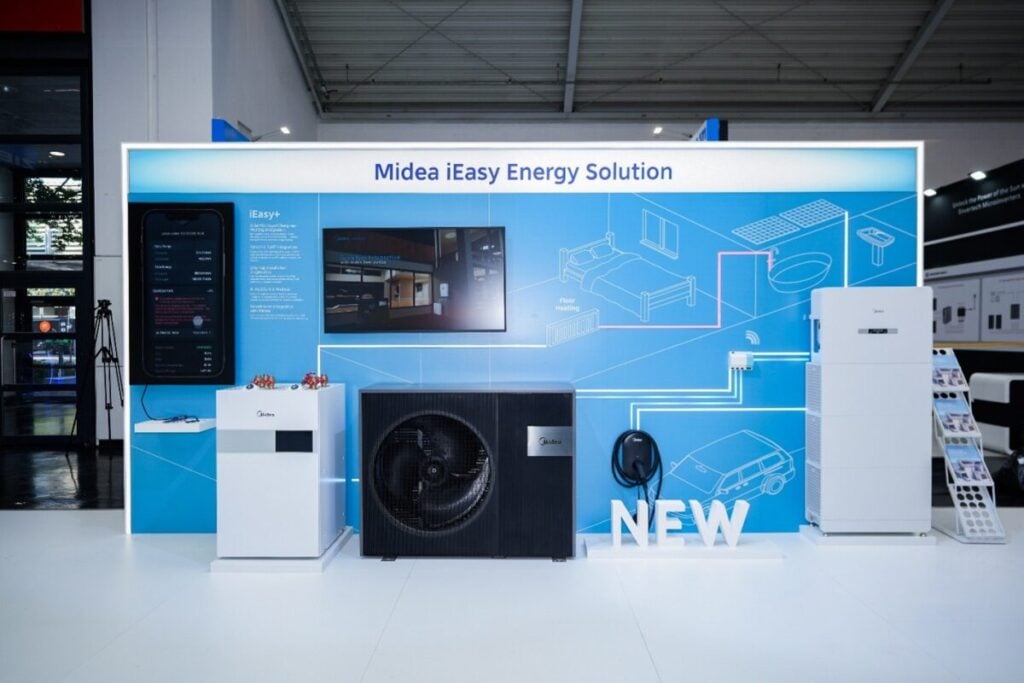
Front and centre of Hiconics’ presentation was the PowerNexus all-in-one residential energy storage system, which is designed to combine solar power and energy storage with a smart home energy management system (EMS) in a single unit. We heard that the system can offer dynamic, smart responses to Europe’s fluctuating power prices while meeting the continent’s stringent security and fire safety standards, as well as adapt to the growing use of heat pumps and demand for larger residential energy systems.
Energy-storage.news: The PowerNexus solution features advanced energy scheduling, including dynamic tariff response, smart peak shaving, and virtual power plant (VPP) readiness. In the context of fluctuating electricity prices in Europe, how do these software-driven features maximise energy independence and enhance grid interaction flexibility for homeowners?
Try Premium for just $1
- Full premium access for the first month at only $1
- Converts to an annual rate after 30 days unless cancelled
- Cancel anytime during the trial period
Premium Benefits
- Expert industry analysis and interviews
- Digital access to PV Tech Power journal
- Exclusive event discounts
Or get the full Premium subscription right away
Or continue reading this article for free
Liu: Our dynamic tariff response detects that prices will be elevated for 48 hours straight due to low renewable generation.
Smart peak shaving prioritises battery dispatch to cover the 5-8 pm peak window each evening, and pre-charges from the grid during the 2-4 am early morning lull when wind picks up and prices dip.
VPP readiness enables the aggregator to call on the home’s battery for a 15-minute frequency stabilisation event, earning the homeowner a capacity payment that offsets the higher cost of grid imports.
The software is constantly solving a multi-objective optimisation problem: minimise cost, maintain comfort, preserve battery longevity, and participate in grid services where profitable
In the European market, PowerNexus transforms a home from a passive consumer paying the average price into an active energy trader that buys low, sells high, avoids peak network charges, and can monetise its flexibility through VPP programmes. The result isn’t energy independence in the off-grid sense — it’s economic independence from the worst of the market’s swings, combined with the flexibility to participate in the best of them.
ESN: With the increasing adoption of heat pumps in Europe, system integration can be complex. The PowerNexus architecture supports AC coupling and compatibility with additional energy assets such as heat pumps and diesel generators. What drove this highly flexible design, and how does it empower installers and homeowners to create customised energy solutions?
Liu: The flexible architecture design reflects a broader European trend toward sector coupling — linking electricity, heat, and transport into a single optimised energy system. A heat pump is the bridge between electricity and heat; an EV charger is the bridge to transport; a generator is the bridge to fuel-based backup. PowerNexus makes it the energy hub that spans all three sectors, not just an electric-only solar controller.
Installers in Europe operate in a fragmented market where customer homes arrive with unpredictable existing equipment. The AC-coupled, multi-asset architecture means an installer can pair a PowerNexus controller with one brand of solar panels, a different brand of battery, a third brand of heat pump, and a fourth brand of generator — all without compatibility issues. This lets them optimise each installation on cost, performance, and availability rather than being constrained to a single brand’s ecosystem.
ESN: On the hardware side, PowerNexus utilises a wireless modular design and mixed battery pairing capability. Combined with IP66-rated construction and built-in battery heating, how does Hiconics balance industry-leading safety standards with the need to simplify installation and commissioning for European partners?
Liu: The PowerNexus hardware design resolves a fundamental tension in the European residential storage market: the simultaneous demand for rigorous safety compliance (like VDE-AR-N 4105 in Germany) and the installer’s need for fast, low-risk deployments that can scale across diverse housing stock.
ESN: The European market has stringent safety requirements for residential storage. Beyond the high-quality LFP cells, how do the multi-level protection mechanisms and isolated fire-resistant structures in PowerNexus function in practice? Furthermore, how do features like the IP66 rating and built-in battery heating ensure dependable performance in extreme cold climates?
Liu: Multi-level protection monitors voltage, current, temperature, and insulation in real time, cutting power automatically at any abnormal reading.
Meanwhile, the BMS performs active cell balancing to prevent overcharging or deep discharge across all cells.
Isolated fire-resistant structures use non-combustible materials between modules and a steel enclosure to contain thermal runaway within the unit, and the system also includes short-circuit protection and residual current detection, shutting down in milliseconds if a fault is detected.
The IP66 rating means the enclosure is fully dust-tight and withstands powerful water jets, so rain, snow, and debris pose no risk.The built-in battery heating automatically activates when the internal temperature drops below freezing, warming cells to a safe operating range.This ensures reliable charging and discharging in extremely cold climates down to around -20°C, where standard batteries would fail. Together, these features allow dependable outdoor installation in harsh European winters without needing an additional heated enclosure.
ESN: As household energy needs grow, phased capacity expansion is becoming the norm. PowerNexus supports an innovative mixed battery pairing capability. From a technical perspective, how does the residential energy system manage the differences between new and existing modules, and how does this translate to actual cost advantages for end-users and installers?
Liu: The mixed use of new and old battery modules in PowerNexus benefits from DC-DC conversion technology. Each module has its own dedicated DC-DC converter that regulates its voltage and current independently before coupling to the common DC bus.
This means the system decouples the electrical characteristics of each module — differences in voltage, internal resistance, and state of charge no longer cause current circulation or imbalance.
This removes the traditional limitation that all batteries in a string must be identical, enabling true plug-and-play capacity expansion regardless of module age.
ESN: Hardware sets the baseline, but software determines the system’s full potential. The intelligent energy management application for PowerNexus monitors not only battery status but also integrates EV charging and overall household consumption. How does Hiconics leverage advanced analytics to help homeowners visualise their energy savings and return on investment (ROI)?
Liu: The iEasy+ app aggregates real-time data from the battery, EV charger, and home consumption meters into a single dashboard.
Advanced algorithms automatically calculate self-consumption rates — how much solar energy is used directly versus exported to the grid.
It tracks time-of-use savings by logging how much energy was drawn from the battery during peak tariff periods versus charging during off-peak hours.The system generates daily, weekly, monthly, and annual reports showing total energy flow, grid dependence reduction, and estimated monetary savings.
An ROI projection model uses historical usage patterns and local tariff data to forecast payback periods and lifetime savings. The interface presents all this data through simple charts and colour-coded summaries, making complex analytics immediately understandable for non-technical homeowners.
