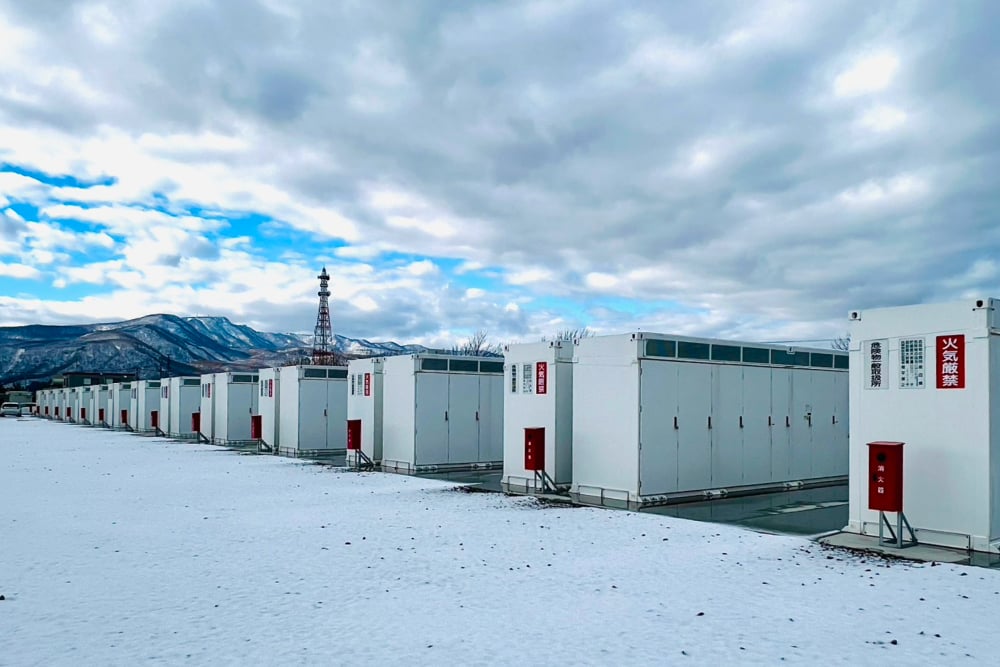
Partners Manoa Energy and HD Renewable Energy Japan have begun commercial operation of a 50MW/104MWh battery storage project in Hokkaido, Japan.
The start of operations at the pair’s Helios 50MW Battery Energy Storage System (BESS) was announced yesterday (1 December) by Manoa Energy’s parent company, Brawn Capital, a private equity investment manager focused on energy transition opportunities in the Asia-Pacific (APAC) region.
Helios 50MW is a “100% merchant” asset, and the partners intend for it to participate in wholesale electricity trading, balancing and capacity market opportunities, Brawn said.
The ability to stack revenues from participation in a range of merchant markets in this way is a significant factor driving growth in Japan’s energy storage sector. This is accompanied by a government which has recognised the need for new storage capacity to enable the integration of renewables and add flexibility to the grid.
Try Premium for just $1
- Full premium access for the first month at only $1
- Converts to an annual rate after 30 days unless cancelled
- Cancel anytime during the trial period
Premium Benefits
- Expert industry analysis and interviews
- Digital access to PV Tech Power journal
- Exclusive event discounts
Or get the full Premium subscription right away
Or continue reading this article for free
The asset began day-ahead and intraday trading in the Japan Electric Power Exchange (JEPX) after commissioning. HD Renewable Energy (HDRE) said it is completing 48 transactions per day.
HDRE claimed Helios 50MW is expected to earn up to JP¥2 billion (US$12.8 million) revenue from power trading in its first full trading year, while the asset is also due to enter the Electric Power Reserve Exchange (EPRX) balancing market in Q2 2026.
Helios 50MW’s developers are hoping to put the new system into the capacity market by 2028.
Manoa Energy is Brawn’s wholly owned renewable energy development platform in Japan. Manoa Energy originated the Helios 50MW project in Sapporo City, the capital of Japan’s most populous northern island, Hokkaido. Construction began in April 2024.
Hokkaido, due to its limited interconnection with the main island of Honshu and its relative abundance of land, has become a major hub for renewable energy development in Japan and was the first region where a local utility and grid operator, Hokkaido Electric Power (HEPCO), mandated the deployment of energy storage.
HD Renewable Energy Japan, meanwhile, is a subsidiary of Taiwan’s HD Renewable Energy (HDRE). Regular readers of Energy-Storage.news will likely be aware of HDRE’s BESS development activities in Australia. Its Japan entity entered a bilateral interest purchase agreement for the Helios project earlier this year with Brawn Capital and HDRE now owns a 90% controlling stake.
Engineering, procurement and construction (EPC) duties were carried out by HOKKAIDENKO Corporation, an electricity infrastructure construction subsidiary of utility HEPCO. HEPCO will also carry out operations and maintenance (O&M) on the project. The BESS equipment supplier was Tesla, comprising the US EV and BESS company’s Tesla Megapack 2XL solution.
HDRE is itself targeting the development of 3GW of clean energy assets in Japan, including 2.6GW of energy storage and 400MW of solar PV. The company successfully bid for long-term contracts in Japanese government’s Long-Term Decarbonisation Auction (LTDA) capacity market solicitations, which were open to batteries. HDRE won 73MW capacity market contracts from two projects in the 2024 LTDA and 300MW in the 2025 round.
The LTDA offers 20-year fixed revenue contracts while allowing operators to take home 10% merchant upside and is hosted by the national association of grid operators, OCCTO. A total 1.4GW of energy storage of 3-hour to 6-hour duration, including 360MW of pumped hydro energy storage (PHES), was awarded in the latest auction, although in future years, the target capacity will decrease.
Fresh, but volatile, Japanese market
“Japan’s energy storage sector is experiencing rapid acceleration, positioning Japan among the world’s most dynamic energy storage markets,” Manoa Energy head and COO of Brawn, Dean Cooper, said, noting that the country “emphasises battery energy storage systems as a strategic priority for its critical energy infrastructure.”
Despite this growth and the breadth of opportunities, which also include subsidy schemes from both the national and Tokyo Metropolitan Governments that provide capital expenditure (Capex) support to project developers and market entrants, market entrants have been warned that doing business in Japan’s energy storage market can be challenging.
For instance, while ancillary services prices are currently very high, those opportunities could be subject to volatility or saturation.
According to various sources, there are also quite sudden changes in the regulatory environment applying to these and other revenue streams, while the cost of everything from components to labour are relatively high, grid connection wait times can be long and the permitting process complex, while developers are competing for very limited land resources.
ESN Premium looked at the complex Japanese market, including its opportunities and challenges, for a two-part series of articles in July. BloombergNEF (BNEF) global energy storage market analyst Isshu Kikuma told the site that from 2026 onward, grid-scale BESS installations are expected to exceed 1GW annually in Japan.
Kikuma’s BNEF colleague Umer Sadiq, a Japan energy market specialist, said that as balancing prices go down with increased participation from new assets, developers should consider the future direction of revenues in grid services markets versus wholesale trading and other streams, rather than focusing on the high prices available today.
Despite the growth of opportunities in a relatively unsaturated market, Sadiq noted, the Japanese BESS sector remains more volatile compared to more mature markets.