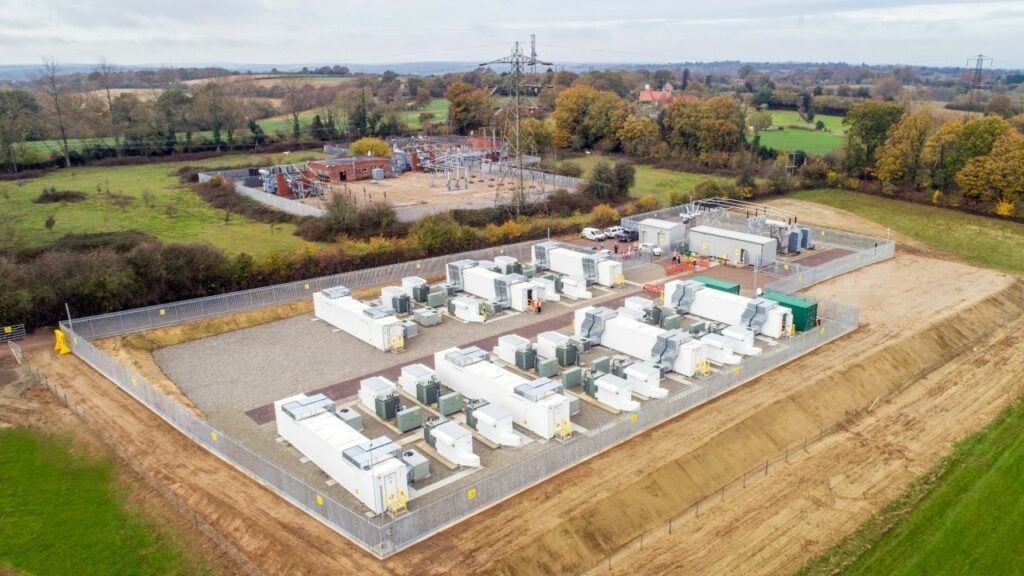
Battery energy storage fund Gresham House has released annual accounts for the first half of 2023, showing lower H1 2023 revenues and a drop in share value.
In 2022, the company’s earnings before tax (EBITDA) was £48.8 million (US$61.80 million), “a like-for-like increase of 23.2%”, while the share value increased from 116.86p to 155.51p over the year. As with many renewable energy stocks, Gresham House Energy Storage Fund’s share price has fallen in 2023, now sitting at around 119p. The share price stood at 146.66p at the end of H1.
However, the company, which lists on the London Stock Exchange under the ticker symbol ‘GRID’, says it has a 2.5GWh target portfolio which could be deployed by mid-2025 representing a 310% growth compared to 31 December 2022.
The lower H1 2023 revenues were “due to near-term systems and process challenges being addressed at National Grid Electricity System Operator (NG ESO), and cyclically low levels of power price volatility,” the company said, eyeing “strong revenue recovery potential from current levels boosted by [a] growing operational portfolio”.
Try Premium for just $1
- Full premium access for the first month at only $1
- Converts to an annual rate after 30 days unless cancelled
- Cancel anytime during the trial period
Premium Benefits
- Expert industry analysis and interviews
- Digital access to PV Tech Power journal
- Exclusive event discounts
Or get the full Premium subscription right away
Or continue reading this article for free
The company says its manager and board “remain very positive about the outlook for the Great Britain (GB) BESS market and continue to be excited about maintaining GRID’s leading market position.”
However, there is a “widening gap” between installed battery storage capacity and the growth in renewables, Gresham House said, with only 2.7GW of BESS, smaller than the 2.9GW increase in renewable generation in the UK in Q1 2023. As a consequence, the battery storage industry represents a “fundamental investment opportunity”, the company said.
Revenues for 2023, however, had been lower than 2021 and 2021 and below budget, impacted by reduced consumer demand as a result of higher power prices.
To read the full version of this story visit Solar Power Portal.