New software that helps businesses and utilities in the US to assess the value of energy storage has been launched by Sandia National Laboratories, while the Electric Power Research Institute (EPRI) has launched its own platform for calculating the value of distributed energy resources (DERs).
Both solutions are open-source and are being offered free of charge by the organisations. The development of Sandia’s Quest software was funded by the Energy Storage Programme at the US Department of Energy’s Office of Electricity, while EPRI is a non-profit member organisation which counts utilities responsible for 90% of the US’ electricity generation and delivery in its membership.
Sandia’s Quest for energy storage
Sandia National Laboratories launched Quest earlier this month with the aim of enabling utility companies and corporate project developers to “do their own energy storage analysis,” Sandia energy storage research programme manager Babu Chalamala said. It could be used by anyone from small utilities and cooperatives to vertically-integrated utilities and project developers.
Try Premium for just $1
- Full premium access for the first month at only $1
- Converts to an annual rate after 30 days unless cancelled
- Cancel anytime during the trial period
Premium Benefits
- Expert industry analysis and interviews
- Digital access to PV Tech Power journal
- Exclusive event discounts
Or get the full Premium subscription right away
Or continue reading this article for free
“They can take this application suite and evaluate for the needs of their particular project. Does energy storage make sense? And, if so, what is the cost-benefit analysis? Quest can help with all those things,” Chalamala said.
It allows for the evaluation of different energy storage scenarios and the modelling of various solutions. Its two principal tools are a behind-the-meter analysis tool which can figure out the energy costs savings that can be made with customer-sited energy storage systems at businesses, hospitals, schools and so on, and a market-analysis tool which can calculate for a utility how much a front-of-meter energy storage system could generate.
- Behind-the-meter:
Savings on energy cost are largely achieved for commercial electricity users in the US by reducing their demand for electricity from the grid at peak times, which is called “peak shaving”. Inputting the location of their system and the rate structure they currently pay, users of the Quest software can estimate how much they can peak shave. Such behind-the-meter energy storage solutions are often paired with solar panels or other onsite generation and the software can also input data on their generation profile into the software.
- Utility:
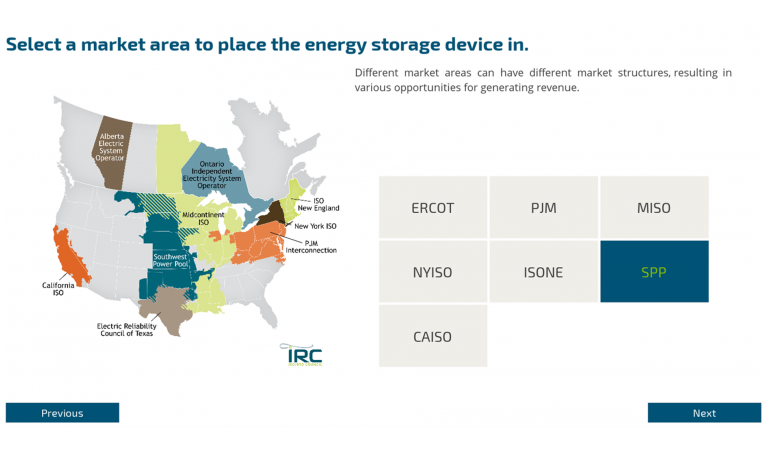
The other principal tool of the software takes historical data from the US’ seven main energy markets and calculates how much revenues energy storage systems can earn for utilities in each jurisdiction.
Learn more about the Quest tool at the website, here.
EPRI’s Distributed Energy Resource Value Estimation Tool
This week EPRI launched DER-VET, the Distributed Energy Resource Value Estimation Tool, which has been developed in collaboration with the California Energy Commission (CEC).
The platform is an extension to EPRI’s existing tool for energy storage value estimate, StorageVET. DER-VET allows users to make site-specific assessments for calculating, understanding and optimising the value of distributed energy resources (DERs).
Its aim is to determine the optimal size, duration and other characteristics of DER operation that can maximise the benefits of projects. Applicable technologies include solar, wind, demand response, electric vehicle (EV) chargers, generators, combined heat and power (CHP) systems and of course, energy storage. While the software could enable the development of a more flexible, optimised grid, the platform can also deal with DERs in different configurations that include microgrids.
“DER-VET empowers developers, utilities, and regulators across the electric power industry to make better-informed DER application decisions based on a comprehensive, real-world dataset. Innovative tools are essential to capturing more value from increasingly complex DER solutions that enable greater electric grid flexibility and reliability,” EPRI’s VP of integrated grid and energy systems, Daniel Brooks, said.
The DER-VET software version 1.0 can be downloaded for free from its website here, while EPRI has also placed the source code on GitHub, here.