Ford Motor Company’s entry into the “fiercely competitive” energy storage market is a “big strategic pivot,” but one that makes sense, ESN Premium has heard.
US automobile giant Ford announced earlier this week that it is taking the long view on the electrification of transport, i.e., pulling back on investments in electric vehicle (EV) manufacturing to retain some of its share of internal combustion engine (ICE) vehicles and increase production of hybrid EVs.
As reported by our colleagues at EV Infrastructure News (EVIN), the company is writing down losses of US$19.5 billion in current investments, signalling a shift to ‘higher-return opportunities’ and launching a new ‘high-growth’ battery energy storage system (BESS) business division.
“For a new player to enter with zero experience in the energy storage market, it is a big strategic pivot,” Pete Tillotson, senior research analyst with Benchmark Minerals’ BESS and EV battery market intelligence firm Rho Motion, told ESN Premium in an interview.
Try Premium for just $1
- Full premium access for the first month at only $1
- Converts to an annual rate after 30 days unless cancelled
- Cancel anytime during the trial period
Premium Benefits
- Expert industry analysis and interviews
- Digital access to PV Tech Power journal
- Exclusive event discounts
Or get the full Premium subscription right away
Or continue reading this article for free
“However, when looking at battery demand dynamics, particularly in the US, it begins to make sense.”
The announcement on Monday (15 December) came just a few days after Ford and South Korean battery manufacturer SK On said they would be ending an EV battery joint venture (JV), BlueOval SK.
Ownership and operation of BlueOval SK production facilities in three US states has been split between the JV partners: Ford takes ownership of two factories in Kentucky, SK On takes an under-construction battery manufacturing plant in Tennessee, and Ford will operate a further site, BlueOval Battery Park Michigan.
US$2 billion BESS business
Ford said it intends to convert EV battery production lines in Glendale, Kentucky, to serve the BESS market and will invest around US$2 billion to scale up the facility.
That includes the production of lithium iron phosphate (LFP) prismatic cells and 20-foot DC container BESS enclosures, with Ford claiming the site will produce ‘5MWh+ advanced battery energy storage systems,’ bringing initial capacity online within 18 months and targeting the deployment of at least 20GWh annually by late 2027.
Meanwhile, at the Michigan site, it plans to make residential battery storage products.
“With the EV tax credit ending in September this year, CAFE (Corporate Average Fuel Economy) standards weakening and removal of fines for OEMs regarding EV sales, there is little incentive to produce EVs if you can make more [money] producing ICE vehicles. Ford, therefore, has access to battery manufacturing facilities that could be better used serving a stronger growth market in energy storage,” Rho Motion analyst Tillotson said.
The company can benefit from already owning production facilities in development that it can use to capitalise on the growing demand for BESS in the US.
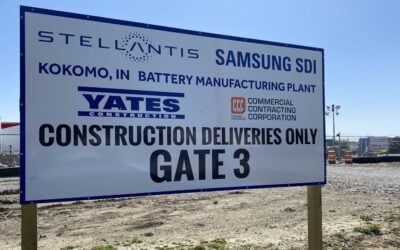
It’s a path already taken by a number of other players, most notably South Korean battery manufacturers with EV cell production plants in the US: LG Energy Solution, Samsung SDI, and Ford’s JV partner SK On.
In all three instances, the companies have either retooled existing production lines or redirected planned investments into EV batteries, moving quickly to capitalise on the market demand shift away from electric transport and the policy shift away from Chinese battery imports.
ESN Premium recently heard from an industry consultant that the domestic supply of cells, with South Korean players comprising a significant share, could be enough to cover US demand without Chinese imports within a few years.
“Ford’s retooling of its planned operations in Kentucky will require the acquisition of new equipment in order to create production lines geared towards BESS-appropriate LFP cells, rather than the previously planned nickel cobalt manganese (NCM) EV cells,” Tillotson said.
“Ford will also need to establish new supply chains, particularly when it comes to the procurement of LFP cathode active material, for which 99% of the world’s manufacturing capacity is currently located in China, with what little overseas capacity there is often Chinese-owned.”
The US automaker does have an existing planned supply agreement for cathodes from an Indonesian-based facility owned by Chinese materials company Jiangsu Lopal, but there are questions over compliance with the ‘One, Big, Beautiful Bill Act’ (‘OBBBA’) provisions of foreign entity of concern (FEOC) material assistance.
Ford is, on the other hand, unlikely to struggle in terms of bankability, the most important metric for assessing the financial health of energy storage providers.
Charlotte Gisbourne, analyst at Solar Media Market Research, which produces the quarterly Battery StorageTech Bankability Ratings Report, said that with Ford as an already established company, “the financial side of things looks solid from a bankability perspective, with decent revenue growth.”
Gisbourne noted that Ford could also be an indirect beneficiary of Chinese battery technology investment, due to an existing supply relationship with CATL, which lessens Ford’s required R&D expense.
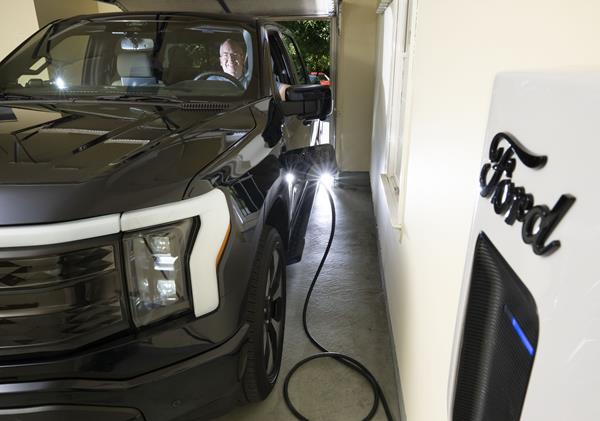
Aside from that, Ford’s only major previous brush with the energy storage space is its pilot programme with US residential solar and storage leasing company Sunrun. Through the programme, Ford’s F-150 Lightning all-electric pickup truck was made compatible with bidirectional chargers, which allowed for vehicle-to-home (V2H) and a limited amount of vehicle-to-grid (V2G) demand response participation in pilot deployments with utilities.
‘US-made cells are an attractive option for US-based system integrators and developers’
“The energy storage market is a fiercely competitive one. Performance, cost and safety are the priorities for BESS cell technology, all of which are improving and have been over the past two years,” Tillotson said.
Nonetheless, as a US-based company building its factories domestically, Ford could potentially be a major supplier of products that comply with FEOC restrictions and meet domestic manufacturing guidelines that eliminate tax credit subsidies for projects or production lines that use Chinese products or investment.
“Ford will be competing with US-made cells, making it an attractive option for US-based system integrators and developers, due to tightening material sourcing rules that come into force from 2026,” Tillotson said.
“Depending on performance and initial costs of production, Ford could potentially outweigh a lot of the Chinese cell manufacturing that still may be entering the market to be used within AC systems that are integrated in the US.”
Pete Tillotson said Ford’s primary competitors will be companies setting up domestic cell manufacturing in the US, including the South Korean trio and others, like Tesla.
Companies with partial or full Chinese ownership or with manufacturing investments in China may look to reconfigure their ownership structures: Tillotson gave Canadian Solar’s recent move to form the US JV CS Power and onshore its solar and BESS manufacturing as an example.
The analyst said, however, that there are still “viable competitors from China,” citing recent large-scale offtake deals in the US announced by Trina Storage and Rept Battero in recent months.
Risk versus steady reward?
Setting up and cost-effectively running fresh manufacturing lines with a newly trained workforce is, the analyst said, “notoriously difficult,” as seen in the numerous examples of non-Chinese battery startups that have failed.
Another key barrier will be proving technology in the market, with Ford set to compete for market share with players that have proven track records of delivering high-performance cells to the market.
“There will have to be a period of in-the-field testing of these cells and systems to convince the market they are worth procuring,” Tillotson said.
Still, despite those barriers to entry and challenges ahead, the US market—which Rho Motion assumes to be Ford’s primary target market—is still showing “strong momentum to the upside” even in the face of legislative challenges.
“Perhaps this is a longer-term play by Ford which wishes to get into a more predictable and steady growth market compared to the more variable EV market”
The Energy Storage Summit USA will be held from 24-25 March 2026, in Dallas, TX. It features keynote speeches and panel discussions on topics like FEOC challenges, power demand forecasting, and managing the BESS supply chain. For complete information, visit the Energy Storage Summit USA website.