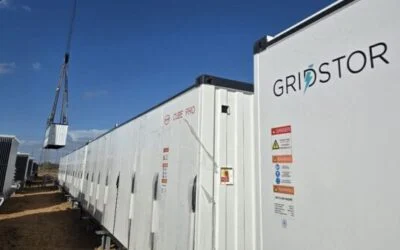
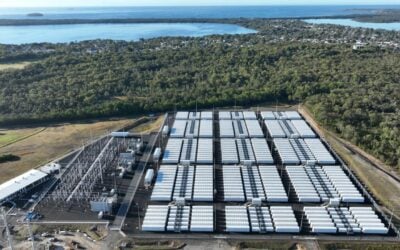
Samsung SDI batteries in a Younicos energy storage project. Image: Younicos.
Workable alternatives to utility power involving energy storage are beginning to emerge with new and innovative business models, according to an investment advisor who worked on Younicos’ recent US$50 million “land grab”.
The grid-scale storage specialists raised the sum towards the end of last year, with investors including First Solar and sustainable investment group Grupo ECOS. Gerard Reid of Alexa Capital explained that his firm had seen the opportunity to gain ground in the emerging sector for grid storage.
Speaking to Energy Storage News about a number of storage-related topics, Reid said he was “really excited” by emerging business models for energy storage at the smaller scale, including Sonnen’s recently launched SonnenCommunity concept for households.
SonnenCommunity allows PV system owners to use the grid to “trade” surplus energy from their PV systems, in a business model that the company said had been developed to further improve the competitiveness of storage in the expectation that existing support schemes for the technology would be removed this year. The company said that as the subsidy scheme looks likely to be renewed this year, their customers could reap greater economic benefit from the new service than Sonnen had originally expected.
Try Premium for just $1
- Full premium access for the first month at only $1
- Converts to an annual rate after 30 days unless cancelled
- Cancel anytime during the trial period
Premium Benefits
- Expert industry analysis and interviews
- Digital access to PV Tech Power journal
- Exclusive event discounts
Or get the full Premium subscription right away
Or continue reading this article for free
According to Reid, this and another business model which was launched in late 2014 represent something of a paradigm shift. He said that BEEGY Energy, a joint venture by heating manufacturer Glen Dimplex and four other companies, had also launched a “really exciting” offering. BEEGY is being marketed to commercial customers as well as residences.
“They’re looking at it as much beyond just storage and electricity. They’re looking at it as a whole package to allow you to go off-grid and they provide all the equipment to you, finance it over 25 years and you sign a kind of power purchase agreement. They’re looking at heat as well as electricity and the idea is that it’s at a flat rate per month, the same every month and you can use as much heat and power as you want.”
“
I can’t say which one of them will win at this point in time, what I can say is that there’s a lot of exciting stuff out there.”
The revolution began 18 months ago
Reid said that having been in the sector for 10 years, only two years ago he and his colleagues were considering a change of industries, when it became clear that “there was a revolution going on”.
“I live in Berlin and it’s the capital of European internet and I thought it might be easier for me to get back into internet finance… [but we] decided we didn’t want to do that, it’s clear there was a revolution going on.”
The rapid pace of change became apparent about a year and a half ago, Reid said, driven partly by the huge success of solar in the US which was stirring up excitement globally. The other big factor is that European utilities are looking to new business models themselves to counter threats to their revenues, represented by solar and other distributed energy technologies.
Reid said that while it is early days for either Sonnen or BEEGY’s business models, with Sonnen’s idea only just about to pass regulatory hurdles – although widely expected to do so – and an expectation that Germany’s consumers might be more keen to invest than save money through the BEEGY offering, what was clear is that they are fast emerging as serious alternatives to utility power and energy.
“I can’t say which one of them will win at this point in time, what I can say is that there’s a lot of exciting stuff out there. I’m not a marketer but what I do know is, it’s very clear for me is that one or other is going to be the way to go, going forward,” Reid said.
“If these guys can actually provide financing solutions, that’s really interesting and suddenly you really do have a competitive alternative to buying all or part of your power from a utility…what you’re seeing is a lot of interesting business models come up like Sonnen and BEEGY, that’s what’s driving it and you’re also seeing entrepreneurship and innovation. Go to the US and look at Tesla and so on. As someone advising a lot of these companies on financing, what I’m clear of is that the sector is getting quite excited again and there are real, interesting businesses coming along”.
Gerard Reid of Alexa Capital will be among the speakers in London at Solar Finance and Investment, an event hosted by Energy Storage News’ publisher, Solar Media on 1-3 February.
“
As someone advising a lot of these companies on financing, what I’m clear of is that the sector is getting quite excited again and there are real, interesting businesses coming along”