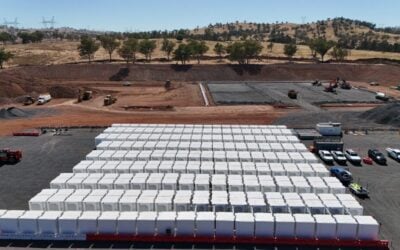
Finland’s largest battery energy storage system (BESS) to date will need to cope with “especially challenging” operating conditions and stringent and evolving grid code requirements.
Energy-Storage.news spoke with Alberto Prieto, head of power conversion solutions, grid automation at Hitachi Energy, after the company signed an agreement to supply an end-to-end power conversion solution for the 125MW/250MWh BESS project in Haapajärvi, about 470km north of the Finnish capital Helsinki.
Hitachi Energy signed the agreement with EPC contractor Nordic Electro Power (NEPower), which is building the 2-hour duration BESS for Switzerland-headquartered energy company Alpiq.
Alpiq acquired the project in March from developer Pohjan Voima. The Haapajärvi is its second BESS in Finland after a recently completed 30MW/36MWh project, while the Swiss company also has BESS project investments in France and Germany.
Try Premium for just $1
- Full premium access for the first month at only $1
- Converts to an annual rate after 30 days unless cancelled
- Cancel anytime during the trial period
Premium Benefits
- Expert industry analysis and interviews
- Digital access to PV Tech Power journal
- Exclusive event discounts
Or get the full Premium subscription right away
Or continue reading this article for free
Hitachi Energy will supply NEPower with key components that include power conversion system (PCS), transformers, Ring Main Units (RMUs), power plant controller (PPC) and SCADA-based energy management system (EMS).
Alberto Prieto said it was “critically important” that Hitachi Energy can provide an end-to-end AC solution for NEPower, particularly because the project is “a grid-forming, grid-connected system that must comply with increasingly stringent and evolving grid code requirements.”
“In this context, seamless integration across technologies is not optional — it is essential to ensure stable, predictable performance and on-time delivery,” Prieto said.
In addition to the hardware and software solutions, Hitachi Energy will also provide a full set of system studies, simulation models and validation capabilities, which are required to design, test and verify the system’s grid-forming ability before deployment.
NEPower is also working on another grid-forming BESS project in Finland’s North Ostrobothnia province where Haapajärvi is located, a 55MW/110MWh system for which Fluence was selected as BESS provider by project investor NTR earlier this year.
Evolving revenues and grid codes, challenging conditions
Construction at Haapajärvi is underway and commissioning is planned for mid-2027. Its key applications will include playing into the lucrative Nordic ancillary services market, where Prieto said Hitachi Energy already has experience with projects in Danish territories, participating in frequency regulation and other ancillary services.
That means Hitachi’s equipment already meets the latest Nordic grid code requirements, including those from Finland’s Fingrid transmission system operator (TSO).
Prieto claimed the Hitachi Energy solution enables the fast response, accuracy and availability required to compete in ancillary services markets, while retaining flexibility to capture future revenue opportunities.
“Through software and control upgrades, rather than major hardware changes, systems can be adapted over time to support additional applications as market rules and price signals evolve,” Prieto said.
“While the exact revenue mix in Finland is still evolving and may differ from neighbouring markets, the overall direction is clear: battery storage will play an increasingly important role in providing fast and flexible grid services.”
The system also needs to be rugged to meet “especially challenging” operating conditions in the Nordic region, from low temperatures and high humidity, snow and ice, and limited access for equipment in some cases, he said.
“Equipment must be both physically tough and highly reliable over a long operating lifetime, while continuing to meet stringent grid performance requirements,” Prieto said, adding that, like some other projects in these climates, Haapajärvi is designed to be an indoor system.
PCS maker acquisition
Hitachi Energy recently closed the acquisition of PCS maker Eks Energy, buying out a remaining 20% stake held by previous owner Powin in August, after the US system integrator filed for bankruptcy.
As ESN Premium heard from Alberto Prieto about a year ago, the acquisition gave Hitachi Energy a complete ecosystem of high-voltage equipment customers in the energy storage industry might need. It also allowed the company to leverage Eks Energy’s expertise in control systems for power conversion, honed through work on renewable energy, hybrid and battery storage projects in challenging island and microgrid settings.
Hitachi Energy began as Hitachi ABB Power Grids, with Hitachi acquiring ABB’s grid edge solutions business and rebranding upon the exit of the joint venture (JV). This move added grid automation technologies to Hitachi Energy’s existing suite of products.
However, ABB had already long sold its inverter business by this time (the Swiss company has again made a move to re-enter the inverter business in the past few weeks with the acquisition of Gamesa Electric’s power conversion division).
A year on, Alberto Prieto said the Eks acquisition “has meaningfully strengthened our competitive position by combining Hitachi Energy’s global scale, grid expertise, and execution capabilities with eks Energy’s proven power electronics technology.”
“This combination has elevated our technology capabilities, particularly in grid-forming energy storage, and has enabled us to offer a more comprehensive AC-side portfolio, from key components through to fully engineered systems,” Prieto said.
“It has also reinforced our capabilities on the AC block side, including SCADA and digital control technologies, which remain central to our integrated offering.”
PCS equipment represents a small fraction of the total cost of an energy storage project, but has a significant impact on project success. Prieto said the industry’s evolution and maturation in recent years has gone together with an increased awareness among customers of its “critical role”.
“The PCS is effectively the ‘brain’ of the energy storage system,” Prieto said.
“It is responsible for how energy is converted and controlled, and ultimately for how the asset interacts with the grid. As power systems evolve and grids become more dynamic due to higher penetration of renewables and reduced synchronous generation, the performance and capabilities of the converter become increasingly critical.”
“The PCS directly influences grid stability, power quality, and compliance with grid codes. It can also be a determining factor in system availability and long-term performance. As a result, choosing a high-quality, well-engineered converter is not just a technical decision — it is a strategic one that has a direct impact on project risk, reliability, extensibility, and overall value.”
Energy-Storage.news publisher Solar Media is hosting the Energy Storage Summit EU 2026 in London, UK, on 24-25 February 2026 at the InterContinental London – The O2. See the official website for more details, including agenda and speaker lists.