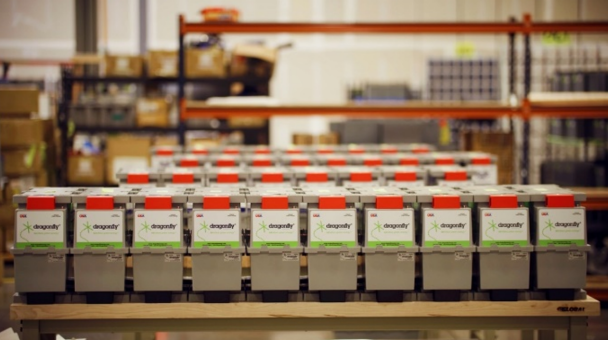
Lithium-ion battery pack manufacturer Dragonfly Energy expects revenues to increase 47% this year, during which it will complete a Nasdaq listing through a SPAC merger, before doubling in 2023.
As reported by Energy-Storage.news last month, Dragonfly Energy is going public via a merger with special purpose acquisition company (SPAC) Chardan NexTech Acquisition 2 Corp. The transaction will be concluded in the second half of this year and its Form S-4 registration statement, filed yesterday (June 22) has provided more details about the company’s financials, long-term plans and risks, and the transaction structure.
Financial consultancy Duff & Phelps estimates that the enterprise value of the new combined entity, Dragonfly Energy Holdings Corp, to be between US$640-760 million.
Dragonfly has to-date focused on recreational vehicle (RV), marine and off-grid residential storage markets but wants to go into grid connected energy storage solutions, and is also developing a solid-state battery product. It buys lithium iron phosphate (LFP) battery cells from two suppliers in China and relies on one, also in China, for its battery management system (BMS) platform.
Try Premium for just $1
- Full premium access for the first month at only $1
- Converts to an annual rate after 30 days unless cancelled
- Cancel anytime during the trial period
Premium Benefits
- Expert industry analysis and interviews
- Digital access to PV Tech Power journal
- Exclusive event discounts
Or get the full Premium subscription right away
Or continue reading this article for free
Dragonfly Energy financials
Dragonfly Energy expects to clock in US$115 million in revenue this year, up 47%, with negative EBITDA of US$18.1 million and adjusted EBITDA of US$12.2 million.
For 2023, it expects revenues to more than double to US$255.1 million and unadjusted EBITDA to become positive at US$39.1 million.
The company currently has 13,500 customers in North America, made up of large electric vehicle OEMs (original equipment manufacturers), distributors who buy bulk and re-sell, upfitters who augment vehicles, and retail customers buying directly.
For the three months ending March 31, 2022, during which it sold 19,664 batteries, revenue was up 17% year-on-year to US$18.1 million.
OEMs made up 17.4% of sales in the period but Dragonfly expects that to reach 37% by 2023. The OEM mix of revenues has grown from 2020 and 2021 when OEMs made up just 9/10% of sales, with retail and distributors making up the rest.
Long term strategy, expansion into grid storage and risks
Dragonfly wants to expand outside of its three current markets. In the medium term, it wants to sell into industrial, specialty and work vehicles, material handling, solar integration and emergency and standby power.
In the long term, it is targeting the data centre, telecom and distributed on-grid or grid-connected storage markets. It said there are 2,750 data centres in the US and expects these to increasingly shift towards lithium-ion batteries to provide a reliable power supply.
For on-grid storage, the company believes its solid-state technology will help reduce the related cost of storage to reach ‘grid parity’, meaning cost competitiveness with power from the grid, sooner than currently expected.
On risks, Dragonfly highlighted that its future growth depends on the needs and success of its customers. This is particularly true for selling to OEMs. It also expects competition to increase and that expanding into new markets for LFP batteries depends in part on the ability to develop and manufacture products.
It has no plans to diversify its cell and BMS supply mix as of yet but concedes that “any disruption in the operations of these key suppliers could adversely affect our business and results of operations”, and its reliance on one single manufacturing facility was also highlighted as a business risk.
There are also clear risks to its decision to invest in solid-state batteries, and the success of that venture actually ties into the SPAC listing, the company’s registration statement explained. Dragonfly mentioned significant engineering challenges in the development of the product and admitted that it may be delayed or even fail. It may also fail to adequately control the capital investments needed to be successful.
SPAC listing additional details
As Chardan is an existing publicly-listed entity, its shareholders have the right to demand the company redeem their shares for cash once the business combination occurs. Assuming no redemption shares, Dragonfly’s existing shareholders will hold 66% of the new entity and Chardan’s existing public shareholders hold 23%, with the remainder held by initial stockholders and a term loan lender. Assuming maximum redemption, the mix changes to 87/0/9/4% respectively, since all Chardan’s shareholders will have been bought out.
The work that has gone into the registration document has not factored any solid-state battery sales into future revenue projections. Interestingly, up to 25 million earnout shares as part of the SPAC merger are only payable if related trading price targets of US$22.50 by the end of 2026 and/or US$32.50 by the end of 2028 are met.
But the registration document says: “We believe that meeting these trading price targets is unlikely to occur unless Dragonfly successfully develops its solid-state technology and solid-state battery sales prospects.”
Other players in the energy storage market to have gone public in recent years through the SPAC route include C&I-focused energy storage solution provider Stem Inc, iron flow battery company ESS Inc and lithium-ion recycler Li-Cycle.