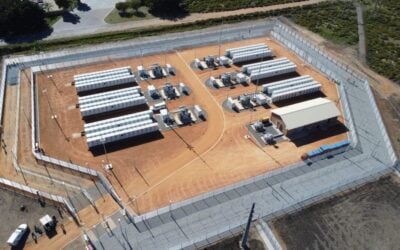
Croatia will provide some €500 million (US$534 million) in subsidies for battery energy storage system (BESS) technology, a government minister has said.
Minister of Economy and Sustainable Development Damir Habijan revealed the funding, part of a larger €1.6 billion for energy projects, at the JANAF conference in Zagreb earlier this month, according to state-owned news agency Zelena Hrvatska. The JANAF event covers the JANAF oil pipeline and storage system which spans Croatia.
The bulk of that funding will go towards liquified natural gas (LNG) pipelines and infrastructure but €500 million will go to large BESS units, Habijan said.
“All electricity producers who will not immediately release the electricity produced from renewable sources into the network will have such large storage tanks ready for batteries,” he said.
Try Premium for just $1
- Full premium access for the first month at only $1
- Converts to an annual rate after 30 days unless cancelled
- Cancel anytime during the trial period
Premium Benefits
- Expert industry analysis and interviews
- Digital access to PV Tech Power journal
- Exclusive event discounts
Or get the full Premium subscription right away
Or continue reading this article for free
The funding will come from Croatia’s share of the European Union-wide Recovery and Resilience scheme aimed at mitigating the negative economic effects of the Covid-19 pandemic. Similar grant schemes for BESS have used that funding in Spain, Romania, Finland and Greece to name a few.
The minister didn’t give more details about what kind of funding scheme the €500 million would be nor when it would come into effect in remarks reported by the state news agency. However, most other schemes using Recovery and Resilience funding have been via a mix of capex and opex grants per MW of construction, with an auction to decide which projects receive the funding.
Companies active in the Croatian energy storage market include developer-IPPs NGEN and Woodburn Capital while the country is also notable for being the home of Rimac Group, the EV technology firm which last year launched its first BESS product, the Sinestack.
Energy-Storage.news’ publisher Solar Media will host the 2nd Energy Storage Summit Central Eastern Europe on 24-25 September this year in Warsaw, Poland. This event will bring together the region’s leading investors, policymakers, developers, utilities, energy buyers and service providers all in one place, as the region readies itself for storage to take off. Visit the official site for more info.