New legislation in California that requires battery storage facilities to put in place safety and communication protocols has been signed into law by state governor Gavin Newsom.
Newsom signed Senate Bill 38 (SB 38) earlier this month (7 October). It makes it a requirement for battery storage facilities in the state to put in place emergency response and emergency plans, in addition to existing requirements for their maintenance and operation to meet standards set by the regulatory California Public Utilities Commission (CPUC).
The bill comes into force with California’s rapid deployment of battery energy storage system (BESS) assets continues. BESS resources help balance the grid, integrate growing shares of renewable energy, maintain electricity supply reliability in the face of load growth, wildfires and other causes of outages and enable thermal generation retirements.
SB 38 was introduced last December by Senator John Laird of Santa Cruz. Laird said at that time that an increase in battery storage “is essential to reaching our clean energy goals, but we also have to ensure that these facilities have safety systems in place to ensure the safety of workers and surrounding communities”.
Try Premium for just $1
- Full premium access for the first month at only $1
- Converts to an annual rate after 30 days unless cancelled
- Cancel anytime during the trial period
Premium Benefits
- Expert industry analysis and interviews
- Digital access to PV Tech Power journal
- Exclusive event discounts
Or get the full Premium subscription right away
Or continue reading this article for free
Laird also acknowledged that BESS technology is playing a vital role in ensuring the reliability of the electric system, which in California means the California Independent System Operator (CAISO) grid for the majority of the state, in addition to pockets served by other system operators.
What is striking is that in December 2022, Laird noted that the 3,500MW of BESS investments made in the state had contributed to keeping the lights on during late summer heatwaves of September that year that had “put immense strain” on the grid.
Already since then, California’s investments in BESS have soared, with CAISO reporting that its service area surpassed 5,000MW of installed grid-scale battery storage in May this year.
Recent reports from research firms such as Wood Mackenzie and S&P Global Commodities continue to rank California as the top US state for BESS adoption, albeit Texas is running an increasingly close second and according to some sources could outpace its northwestern neighbour as early as the end of this year.
At the same time, the importance of battery storage safety, and fire safety in particular, is at the top of the agenda for many local authorities, lawmakers and the general public – as well as for the industry.
ESN analysis: California puts industry best practice on safety into law
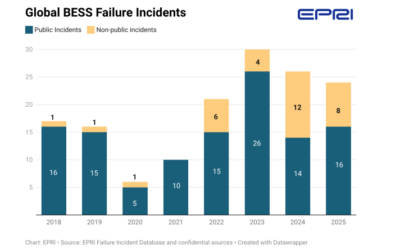
This year has seen a handful of fires at battery storage facilities, which although rare in the big picture scheme of just how many new BESS assets are being installed, nonetheless reinforce the need to put rules and safeguards in place around this relatively new technology set.
New York’s governor Kathy Hochul convened a working group of multiple state agencies including fire respondents earlier this year in response to three fires which occurred just a few weeks apart. Like Senator Laird and her California counterpart Newsom, Hochul acknowledged a need for BESS uptake to continue, but similarly emphasised that it needed to happen safely.
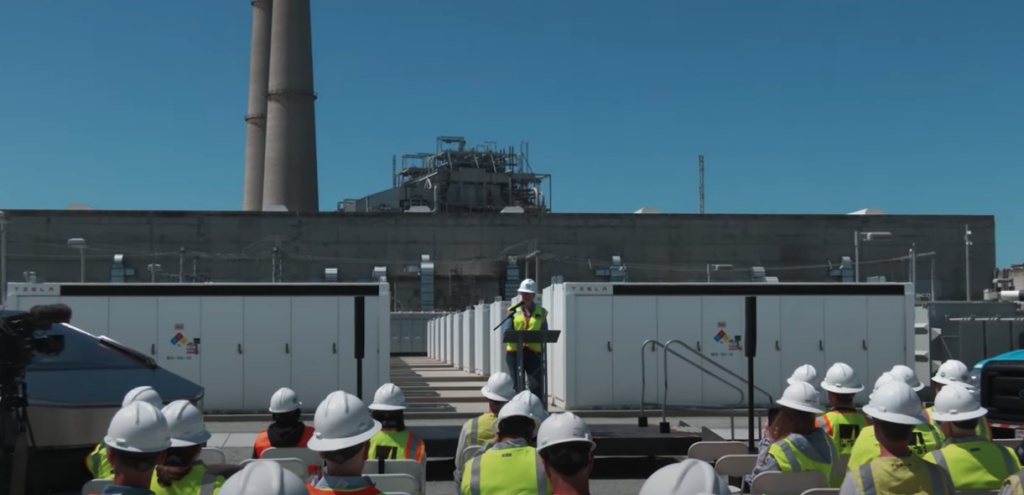
For Laird, the bill’s introduction came after the overheating incident at utility Pacific Gas & Electric’s (PG&E’s) Elkhorn BESS facility at Moss Landing which happened in September 2022.
The text of SB 38 states that the new requirements impose additional duties on local authorities, therefore a state-mandated programme will be created, with BESS owners or operators submitting their plans to county or city authorities.
In developing plans, owners or operators must coordinate with local emergency management, unified programme and first responder agencies.
These appear to be broadly in line with recommendations made by experts following a 2017 incident at a BESS in Arizona, and have already been adopted as best practice by some BESS companies, but are not thought to have been widely put into law in the US. Trade group American Clean Power Association (ACP) recently put out a battery storage safety guide for first responders.
The full text of Senate Bill 38 can be seen here.