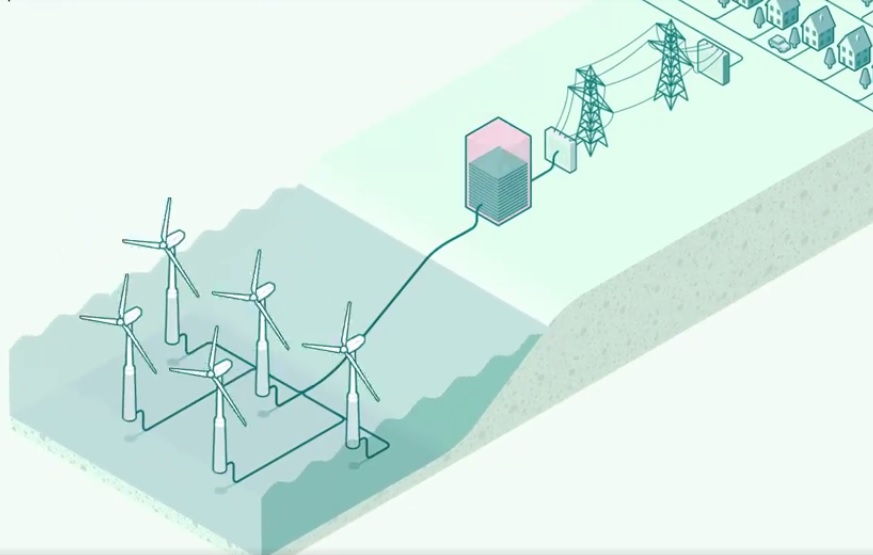
‘Batwind’, a much-talked about battery storage project due to being the first grid storage system connected to an offshore floating wind farm 25km off the Scottish coast, is now online.
In January, the project was described as holding great potential to learn from in showing how renewable energy could become a provider of baseload energy, by Statoil (now known as Equinor) and Masdar, two of the project’s partners which have committed to studying and analysing its performance.
The 1MW/1.3MWh ‘Batwind’ battery, designed and constructed by system integrator Younicos, is now complete and paired with ‘Hywind Scotland’, the floating offshore wind farm near Peterhead, Aberdeenshire.
“By adding energy storage capabilities to another world “first” – the world’s first floating wind farm – we hope to demonstrate the essential role that storage plays as we continue pushing the frontier in producing sustainable energy,” Younicos managing director Karim Wazni said.
Try Premium for just $1
- Full premium access for the first month at only $1
- Converts to an annual rate after 30 days unless cancelled
- Cancel anytime during the trial period
Premium Benefits
- Expert industry analysis and interviews
- Digital access to PV Tech Power journal
- Exclusive event discounts
Or get the full Premium subscription right away
Or continue reading this article for free
“Specifically, we’ve equipped Batwind with our intelligent Y.Q software, which ensures that the battery ’learns’ the optimal storage conditions. Our software tells the battery when to store electricity and for how long, and when and how much to inject back onto the grid.”
Equinor has described the project as the first step towards a “scalable, global renewables energy storage system” and said it and Masdar are together developing the algorithms that instruct the system when to store power and when to send it to the grid. The software behind the algorithms will incorporate various data sources including weather forecasting, market pricing, maintenance, expected consumption data and how, when and if to provide grid services.
“Digitalisation is a key driver here. The more we feed Batwind’s power management system with data, the smarter it gets. In addition, Batwind can be utilised for other renewable energy sources including solar and onshore wind. We believe this will expand the market for all renewable energy sources,” Sebastian Bringsvaerd, development manager for Hywind and Batwind with Equinor.
“The value in storage is not necessarily in the amount of energy you can store, but how you optimize, control and offer smarter energy solutions. By developing Batwind we get real time data, commercial experience and technical verification,” Bringsvaerd said.
The project has been funded by Abu Dhabi-headquartered Masdar and Equinor and supported by UK technology innovation and research centre for offshore renewable energy, Offshore Renewable Energy Catapult.