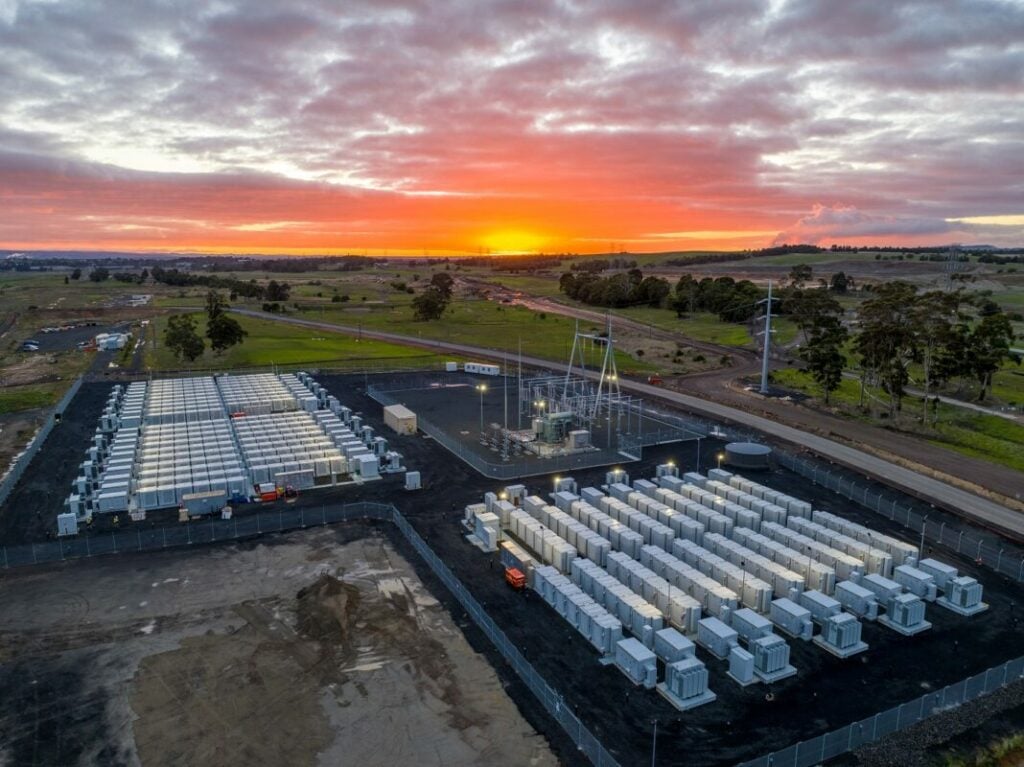
Battery energy storage projects have emerged as the dominant force in Australia’s energy investment landscape, accounting for 46% of the nation’s 64GW development pipeline, according to the Australian Energy Market Operator’s (AEMO) latest quarterly report.
The December quarter data reveal battery storage’s commanding position in the National Electricity Market (NEM), with standalone battery projects representing nearly half of all planned capacity additions.
AEMO’s analysis shows hybrid solar-battery projects comprise an additional 19.7% of the pipeline, bringing the total battery storage component to approximately 42GW when combined with standalone battery developments.
Australia’s battery storage sector has experienced rapid expansion over recent years, with deployment in the NEM surging 150% year-on-year, according to previous AEMO data.
Try Premium for just $1
- Full premium access for the first month at only $1
- Converts to an annual rate after 30 days unless cancelled
- Cancel anytime during the trial period
Premium Benefits
- Expert industry analysis and interviews
- Digital access to PV Tech Power journal
- Exclusive event discounts
Or get the full Premium subscription right away
Or continue reading this article for free
The 64GW pipeline represents a substantial increase from previous reporting periods, with wind projects accounting for 16% of planned capacity, followed by solar at 11.9%, hydro at 4.7% and gas at 1.4%.
The data demonstrates a clear market preference for storage-enabled generation, reflecting both policy incentives and commercial drivers favouring dispatchable renewable energy solutions.
AEMO’s December quarter report builds on previous pipeline assessments that have consistently shown storage technologies gaining market share. Earlier reporting indicated energy storage comprised 26.1GW of AEMO’s then-record 56.6GW NEM project pipeline, demonstrating continued growth in both absolute terms and pipeline share.
Battery storage projects in the pipeline span multiple duration categories, from short-duration systems designed for frequency regulation and peak shaving to longer-duration installations targeting energy arbitrage and renewable energy firming applications.
The rise of solar-storage hybrids in Australia
Co-location has also seen favourable developments in the policy landscape to support its uptake.
Indeed, the ASL, formerly AEMO Services, recently launched a consultation on a new Hybrid Generation Long-Term Energy Service Agreement (LTESA) product alongside its 2026 New South Wales (NSW) Consumer Trustee Investment Priorities.
It is hoped that this will complement the existing Generation LTESA to accommodate better hybrid projects combining solar PV generation with lithium-ion battery energy storage systems (BESS).
Hybrid developments enable operators to capture energy during peak solar generation periods and dispatch power during evening demand peaks, improving revenue potential while providing grid services.
The prominence of hybrid solar-battery projects in the pipeline reflects evolving market dynamics where co-located storage enhances project economics and grid integration capabilities.
This echoes the thoughts of Neha Sinha, product manager for energy storage systems at Wärtsilä Energy Storage, who discussed the topic with ESN Premium last year.
The pipeline data comes as Australia advances grid-forming battery storage capabilities, with AEMO tracking nearly a hundred projects incorporating advanced inverter technologies that can provide grid stability services traditionally supplied by synchronous generators.
These grid-forming capabilities represent a technological evolution that enhances the value proposition of battery storage beyond traditional energy arbitrage applications.
Renewables achieve historic milestone as battery storage deployment accelerates
The investment pipeline data coincide with a historic achievement for Australia’s electricity sector: renewable energy sources supplied more than half of the NEM’s quarterly energy demand for the first time.
Earlier this week, AEMO announced that renewables, including energy storage, accounted for 51% of overall supply in the December 2025 quarter, up from 46% in the corresponding period of 2024.
The milestone achievement delivered immediate economic benefits, with wholesale electricity prices nearly halving to an average of AU$50/MWh (US$35/MWh) across the NEM, representing a reduction of AU$39/MWh from the December 2024 quarter.
AEMO attributed the price decline to record renewable energy generation output and increased battery storage deployment across the grid.
Grid-scale solar PV and wind output reached a new quarterly average record of 6,627MW, representing a 23% increase from the December 2024 quarter.
Wind generation increased by 29% and grid-scale solar output rose by 15% during the period, demonstrating the operational impact of projects transitioning from the development pipeline to commercial operation.
Western Australia’s Wholesale Electricity Market (WEM) also achieved a milestone, with renewable energy delivering an average of 52.4% of electricity generation during the quarter.
At peak periods, renewable energy supplied 91% of demand in the western grid, with wholesale prices falling 13% to AU$69.55/MWh.
Battery energy storage systems demonstrated substantial growth in operational performance, with average output nearly tripling to 268MW during the quarter.
AEMO reported that 3,796MW of new large-scale battery capacity with 8,602MWh of energy storage was added to the grid since the end of the December 2024 quarter, reflecting the transition of pipeline projects to operational status.
A more renewable energy and generation-focused version of this analysis first appeared on our sister site, PV Tech.
The Energy Storage Summit Australia 2026 will be returning to Sydney on 18-19 March. It features keynote speeches and panel discussions on topics such as the Capacity Investment Scheme, long-duration energy storage, and BESS revenue streams. ESN Premium subscribers receive an exclusive discount on ticket prices.
To secure your tickets and learn more about the event, please visit the official website.