Regulators in the Eastern Caribbean island nation of Barbados have opened up a pathway for the widespread deployment of energy storage.
Barbados is targeting becoming a 100% renewable energy and carbon neutral economy by 2030. It currently depends on imported fossil fuels for the vast majority of its power generation. In 2018, Barbados spent US$253 million on importing fuels.
In order to support reaching the ambitious goal, authorities have identified energy storage as a critical tool that can also drive investment in the economy.
Towards the end of June, the independent British Commonwealth country’s Fair Trading Commission (FTC), ordered that a four-year pilot deployment of battery energy storage systems (BESS) should be conducted.
Try Premium for just $1
- Full premium access for the first month at only $1
- Converts to an annual rate after 30 days unless cancelled
- Cancel anytime during the trial period
Premium Benefits
- Expert industry analysis and interviews
- Digital access to PV Tech Power journal
- Exclusive event discounts
Or get the full Premium subscription right away
Or continue reading this article for free
While that means it will be a tight timeline for stakeholders including main utility Barbados Power & Light to take learnings from the pilot to scaled deployment, even large-scale BESS projects can be executed in as little as six months, although typically the timeline is closer to around 18 months.
Totalling 50MW across multiple systems of different sizes, the FTC said BESS installations of 4-hour, 3-hour and 2-hour duration should be used to gather data on the functioning of energy storage systems and the value they can provide to the electricity grid.
As reported by Energy-Storage.news last August, the government of Barbados created a national energy storage policy, and at that time, Minister of Energy Kerrie Symmonds said energy storage could unlock billions of dollars in investment.
The new pilot programme is based on a roadmap created through those efforts, while the FTC is also determining pilot tariffs and a framework for energy storage deployment.
The first two years of the pilot will see design, procurement, installation and grid connection of the BESS equipment, the remaining two years will cover their operation and the gathering of relevant data to assess project performance and technological viability.
Projects will receive the FTC’s storage tariff, as long as they meet a defined criteria of “used and useful”.
That means they will have to provide three or more “storage power services” and at least two voltage and/or reactive power services to the grid, the FTC said.
The list of services is as follows:
- Peak shaving
- Renewables firming and ramping
- Reducing renewable energy curtailment
- Spinning reserve
- Frequency response
- Distribution hosting capacity control
- Voltage control
- Power factor control
The FTC wants to test a range of system sizes. Tariffs range from Bds$0.675/kWh (US$0.33/kWh) or Bds$56.78/kW-month for systems up to 25kW, to Bds$0.270/kWh and Bds$30.34/kW-month for systems >1MW and 10MW.
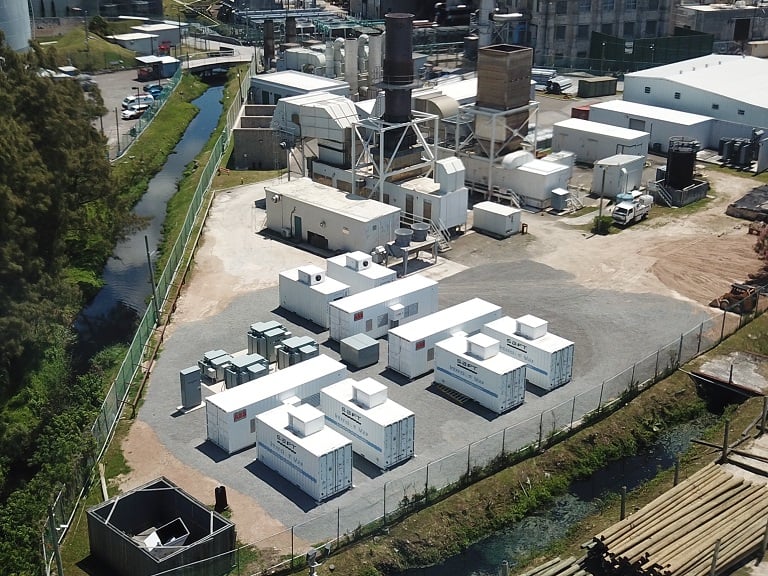
Successful projects of this type have been executed in regions with similar profiles to Barbados. One example is Bermuda, where a 10MW/5.5MWh BESS providing reserve capacity to the local grid was completed in 2019.
Stephanie Simons, an engineer with Bermudan utility BELCO told Energy-Storage.news at the time that the project was a “no brainer” from both a technical and economic standpoint in terms of the value it provided to the island’s energy system operation. In other words, the technology lowered costs while increasing reliability of supply of energy, Simons said.