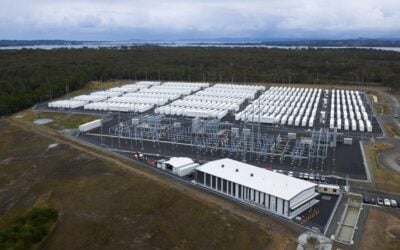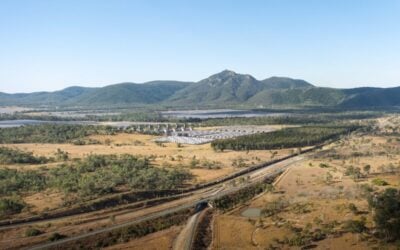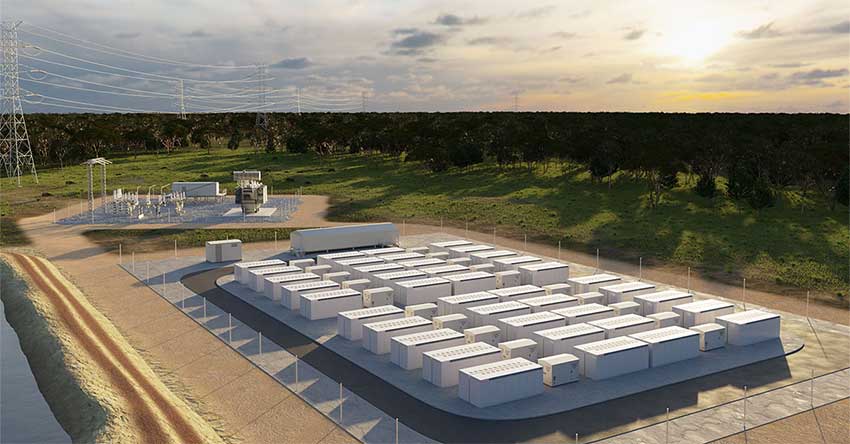
Queensland, Australia, achieved a new battery discharge record on 30 March 2025, with a maximum instantaneous battery discharge of 474.1MW at 17:55.
Geoff Eldridge, National Electricity Market (NEM) and energy transition observer at consultancy Global Power Energy, took to LinkedIn to point out that this figure is up 48MW on the previous record, which was achieved at 18:30 on 28 February 2025.
A year prior, the record stood at 153MW, which was achieved at 10:15 on 5 March 2024. This represents a rise of 321.1MW or 210% over the past 12 months.
Eldridge said: “This new record highlights the growing role of battery storage in supporting dispatchable capacity, firming renewables, and responding to volatile price conditions.”
Try Premium for just $1
- Full premium access for the first month at only $1
- Converts to an annual rate after 30 days unless cancelled
- Cancel anytime during the trial period
Premium Benefits
- Expert industry analysis and interviews
- Digital access to PV Tech Power journal
- Exclusive event discounts
Or get the full Premium subscription right away
Or continue reading this article for free
The record discharge coincides with a day of strong solar PV generation, with rooftop PV having reached 3,571MW during the day. Curtailment also reached 431MW on the day. As such, the batteries charged excess energy and released it during the evening ramp.
The average price reached AU$86/MWh (US$54/MWh), ranging from AU$1,049 to -AU$27/MWh. The negative pricing often occurs when solar PV generation peaks and creates a surplus in the middle of the day, which means that project and portfolio owners have to pay people to take their energy.
At the Energy Storage Summit Australia 2025 in Sydney last month, Tim Buckley, founder and director of the think tank Climate Energy Finance, touched on negative pricing events, flipping traditional views and describing them as “an advantage.”
Buckley added that negative pricing was experienced for 24% and 26% of last year in the states of Victoria and South Australia, respectively.
Australia’s NEM bags new battery charge record
Elsewhere in Australia, Eldridge noted that the NEM, which covers New South Wales, Queensland, Victoria, South Australia, the Australian Capital Territory and Tasmania, achieved a new battery charge record with –1,067MW on 2 April 2025.
The NEM recorded a new maximum instantaneous battery charge of –1,067.2MW at 12:35 on 2 Apr 2025, surpassing the previous record of –1,043MW at 10:15 on 13 Jan 2025.
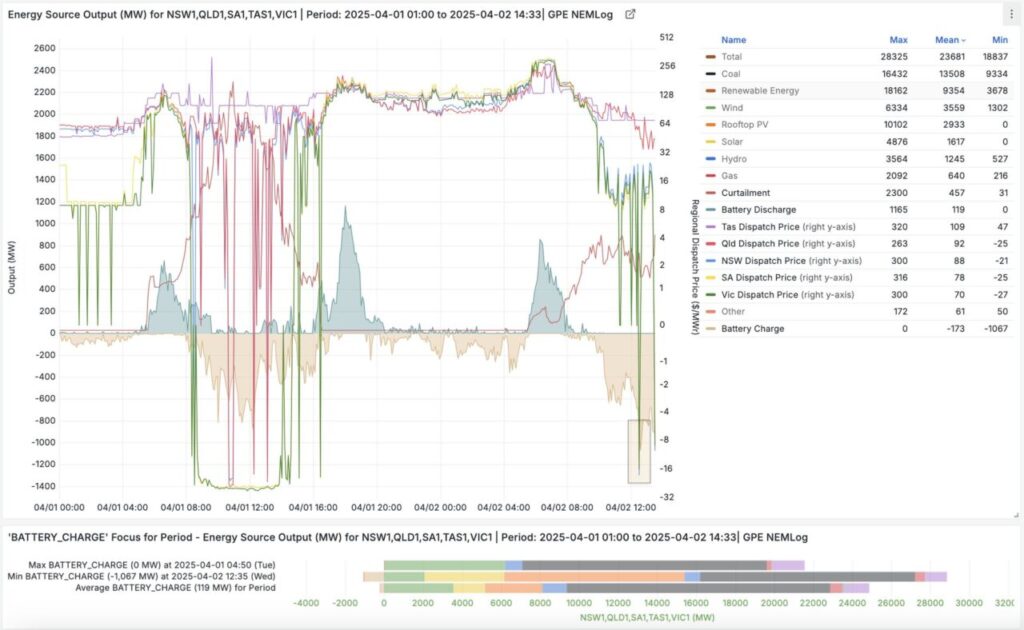
According to a separate post by Eldridge on LinkedIn, this battery charge record is due to several denominators. These include strong rooftop solar PV generation, which peaked at 9,266MW, and curtailment, which reached 903MW as midday supply exceeded system demand.
Interestingly, the battery charge peaking at –1,067MW, closely aligned with solar surplus and low regional prices.
Eldridge said: “Battery systems are now routinely engaging at scale—establishing a steady operational rhythm as the grid adapts to high renewable energy penetration.”