An AU$120 million (US$81.34 million) government funding round has opened in Australia for community battery energy storage projects.
Defined as battery facilities of between 50kW to 5,000kW nameplate output, connected to the distribution network, grant funding in the range of AU$3 million to AU$20 million per successful application will be available.
Proposals must deploy at least five battery storage systems each, with batteries sharing a grid connection point or co-located to be counted as one facility.
The money is coming from a total pot of AU$200 million allocated through the federal budget for 2022/2023 to fund 400 community battery installations across the country from Australia’s Household Solar Budget.
Try Premium for just $1
- Full premium access for the first month at only $1
- Converts to an annual rate after 30 days unless cancelled
- Cancel anytime during the trial period
Premium Benefits
- Expert industry analysis and interviews
- Digital access to PV Tech Power journal
- Exclusive event discounts
Or get the full Premium subscription right away
Or continue reading this article for free
Of that pot, AU$171 million was allocated to the Australian Renewable Energy Agency (ARENA), to fund at least 342 of those batteries. The money announced today represents Round 1 of that allocation, with projects funded from it to inform projects in a future round.
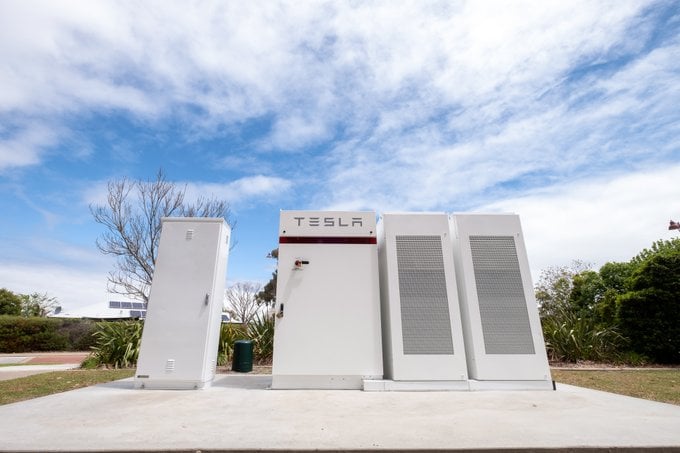
Community batteries, which store surplus solar-generated energy for later use, aim to maximise the benefits of Australia’s high uptake of rooftop solar PV, even for those households that can’t afford or are otherwise unable to host it on their own roofs.
Another term to describe them, coined by a team from Australian National University (ANU), is ‘neighbourhood batteries’. Writing in a technical paper for our journal PV Tech Power (vol.29) last year, the ANU experts said their preferred monicker comes from the fact that the word ‘community’ implies a degree of local community ownership of the facilities, which is not always the case.
‘Neighbourhood’ instead implies that the benefits of the battery energy storage system (BESS) technology will be shared by a community, even if the ownership isn’t. Either way, the ANU authors wrote that while the medium-sized battery installations do indeed offer numerous benefits to networks and their operators and users, more work needs to be done to establish a business case for them.
The purpose of ARENA’s community battery funding is to determine whether the systems can be a “missing link” in Australia’s energy storage needs, the agency wrote on its corporate blog today. The funding round aims to “fix the knowledge gap” on what is currently still a fairly rare technology set, it said.
“Not everyone is able to install rooftop solar, but by storing electricity close to the point of consumer demand, we can reduce network costs and alleviate constraints in areas with high solar penetration. This will ultimately reduce electricity costs for all consumers,” ARENA CEO Darren Miller said.
Round 1 is split into two streams with AU$60 million available for each. Stream A is for community battery projects by, or to be owned by, distribution network service providers (DNSPs) and installed in front-of-the-meter. Stream B is for project proposals from non-DNSP entities that can be installed behind-the-meter on distribution networks.
ARENA has produced an expression of interest (EOI) which details eligibility and other criteria, which can be seen here.
Some neighbourhood or community battery programmes are also underway by individual Australian states. For example, the state of Victoria in June last year offered funding from a pool of just under AU$11 million for projects that can demonstrate the multi-use benefits of such BESS installations. In February this year, Queensland committed AU$10 million for the deployment of 35 systems in the city of Ipswich.
ARENA meanwhile noted that the funding round follows its pledge of financial support for large-scale BESS projects equipped with advanced inverters. The aim of that programme is to establish how BESS can provide inertia to maintain stability of the grid, which traditionally has been a role played by thermal power plants. In December 2022 ARENA announced AU$176 million funding towards eight projects totalling 4.2GWh through that programme.
Energy-Storage.news’ publisher Solar Media will host the 1st Energy Storage Summit Asia, 11-12 July 2023 in Singapore. The event will help give clarity on this nascent, yet quickly growing market, bringing together a community of credible independent generators, policymakers, banks, funds, off-takers and technology providers. For more information, go to the website.