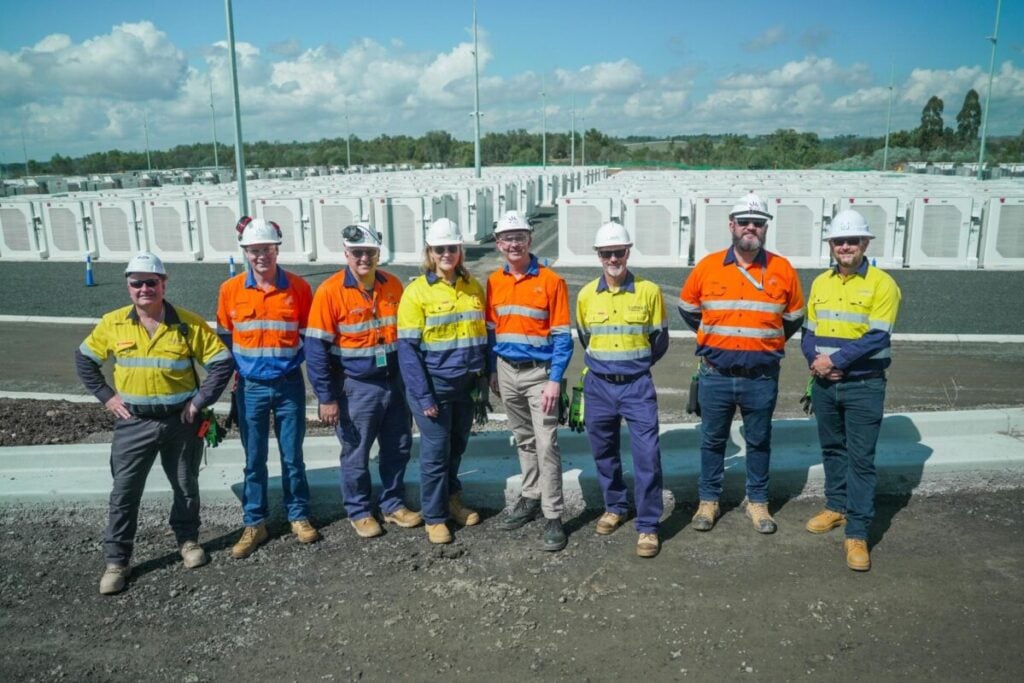
Australian utility AGL has started commissioning its 500MW/1,000MWh Liddell battery energy storage system (BESS) in New South Wales.
The project, located on the shores of Lake Liddell, approximately 220km north of Sydney and 120km west of Newcastle, completed construction in March 2026, with commissioning of the first 250MW now underway.
The facility is expected to ramp up to full commercial operations by June 2026 through a staged process that involves progressively testing battery performance and grid dispatch over several months.
Speaking at a commissioning event, AGL managing director and CEO Damien Nicks described the milestone as another important step in repurposing the site where Liddell Power Station, a 2,000MW coal-fired power plant, operated for 50 years before closing in April 2023.
Try Premium for just $1
- Full premium access for the first month at only $1
- Converts to an annual rate after 30 days unless cancelled
- Cancel anytime during the trial period
Premium Benefits
- Expert industry analysis and interviews
- Digital access to PV Tech Power journal
- Exclusive event discounts
Or get the full Premium subscription right away
Or continue reading this article for free
“Three years on I am proud to stand here today, to celebrate the commissioning of the Liddell Battery as the first major development in our plans to repurpose this site,” Nicks said.
“This battery will deliver important firming storage for the energy system which is increasingly needed as coal exits the market, and the percentage of renewable energy generation increases.”
As readers of Energy-Storage.news will be aware, the Liddell BESS utilises grid-forming inverter technology that can provide system strength services without relying on traditional synchronous machines.
The Liddell BESS was registered with the Australian Energy Market Operator (AEMO) in September 2025, a critical regulatory milestone that preceded the commissioning phase now underway.
Once fully operational, the Liddell Battery will join AGL’s expanding portfolio of grid-scale battery storage systems, including the 250MW Torrens Island Battery, the 50MW Broken Hill Battery, and the under-construction 500MW Tomago Battery.
The company continues to progress the transformation of the Liddell site as part of its vision to create an integrated energy hub, with potential partners in materials recovery and recycling, low-carbon fuels, and data centres all under consideration.
Navigating uncharted technical territory
The technical complexity of deploying grid-forming technology at scale posed challenges beyond those of conventional battery storage projects.
Speaking at the Energy Storage Summit Australia 2026 in Sydney last week, Ghasem Jahedi, principal grid engineer at AGL, acknowledged the knowledge gap that existed when the project commenced two years earlier.
“When we started back in two years ago, there was a lack of understanding in the market about how the grid-forming inverters operate,” Jahedi said.
The project secured AU$35 million (US$24.8 million) in funding from the Australian Renewable Energy Agency (AEMO) specifically to demonstrate grid-forming inverter capabilities, alongside a Long-Term Energy Service Agreement (LTESA) arranged by ASL on behalf of the NSW government as part of the state’s energy roadmap.
Jahedi explained that the technology selection deliberately targeted both market service requirements and system strength services simultaneously, representing a more ambitious scope than AGL’s previous grid-following battery projects.
Zac Ward, APAC grid director at Fluence Energy, which supplied the technology and served as AGL’s construction partner, identified regulatory frameworks as a particular challenge.
Existing access standards designed primarily for grid-following systems did not always align with the characteristics of grid-forming technology.
“What I found challenging was still needing to meet certain access standards, which are maybe not appropriate for the grid-forming,” Ward said.
“We all know about the requirements on the spot and the rise time, settle times and things like that. And it’s sometimes a very challenging spot to be in, where everyone in the room can see that this is correct in terms of what we expect from a synchronous machine. However, that’s not good enough still.”
The knowledge gap necessitated extensive stakeholder engagement with transmission network service providers, AEMO, original equipment manufacturers, and other project participants to establish a common understanding of how the technology would perform and integrate with the grid.
One critical technical insight centred on battery sizing for grid-forming applications, particularly regarding synthetic inertia provision.
Ward emphasised that grid-forming capability extends beyond inverter specifications to encompass the entire system architecture.
“When we’re talking about fault currents and reactive current, that’s looking at the inverter. But you also need to look at the oversizing of the battery, and that doesn’t just mean putting more capacity behind the inverter,” Ward said.
“Also means you need to look at your C rates and how quickly we need that power.”
The team also discovered new requirements triggered by project scale. Jahedi noted that projects exceeding 350MVA face additional requirements from transmission network service providers to install more power plant controllers, a threshold consideration that will inform future large-scale battery deployments across Australia’s National Electricity Market (NEM).
You can learn more about some of the key lessons from the development of the Liddell BESS in our write-up from the panel discussion on Energy-Storage.news.