
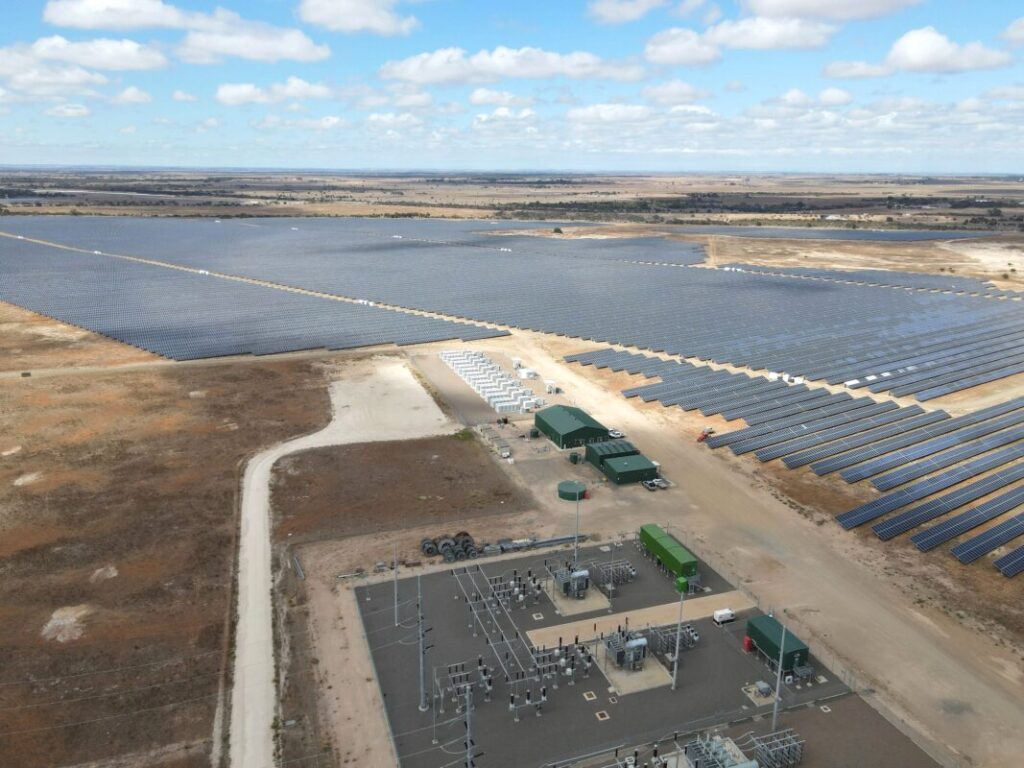
Envision Energy’s Behzad Naderi believes that Australia’s hybridisation rules are reshaping development and connection processes across the NEM.
Envision Energy’s global technical lead says the National Electricity Market (NEM) 2023 rule change requiring co-located battery storage with renewable energy generation is driving Australia ahead of major international markets.
Australia’s NEM has emerged as a multi-gigawatt proving ground for advanced battery storage technologies, propelled by regulatory frameworks that are helping the country compete for attention and investment with prominent markets in Europe, China and the US.
Speaking exclusively to ESN Premium at the Energy Storage Summit Australia 2026 in Sydney last month, Behzad Naderi, global technical lead for Envision Energy’s Future Grid Centre of Excellence, outlined how Australia’s hybridisation requirements are reshaping project development and grid connection processes across the NEM.
Try Premium for just $1
- Full premium access for the first month at only $1
- Converts to an annual rate after 30 days unless cancelled
- Cancel anytime during the trial period
Premium Benefits
- Expert industry analysis and interviews
- Digital access to PV Tech Power journal
- Exclusive event discounts
Or get the full Premium subscription right away
Or continue reading this article for free
“If you look at the rule change we have had since March 2023… a new plant, it has to be a hybrid plant, and what that hybrid plant means is that it has to have a battery energy storage system (BESS) sitting next to your wind farm or your solar farm,” Naderi explains.
The regulatory shift has supported Australia’s accelerating renewable energy transition; however, it has also created technical challenges associated with operating a grid increasingly dominated by variable generation.
The rule change essentially requires new projects to operate at very low short-circuit ratios, a condition that necessitates energy storage to maintain grid stability.
“The main intention is because we are predicting to have more, larger-scale wind and solar farms in Australia’s NEM. And it’s also now just happening, and I believe we are well ahead of other markets, and we are getting close to 100% renewable energy resources,” Naderi adds.
Australia’s position at the forefront of renewable energy integration becomes clear when comparing penetration rates and timelines with other major markets. While Australia is targeting 100% renewable energy by 2030, comparable economies are pursuing more modest goals.
“If we compare with the markets like Europe or China or the US, they are, I think, by 2030, aiming for a maximum of around 55%,” Naderi notes, highlighting the scale of Australia’s ambition relative to international peers.
South Australia is already demonstrating what high renewable energy penetration looks like in practice, regularly operating with renewable energy generation supplying the majority of demand for extended periods.
“If we look at the NEM, we do have a situation in South Australia where even we are more than 70% or 80% for a couple of hours, which means there is less synchronous generating units. There are fewer traditional synchronous generators, but we do have issues of reliability and security in the grid,” Naderi explains.
This operational reality is driving the urgent need for grid-forming battery storage technologies that can provide the voltage and frequency stability traditionally supplied by synchronous generators.
“That’s the time we say, without having a battery storage system, specifically those with grid-forming technology, it’s going to be impossible for us to keep the grid stable and secure,” he says.
Indeed, South Australia has emerged as one of the most progressive regions globally in the renewable energy transition. Back in 2024, renewables supplied 100% of the state’s electricity demand for a third of the entire year.
However, this reliance on variable renewable energy, particularly solar, has increased the need for energy storage. As such, numerous tenders have been proposed for the state, including a 700MW long-duration storage tender last year.
Parallel development and commissioning priorities
The hybrid plant mandate has introduced new considerations for project developers, particularly regarding the sequencing and integration of generation and storage assets.
Naderi emphasises that successful hybrid projects require simultaneous development of both components rather than sequential addition of storage to existing generation.
“When it comes to a hybrid plant, essentially, both of them should be progressing in parallel. We’re not talking about giving priority to one asset over the others. Both should be developed in parallel,” he says.
This perspective contrasts with the thoughts of Matt Baumgurtel, partner and new energy lead at law firm Hamilton Locke, who recently told ESN Premium that developers should be looking to build “battery-led hybrids”.
Naderi notes that this parallel development approach extends beyond construction timelines to encompass fundamental design decisions on system sizing and matching generation and storage capabilities.
“Based on the new system training rule change, you should be able to operate at very low shirt circuit ratio (SCR) conditions. What that means is you have to have a proper design for your wind farm or solar farm, and at the same time for your battery storage system, and that design means you should have a proper ratio defined for your storage system when it comes to the whole generation in your wind farm,” Naderi explains.
Naderi adds that the relationship between generation and storage in hybrid plants is complementary rather than hierarchical, with each asset’s capabilities designed to work in concert with the other.
“The capability we do have in both assets, whether it’s going to be wind, solar or battery storage systems, they fit each other. It’s very complementary,” he said.
While design and development of hybrid plant components should proceed in parallel, the commissioning sequence follows a specific technical logic driven by the fundamental role battery storage plays in providing grid stability.
Asked about commissioning priorities, Naderi clarified that storage systems must be operational before renewable energy generation can be connected.
“When it comes to the commissioning stage, the storage system should come first,” he says, explaining the technical rationale behind this sequencing.
“The reason why we are going to have a storage system, or a grid-forming storage system, is to provide voltage and frequency reference for our generating unit. And what a generating unit means is that it is wind or solar, which means it needs a voltage and frequency reference to operate.
“Without having those, it’s impossible to keep the stability of those generating units, and that’s why we need storage first, which basically replaces traditional synchronous generators, and then we can have our wind or solar plug into the national electricity market.”
This commissioning approach reflects the evolving role of battery storage, from a simple energy arbitrage or firming asset to a fundamental grid-stability service provider that enables renewable energy generation to operate in low-inertia grid conditions.
Hybrid plants are becoming the new normal
Looking ahead to the next several years, Naderi anticipates that hybrid configurations will become the standard project structure across the NEM, fundamentally changing the landscape of renewable energy development in Australia.
“I think the main key trend is we’re going to see almost every project to be a hybrid plant. That means for every project in the NEM, we should have a storage system sitting next to wind and solar. And this is going to be the trend,” he says.
This shift toward universal hybridisation will bring new complexities to the grid connection process, as projects must demonstrate compliance with increasingly sophisticated technical requirements.
“We expect to see some kind of complexity in the grid connection process, because having or making a hybrid plant, from a connection point of view, and achieving S5.3.4 letter, you probably need to have more effort, or have more negotiation with AEMO and the transmission network service providers (TNSPs),” Naderi notes.
The ultimate objective driving these regulatory and technical changes is achieving a fully renewable energy electricity grid while maintaining the reliability and security standards that have characterised Australia’s power system.
“I think the end of the story for us to achieve a 100% renewable energy grid is to have more hybrid plants and also having grid-forming technologies, which basically provide extended high current capability to mimic the behaviour of our traditional synchronous generator,” Naderi concludes.
Interested in Australia? Read Energy-Storage.news’ Energy Storage Summit Australia coverage and related content.