Australia’s heavy reliance on imported fossil fuels has left households and businesses dangerously exposed to global energy shocks, with the current conflict involving the US and Iran costing motorists more than AU$1 billion (US$710 million) in March alone.
This is according to a new report by the community-funded not-for-profit Climate Council, which urges the federal government to accelerate the deployment of renewable energy and storage in the upcoming May budget.
The report argues that while Australia cannot control international conflicts, it can control their economic impact through strategic investment in electrification, renewable energy, and battery storage systems.
Climate Council’s analysis comes as petrol prices have surged nearly 50% since late February, reaching 253.4 cents per litre, while diesel has climbed above AU$3 per litre.
Try Premium for just $1
- Full premium access for the first month at only $1
- Converts to an annual rate after 30 days unless cancelled
- Cancel anytime during the trial period
Premium Benefits
- Expert industry analysis and interviews
- Digital access to PV Tech Power journal
- Exclusive event discounts
Or get the full Premium subscription right away
Or continue reading this article for free
“This is the second major global fuel shock in just four years,” the report states, highlighting how Australia’s dependence on importing more than 90% of its refined fuels creates immediate vulnerability when international supply chains are disrupted.
Indeed, price spikes are flowing through the entire economy, with analysis suggesting prolonged conflict could increase Australian road freight costs by 20-30%, pushing up prices for food and essential goods. Modelling by Griffith University estimates the conflict could add an extra 5% to existing inflation.
Battery storage delivering energy security dividends
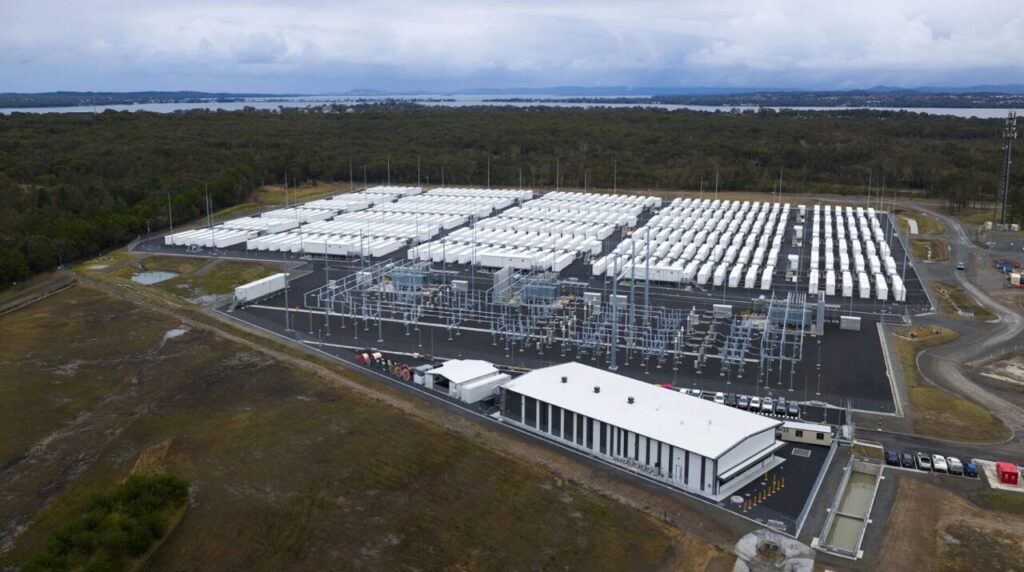
The report suggests that grid-scale battery storage is already providing substantial energy security benefits while reducing Australia’s reliance on gas-fired generation.
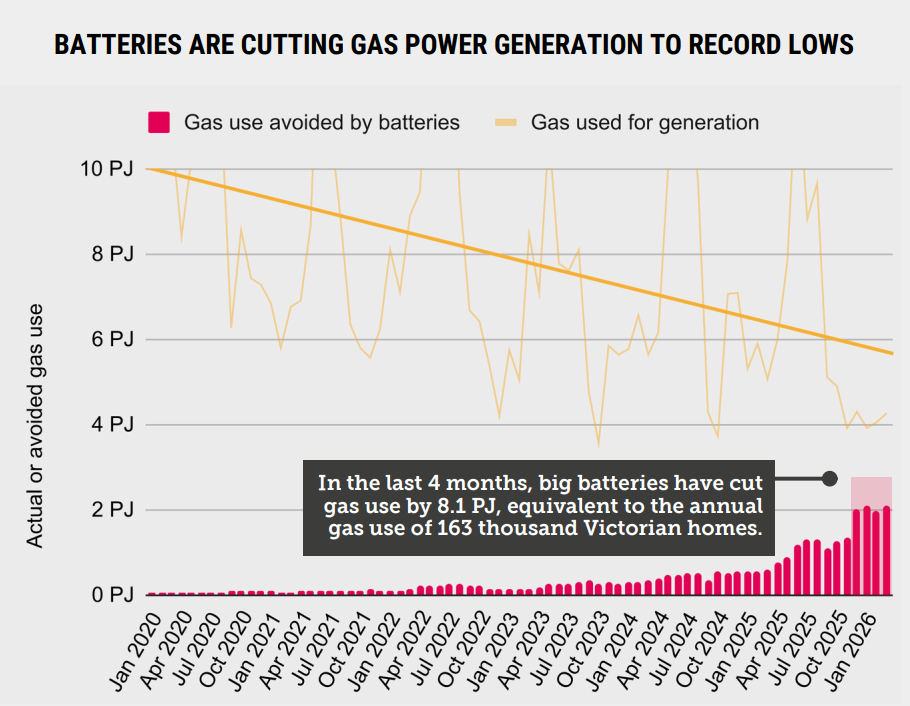
Climate Council analysis shows that by the end of February 2026, large-scale battery storage systems had offset 30 petajoules of gas use in Australia’s main electricity grid since deployment began.
More significantly, in just the four months leading up to the report’s release, grid-scale battery storage reduced gas consumption by 8.1 petajoules.
This displacement effect is particularly important given that gas prices in Australia are tied to volatile international markets, with changes in international gas prices explaining approximately 55% of the variation in domestic gas costs over the past decade.
The impact was especially pronounced during the recent summer period, when gas generation in the National Electricity Market (NEM) reached record lows. Large-scale battery storage provided 3.5x the energy of the previous summer, contributing to a 30% reduction in wholesale electricity prices compared to the prior year.
While gas accounts for less than 5% of generation in Australia’s main grid, it has an outsized influence on wholesale prices, often setting the marginal price during peak demand periods.
For the approximately 400,000 Australian households that have installed rooftop solar paired with home battery systems, the benefits are even more pronounced. These households are achieving power bill reductions of up to 90% while simultaneously reducing grid peak demand.
The Australian government’s Cheaper Home Batteries Program has been a key policy mechanism that has supported the uptake of home battery storage systems and ensured that it keeps up with the world-leading rooftop solar generation across Australia.
Detailed in the Climate Council’s report, the group urges the government to maintain strong support for the home battery scheme in the May budget, arguing that continued subsidies will accelerate uptake, support economies of scale, and drive further cost reductions in battery technology.
Electric vehicles cutting fuel dependency
Beyond stationary storage, the report highlights how electric and hybrid vehicles are already reducing Australia’s exposure to oil price volatility.
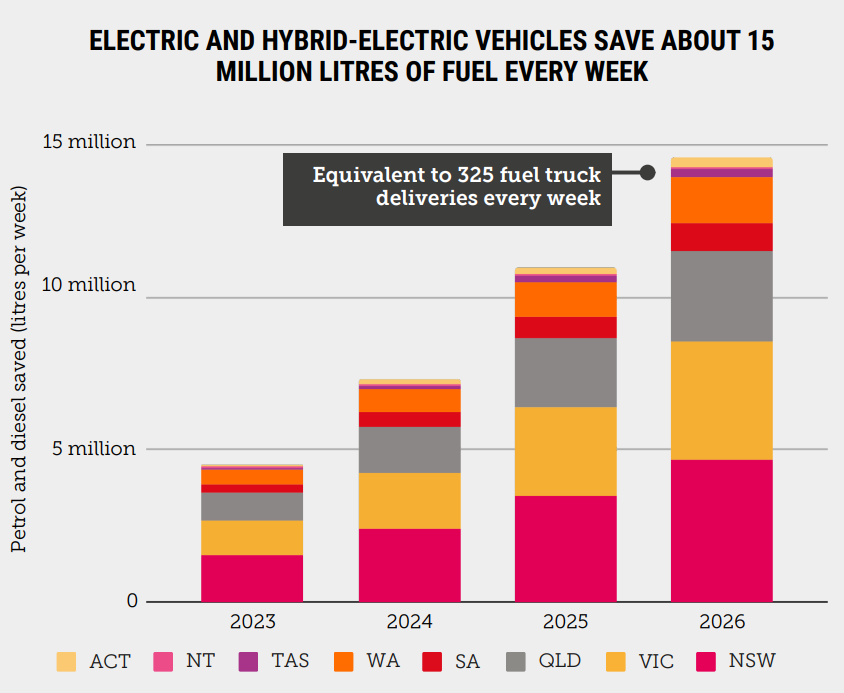
With an estimated 1.3 million fully electric or hybrid electric vehicles (EVs) now on Australian roads, the country is avoiding almost 15 million litres of petrol and diesel consumption every week, the equivalent of 325 fuel truck deliveries.
This saving has tripled in just three years, demonstrating the accelerating pace of transport electrification.
During March’s fuel price spike, EV and hybrid owners avoided approximately AU$50 million in additional fuel costs, on top of the AU$140 million they typically save during four weeks compared to conventional vehicle owners.
The report notes that EV owners spend 40% less on annual vehicle running costs, saving about AU$1,400 through reduced fuel and maintenance expenses. Interest in EVs has surged amid rising oil prices, with NAB reporting a 100% increase in EV loan applications in March.
These cost reductions associated with owning an EV have led to a boom in terms of adoption rates. As reported by our sister site EV Infrastructure News, EV sales in Australia surged in March 2026, with battery-electric vehicles capturing 14.6% of the market.
Significantly, the highest adoption rates for the federal EV tax discount are occurring in outer suburban areas, including Werribee, Hoppers Crossing, and Craigieburn in Victoria; Marsden Park, Kellyville, Baulkham Hills, and Queanbeyan in New South Wales; and Springfield in Queensland.
The Climate Council is calling for the EV fringe benefits tax exemption to continue, while also proposing that similar tax treatment be extended to shared and active transport options, such as public transport fares and e-bike leasing.
Fossil fuel expansion rejected as a solution
The report firmly rejects arguments that Australia should respond to the current crisis by expanding fossil fuel production, presenting a detailed analysis of why increased oil or gas extraction would fail to improve energy security or reduce prices.
Australia has already depleted 90% of its conventional crude oil reserves, with remaining supplies insufficient to meet domestic needs for even one year.
While the country possesses substantial oil shale resources, these require mining and industrial processing, making them among the highest-cost oil sources globally. Australia currently has no oil shale production, and developing unconventional oil resources could take approximately a decade.
On gas, the report emphasises that Australia already produces five times more gas than it consumes domestically but exports approximately 80%, tying domestic prices to international markets.
Since east coast gas exports began, domestic gas prices have nearly quadrupled despite production almost tripling and demand falling 10%. The report argues this demonstrates that increased supply does not translate to lower domestic prices or improved energy security when production is export-oriented.
The analysis also dismisses proposals for new oil refineries or coal-to-liquids facilities as expensive, slow to implement, and ultimately ineffective.
No new refinery has been constructed in a Western nation for more than 20 years, and building one in Australia would likely require close to a decade. Even then, such facilities would require ongoing subsidies and would still process oil subject to global price fluctuations.
Recent developments in the Middle East have underscored the geopolitical risks facing fossil fuel supply chains.
Speaking exclusively to ESN Premium at the Energy Storage Summit Australia 2026 last month, Tim Buckley, founder and director of Climate Energy Finance, revealed that Australia’s position as a stable investment destination for battery storage and renewable energy projects becomes increasingly attractive to international capital seeking to avoid exposure to volatile regions.
Budget recommendations for structural change
The Climate Council’s budget submission centres on four key policy areas: reducing fuel dependence through EVs and public transport; powering heavy industry with renewables rather than imported diesel; cutting household bills through electrification and storage; and ensuring gas corporations pay appropriate taxation on exports.
On industrial electrification, the report proposes phasing out the Fuel Tax Credit scheme, which provides tax refunds for fuel used off public roads and is forecast to reach AU$13 billion annually by the decade’s end.
The mining industry receives almost half of these credits, creating, the report says, a substantial barrier to electrifying heavy machinery. The Climate Council recommends capping fuel tax credit rebates for large mining corporations at AU$50 million, with amounts above this threshold redirected to support the adoption of zero-emissions machinery.
The report also calls for strengthening the Household Energy Upgrades Fund by offering zero-interest finance for household energy improvements, replacing the current marginally discounted rates.
As well as this, the group also proposes implementing a gas exports tax, noting that Australia currently retains only about 30% of revenue from gas exports while most other resource-producing countries keep 75% or more.
The Climate Council concludes that the May budget represents a critical opportunity to implement structural reforms that provide lasting protection against energy price volatility, rather than relying on temporary measures such as fuel excise cuts and emergency stockpile releases.
Interested in Australia? Read Energy-Storage.news’ Energy Storage Summit Australia coverage and related content.